


Page 351 - Hematology_ Basic Principles and Practice ( PDFDrive )
P. 351
Chapter 25  Tolerance and Autoimmunity  287


                                         cTEC                     mTEC/DC
                                                                                      Clonal
                                                                                      deletion
                                           MHC                       MHC
                                           TCR                       TCR
                                                                            Strong
                                      Immature   Adequate       Positively  TCR signal
                                      T cell                    selected                tTreg
                                                 TCR signal     T cell

                                          No TCR signal
                                                                    Moderate TCR
                                      Death by
                                      neglect                       signal
                                                                                Thymus
                                                                               Periphery
                                                      Anergic
                                                      T cell

                                                       No
                                                     IL-6  costimulation

                                                                                         tTreg
                                      T FH              MHC
                                     IL-21, IL-4                                   TGF-β
                               CD40L     TCR     APC         TCR  Mature T cell
                                CD40     MHC         CD80 CD28

                                     B cell                                            IL-6   pTreg
                                                              IFN γ       IL-12        IL-4          TGF β


                                     Plasma           Th 1            Th 2           Th 17
                                     cell

                                  Autoantibodies  Type 1 diabetes    Asthma      Multiple sclerosis
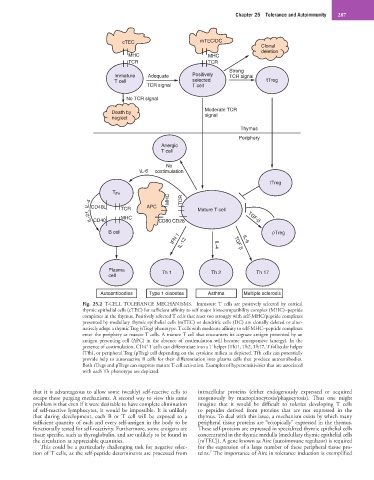
                            Fig.  25.2  T-CELL TOLERANCE  MECHANISMS.    Immature T  cells  are  positively  selected  by  cortical
                            thymic epithelial cells (cTEC) for sufficient affinity to self major histocompatibility complex (MHC)−peptide
                            complexes in the thymus. Positively selected T cells that react too strongly with self-MHC/peptide complexes
                            presented by medullary thymic epithelial cells (mTEC) or dendritic cells (DC) are clonally deleted or alter-
                            natively adopt a thymic Treg (tTreg) phenotype. T cells with moderate affinity to self-MHC−peptide complexes
                            enter the periphery as mature T cells. A mature T cell that encounters its cognate antigen presented by an
                            antigen  presenting  cell  (APC)  in  the  absence  of  costimulation  will  become  unresponsive  (anergy).  In  the
                                                 +
                            presence of costimulation, CD4  T cells can differentiate into a T helper (Th)1, Th2, Th17, T follicular helper
                            (Tfh), or peripheral Treg (pTreg) cell depending on the cytokine milieu as depicted. Tfh cells can potentially
                            provide help to autoreactive B cells for their differentiation into plasma cells that produce autoantibodies.
                            Both tTregs and pTregs can suppress mature T-cell activation. Examples of hypersensitivities that are associated
                            with each Th phenotype are depicted.


            that it is advantageous to allow some (weakly) self-reactive cells to   intracellular  proteins  (either  endogenously  expressed  or  acquired
            escape these purging mechanisms. A second way to view this same   exogenously  by  macropinocytosis/phagocytosis).  Thus  one  might
            problem is that even if it were desirable to have complete elimination   imagine  that  it  would  be  difficult  to  tolerize  developing  T  cells
            of  self-reactive  lymphocytes,  it  would  be  impossible.  It  is  unlikely   to  peptides  derived  from  proteins  that  are  not  expressed  in  the
            that  during  development,  each  B  or  T  cell  will  be  exposed  to  a   thymus. To deal with this issue, a mechanism exists by which many
            sufficient quantity of each and every self-antigen in the body to be   peripheral tissue proteins are “ectopically” expressed in the thymus.
            functionally tested for self-reactivity. Furthermore, some antigens are   These self-proteins are expressed in specialized thymic epithelial cells
            tissue specific, such as thyroglobulin, and are unlikely to be found in   concentrated in the thymic medulla (medullary thymic epithelial cells
            the circulation at appreciable quantities.            [mTEC]). A gene known as Aire (autoimmune regulator) is required
              This could be a particularly challenging task for negative selec-  for the expression of a large number of these peripheral tissue pro-
                                                                      7
            tion of T cells, as the self-peptide determinants are processed from   teins.  The importance of Aire in tolerance induction is exemplified

