


Page 354 - Hematology_ Basic Principles and Practice ( PDFDrive )
P. 354
290    Part III  Immunologic Basis of Hematology


        Depending on the context, only certain effector functions will effec-  [TGF]-β, and IL-35), competition for survival factors (costimulation
        tively eliminate certain pathogens. For example, antibodies will not   and cytokines), and by direct cell–cell contact. Thus regulatory T cells
        be effective against intracellular pathogens. By analogy, only certain   represent a major peripheral tolerance mechanism to prevent aberrant
        effector functions may cause autoimmune disease, depending on the   autoreactive T-cell activation.
        circumstances.  Based  on  their  cytokine  secreting  profile,  T-helper
        (Th) cell responses can be divided into multiple subsets including
        Th1, Th2, and Th17 cells that in turn lead to very different effec-  BREAKDOWN OF SELF-TOLERANCE IN
        tor functions (see Fig. 25.2). The propensity to make these various   AUTOIMMUNE DISEASES
        types  of  responses  depends  on  a  number  of  factors  including  the
        cytokine milieu, costimulation, genetics, route of antigen exposure,   Presumably, for autoimmune diseases and autoantibody production
                        21
        and  dose  of  antigen.   Intriguingly,  in  certain  murine  models  of   to  occur,  one or  more  of  the  multilayered  mechanisms to prevent
        autoimmunity such as the nonobese diabetic (NOD) model, experi-  autoimmunity  must  fail.  Surprisingly,  the  precise  nature  of  these
        mental manipulations that shift responses away from Th1 and toward   failures  is  not  well  understood.  The  mechanisms  of  failure  are
        Th2  are  highly  protective  against  disease. This  is  also  relevant  to   likely  different  for  the  various  autoimmune  diseases  and  perhaps
        B-cell  autoimmunity  per  se  because,  through  the  use  of  different   even  for  different  patients  with  similar  syndromes.  Moreover,  it
        isotypes of Ig, different effector functions can occur. The cytokines   seems  likely  both  from  phenomenologic  and  genetic  studies  that
        secreted by Th1 and Th2 cells have profound effects on the isotypes   failures at several levels are required to generate clinically significant
        of  immunoglobulins  that  are  produced  during  a  response.  Thus,   autoimmunity.
        not only is the T-cell component of the response channeled in this   This chapter is not meant to review the nature of autoimmune
        way, but the humoral response is also influenced. Th17 cells, which   diseases; however, before considering the likely points at which self-
        are  important  for  responses  to  extracellular  bacteria  as  well,  have   tolerance mechanisms break down, it is useful to review some basic
        been recognized as important pathogenic cells in several autoimmune   concepts  about  these  diseases.  Grossly,  autoimmune  diseases  have
        diseases. These include mouse models of multiple sclerosis, collagen-  often  been  divided  into  organ-specific  and  systemic  autoimmune
        induced  arthritis,  and  inflammatory  bowel  disease.  Thus  genetic   syndromes.  This  classification  is  useful,  but  as  these  diseases  are
        predisposition or environmental factors that drive Th-cell differentia-  becoming better understood, the dividing lines are blurring; patho-
        tion to a particular Th subset may enhance the chances of developing   geneses  of  all  these  diseases  are  likely  to  have  much  in  common.
        certain  autoimmune  diseases  that  are  associated  with  that  type  of     In  particular,  systemic  autoimmune  diseases  are  actually  much
        response.                                             more specific in their antigenic targets than is commonly realized.
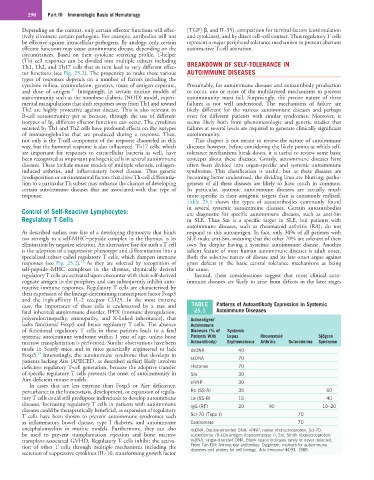
                                                              Table  25.1  shows  the  types  of  autoantibodies  commonly  found
        Control of Self-Reactive Lymphocytes:                 in  several  systemic  autoimmune  diseases.  Certain  autoantibodies
                                                              are  diagnostic  for  specific  autoimmune  diseases,  such  as  anti-Sm
        Regulatory T Cells                                    in  SLE.  Thus  Sm  is  a  specific  target  in  SLE,  but  patients  with
                                                              autoimmune  diseases,  such  as  rheumatoid  arthritis  (RA),  do  not
        As described earlier, one fate of a developing thymocyte that binds   respond to this autoantigen. In fact, only 30% of all patients with
        too strongly to a self-MHC−peptide complex in the thymus, is its   SLE make anti-Sm, meaning that the other 70% are tolerant of their
        elimination by negative selection. An alternative fate for such a T cell   own  Sm  despite  having  a  systemic  autoimmune  disease.  Another
        is the adoption of a suppressive phenotype and differentiation into a   salient feature of most human autoimmune diseases is adult onset.
        specialized subset called regulatory T cells, which dampen immune   Both the selective nature of disease and its late onset argue against
                           22
        responses  (see  Fig.  25.2).   As  they  are  selected  by  recognition  of   gross  defects  in  the  basic  central  tolerance  mechanisms  as  being
        self-peptide−MHC  complexes  in  the  thymus,  thymically  derived   the cause.
        regulatory T cells are activated upon encounter with their self-derived   Instead,  these  considerations  suggest  that  most  clinical  auto-
        cognate antigen in the periphery and can subsequently inhibit auto-  immune diseases are likely to arise from defects in the later stages
        reactive immune responses. Regulatory T cells are characterized by
        their expression of the lineage-determining transcription factor Foxp3
        and  the  high-affinity  IL-2  receptor  CD25.  In  the  most  extreme
        case,  the  importance  of  these  cells  is  underscored  by  a  rare  and   TABLE   Patterns of Autoantibody Expression in Systemic
        fatal inherited autoimmune disorder, IPEX (immune dysregulation,   25.1  Autoimmune Diseases
        polyendocrinopathy,  enteropathy,  and  X-linked  inheritance),  that   Autoantigen/
        lacks  functional  Foxp3  and  hence  regulatory T  cells. The  absence   Autoimmune
        of  functional  regulatory  T  cells  in  these  patients  leads  to  a  fatal   Diseases (% of   Systemic
        systemic autoimmune syndrome within 1 year of age, unless bone   Patients With   Lupus   Rheumatoid   Sjögren
        marrow transplantation is performed. Similar observations have been   Autoantibody)  Erythematosus  Arthritis  Scleroderma  Syndrome
        made  in  Scurfy  mice  and  in  mice  genetically  engineered  to  lack   dsDNA  40
             23
        Foxp3.  Interestingly, the autoimmune syndrome that develops in
        patients lacking Aire (APECED, as described earlier) likely involves   ssDNA  70
        defective regulatory T-cell generation, because the adoptive transfer   Histones  70
        of specific regulatory T cells prevents the onset of autoimmunity in   Sm  30
        Aire-deficient mouse models.                           nRNP            30
           In  cases  that  are  less  extreme  than  Foxp3  or  Aire  deficiency,
        perturbance in the homeostasis, development, or expansion of regula-  Ro (SS-A)  35                 60
        tory T cells could still predispose individuals to develop autoimmune   La (SS-B)  15               40
        diseases. Increasing regulatory T cells in patients with autoimmune   IgG (RF)  20  90            10−20
        diseases could be therapeutically beneficial, as expansion of regulatory
        T  cells  have  been  shown  to  prevent  autoimmune  syndromes  such   Scl-70 (Topo I)   70
        as  inflammatory  bowel  disease,  type  I  diabetes,  and  autoimmune   Centromere       70
        encephalomyelitis  in  murine  models.  Furthermore,  they  can  also   dsDNA, Double-stranded DNA; nRNP, native ribonucleoprotein; Scl-70,
        be  used  to  prevent  transplantation  rejection  and  bone  marrow   scleroderma 70-kDa antigen (topoisomerase I); Sm, Smith ribonucleoprotein;
        transplant-associated GVHD. Regulatory T cells inhibit the activa-  ssDNA, single-stranded DNA. Blank space indicates rarely or never detected.
        tion  of  other T  cells  through  multiple  mechanisms  including  the   From Tan EM: Antinuclear antibodies: Diagnostic markers for autoimmune
                                                               diseases and probes for cell biology. Adv Immunol 44:93, 1989.
        secretion of suppressive cytokines (IL-10, transforming growth factor

