


Page 355 - Hematology_ Basic Principles and Practice ( PDFDrive )
P. 355
Chapter 25  Tolerance and Autoimmunity  291


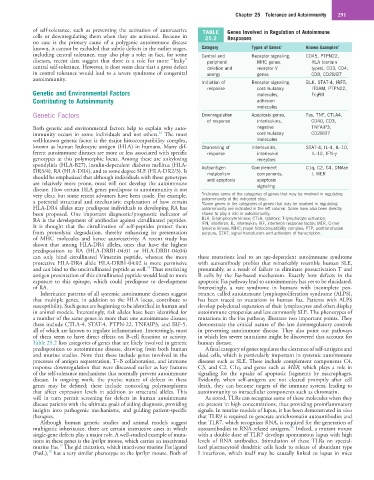
            of  self-tolerance,  such  as  preventing  the  activation  of  autoreactive   TABLE   Genes Involved in Regulation of Autoimmune
            cells  or  downregulating  them  when  they  are  activated.  Because  in   25.2  Responses
            no  case  is  the  primary  cause  of  a  polygenic  autoimmune  disease
            known, it cannot be excluded that subtle defects in the earlier stages,   Category  Types of Genes a  Known Examples b
            including central tolerance, may also play a role; in fact, for some   Central and   Receptor signaling,   CD45, PTPN22,
            diseases,  recent  data  suggest  that  there  is  a  role  for  more  “leaky”   peripheral   MHC genes,   HLA (certain
            central self-tolerance. However, it does seem clear that a gross defect   deletion and   receptor V   types), CD3, CD4,
            in central tolerance would lead to a severe syndrome of congenital   anergy  genes         CD8, CD28/B7
            autoimmunity.
                                                                   Initiation of   Receptor signaling,   BLK, STAT-4, IRF5,
                                                                     response        costimulatory     ITGAM, PTPN22,
            Genetic and Environmental Factors                                        molecules,        FcγRII
            Contributing to Autoimmunity                                             adhesion
                                                                                     molecules
            Genetic Factors                                        Downregulation   Apoptosis genes,   Fas, TNF, CTLA4,
                                                                     of response     interleukins,     CD40, CD3,
            Both genetic and environmental factors help to explain why auto-         negative          TNFAIP3,
                                                     24
            immunity  occurs  in  some  individuals  and  not  others.  The  most    costimulatory     CD28/B7
            well-known genetic factor is the major histocompatibility complex,       molecules
            known as human leukocyte antigen (HLA) in humans. Many dif-  Channeling of   Interleukins,   STAT-4, IL-4, IL-10,
            ferent autoimmune diseases are more or less associated with specific   response  interleukin   IL-12, IFN-γ
            genotypes  at  this  polymorphic  locus.  Among  these  are  ankylosing   receptors
            spondylitis (HLA-B27), insulin-dependent diabetes mellitus (HLA-  Autoantigen   Complement   C1q, C2, C4, DNAse
            DR3/4), RA (HLA-DR4), and to some degree SLE (HLA-DR2/3). It   metabolism   components,    I, MER
            should be emphasized that although individuals with these genotypes   and apoptosis  apoptosis
            are  relatively  more  prone,  most  will  not  develop  the  autoimmune   signaling
            disease. How certain HLA genes predispose to autoimmunity is not
            very clear, but some recent advances have been made. For example,   a Indicates some of the categories of genes that may be involved in regulating
            a  potential  structural  and  mechanistic  explanation  of  how  certain   autoimmunity at the indicated step.
                                                                   Some genes in the categories of genes that may be involved in regulating
                                                                   b
            HLA-DR4 alleles may predispose individuals to developing RA has   autoimmunity are indicated in the left column. Some have also been directly
            been  proposed.  One  important  diagnostic/prognostic  indicator  of   shown to play a role in autoimmunity.
            RA is the development of antibodies against citrullinated peptides.   BLK, B-lymphocyte kinase; CTLA, cytotoxic T-lymphocyte activation;
            It  is  thought  that  the  citrullination  of  self-peptides  protect  them   IFN, interferon; IL, interleukin; IRF, interferon response factor; MER, C-mer
                                                                   tyrosine kinase; MHC, major histocompatibility complex; PTP, posttransfusion
            from  proteolytic  degradation,  thereby  enhancing  its  presentation   purpura; STAT, signal transducers and activators of transcription.
            of  MHC  molecules  and  hence  autoreactivity.  A  recent  study  has
            shown  that  among  HLA-DR4  alleles,  ones  that  have  the  highest
            predisposition  to  RA  (HLA-DRB1-04:01  or  HLA-DRB1-04:04)
            can  only  bind  citrullinated  Vimentin  peptide,  whereas  the  more   these  mutations  lead  to  an  age-dependent  autoimmune  syndrome
            protective  HLA-DR4  allele  HLA-DRB1-04:02  is  more  permissive   with  autoantibody  profiles  that  remarkably  resemble  human  SLE,
                                                 25
            and can bind to the uncitrullinated peptide as well.  Thus restricting   presumably, as a result of failure to eliminate postactivation T and
            antigen presentation of this citrullinated peptide would lead to more   B  cells  by  the  Fas-based  mechanism.  Exactly  how  defects  in  the
            exposure  to  this  epitope,  which  could  predispose  to  development     apoptotic Fas pathway lead to autoimmunity has yet to be elucidated.
            of RA.                                                Interestingly,  a  rare  syndrome  in  humans  with  incomplete  pen-
              Inheritance patterns of all systemic autoimmune diseases suggest   etrance, called autoimmune lymphoproliferation syndrome (ALPS),
            that  multiple  genes,  in  addition  to  the  HLA  locus,  contribute  to   has  been  traced  to  mutations  in  human  Fas.  Patients  with  ALPS
            susceptibility. Such genes are beginning to be identified in human and   develop polyclonal expansion of their lymphocytes and often display
            in animal models. Interestingly, risk alleles have been identified for   autoimmune cytopenias and less commonly SLE. The phenotypes of
            a number of the same genes in more than one autoimmune disease;   mutations in the Fas pathway illustrate two important points. They
            these include CTLA-4, STAT-4, PTPN-22, TNFAIP3, and IRF-5,   demonstrate the critical nature of the late downregulatory controls
            all of which are known to regulate inflammation. Interestingly, most   in  preventing  autoimmune  disease. They  also  point  out  pathways
            of  them seem to have direct  effects  on B-cell  function  or activity.   in which less severe mutations might be discovered that account for
            Table 25.2 lists categories of genes that are likely involved in genetic   human disease.
            predisposition  to  autoimmune  disease,  drawing  from  both  human   A final category of genes regulates the clearance of self-antigens and
            and murine studies. Note that these include genes involved in the   dead cells, which is particularly important in systemic autoimmune
            processes of antigen sequestration, T–B collaboration, and immune   diseases such as SLE. These include complement components C4,
            response downregulation that were discussed earlier as key features   C3, and C2, C1q, and genes such as MER, which plays a role in
            of the self-tolerance mechanisms that normally prevent autoimmune   signaling  for  the  uptake  of  apoptotic  fragments  by  macrophages.
            disease.  In  ongoing  work,  the  precise  nature  of  defects  in  these   Evidently,  when  self-antigens  are  not  cleared  promptly  after  cell
            genes  may  be  defined;  these  include  noncoding  polymorphisms   death,  they  can  become  targets  of  the  immune  system,  leading  to
            that  affect  expression  levels  in  addition  to  structural  alleles.  This   autoimmunity to intracellular components such as chromatin.
            will  in  turn  permit  screening  for  defects  in  human  autoimmune   As noted, TLRs can recognize some of these molecules when they
            disease patients with the ultimate goals of aiding diagnosis, providing   are present in high concentrations, thus providing proinflammatory
            insights  into  pathogenic  mechanisms,  and  guiding  patient-specific    signals. In murine models of lupus, it has been demonstrated in vivo
            therapies.                                            that TLR9 is required to generate antichromatin autoantibodies and
              Although  human  genetic  studies  and  animal  models  suggest   that TLR7, which recognizes RNA, is required for the generation of
                                                                                                26
            multigenic inheritance, there are certain instructive cases in which   autoantibodies to RNA-related antigens.  Indeed, a mutant mouse
            single-gene defects play a major role. A well-studied example of muta-  with a double dose of TLR7 develops spontaneous lupus with high
            tions in these genes is the lpr/lpr mouse, which carries an inactivated   levels  of  RNA  antibodies.  Stimulation  of  these  TLRs  on  special-
                    17
            murine Fas.  The gld mutation, which inactivates murine Fas ligand   ized plasmacytoid dendritic cells leads to release of abundant type
                 18
            (FasL),  has a very similar phenotype to the lpr/lpr mouse. Both of   I  interferon,  which  itself  may  be  causally  linked  to  lupus  in  mice

