


Page 356 - Hematology_ Basic Principles and Practice ( PDFDrive )
P. 356
292    Part III  Immunologic Basis of Hematology


        and humans. These findings highlight a genetic basis for recognizing   1       2             3
        self-molecules in autoimmune diseases and suggest new therapeutic   HPA-1 a  HPA-1 a  HPA-1 b         b
        targets that are currently being explored.               specific  A  specific  B  specific  B   HPA-1
                                                                                                         specific
                                                                  T cell      B cell        T cell        B cell
        Environmental Factors
                                                                    Alloantibody  A            Autoantibody  B
        Environment  plays  a  role  that  is  at  least  as  important  as  genetics.   response  B  response
        This is illustrated by the fact that concordance rates among identical
        twins, even raised in the same household, are surprisingly low. Only   Transfused              Self-platelet
        20%  of  twins  of  patients  with  RA  also  get  RA.  There  are  many   platelet
        examples of environmental factors causing either chronic or transient
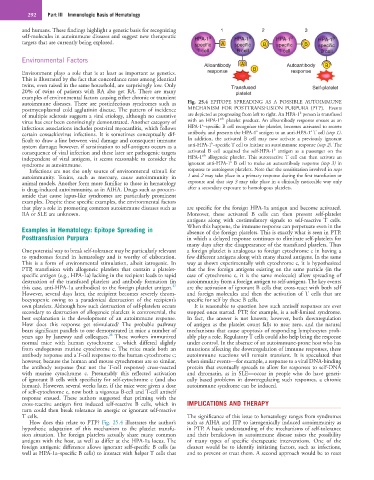
        autoimmune  diseases. There  are  postinfectious  syndromes  such  as   Fig.  25.4  EPITOPE  SPREADING  AS  A  POSSIBLE  AUTOIMMUNE
        postmycoplasmal cold agglutinin disease. The pattern of incidence   MECHANISM  FOR  POSTTRANSFUSION  PURPURA  (PTP).    Events
                                                                                                   b
        of multiple sclerosis suggests a viral etiology, although no causative   are depicted as progressing from left to right. An HPA-1  person is transfused
                                                                         a/b
        virus has ever been convincingly demonstrated. Another category of   with  an  HPA-1   platelet  product.  An  alloantibody  response  ensues  as  an
                                                                   a
        infectious associations includes postviral myocarditis, which follows   HPA-1 –specific B cell recognizes the platelet, becomes activated to secrete
                                                                                                       a
                                                                                     a
        certain  coxsackievirus  infections.  It  is  sometimes  conceptually  dif-  antibody, and presents the HPA-1  antigen to an anti-HPA-1  T cell (step 1).
        ficult to draw a line between viral damage and consequent immune   In  addition,  the  activated  B  cell  may  now  activate  a  previously  ignorant
                                                                      b
        system damage; however, if sensitization to self-antigens occurs as a   anti-HPA-1 –specific T cell to initiate an autoimmune response (step 2). The
                                                                                           b
        consequence of viral infection and these later are pathogenic targets   activated  B  cell  acquired  the  self-HPA-1   antigen  as  a  passenger  on  the
                                                                   a/b
        independent  of  viral  antigens,  it  seems  reasonable  to  consider  the   HPA-1   allogeneic  platelet. This  autoreactive T  cell  can  then  activate  an
                                                                            b
        syndrome as autoimmune.                               ignorant anti-HPA-1  B cell to make an autoantibody response (step 3) in
           Infections are not the only source of environmental stimuli for   response to autologous platelets. Note that the sensitization involved in steps
        autoimmunity.  Toxins,  such  as  mercury,  cause  autoimmunity  in   1 and 2 may take place in a primary response during the first transfusion or
        animal models. Another form more familiar to those in hematology   exposure and that step 3 may take place in a clinically noticeable way only
        is drug-induced autoimmunity, as in AIHA. Drugs such as procain-  after a secondary exposure to homologous platelets.
        amide  that  cause  lupus-like  syndromes  are  particularly  prominent
        examples. Despite these specific examples, the environmental factors
        that play a role in promoting common autoimmune diseases such as   are specific for the foreign HPA-1a antigen and become activated.
        RA or SLE are unknown.                                Moreover,  these  activated  B  cells  can  then  present  self-platelet
                                                              antigens  along  with  costimulatory  signals  to  self-reactive  T  cells.
        Examples in Hematology: Epitope Spreading in          When this happens, the immune response can perpetuate even in the
                                                              absence of the foreign platelets. This is exactly what is seen in PTP,
        Posttransfusion Purpura                               in which a delayed response continues to eliminate self-platelets for
                                                              many days after the disappearance of the transfused platelets. Thus
        One potential way to break self-tolerance may be particularly relevant   a foreign platelet is analogous to foreign cytochrome c in having a
        to  syndromes  found  in  hematology  and  is  worthy  of  elaboration.   few different antigens along with many shared antigens. In the same
        This  is  a  form  of  environmental  stimulation,  albeit  iatrogenic.  In   way as shown experimentally with cytochrome c, it is hypothesized
        PTP,  transfusion  with  allogeneic  platelets  that  contain  a  platelet-  that the few foreign antigens existing on the same particle (in the
        specific antigen (e.g., HPA-1a) lacking in the recipient leads to rapid   case  of  cytochrome  c,  it  is  the  same  molecule)  allow  spreading  of
        destruction  of  the  transfused  platelets  and  antibody  formation  (in   autoimmunity from a foreign antigen to self-antigens. The key events
                                                         27
        this case, anti-HPA-1a antibodies) to the foreign platelet antigen.    are the activation of ignorant B cells that cross-react with both self
        However,  several  days  later,  the  recipient  becomes  severely  throm-  and  foreign  molecules  and  then  the  activation  of T  cells  that  are
        bocytopenic  owing  to  a  paradoxical  destruction  of  the  recipient’s   specific for self by these B cells.
        own platelets. Although how such destruction of self-platelets occurs   It is reasonable to question how such antiself responses are ever
        secondary to destruction of allogeneic platelets is controversial, the   stopped once started. PTP, for example, is a self-limited syndrome.
        best  explanation  is  the  development  of  an  autoimmune  response.   In  fact,  the  answer  is  not  known;  however,  both  downregulation
        How  does  this  response  get  stimulated?  The  probable  pathway   of antigen as the platelet count falls to near zero, and the natural
        bears significant parallels to one demonstrated in mice a number of   mechanisms that cause apoptosis of responding lymphocytes prob-
                                     28
        years  ago  by  Janeway  and  colleagues.  These  workers  immunized   ably play a role. Regulatory T cells could also help bring the response
        normal  mice  with  human  cytochrome  c,  which  differed  slightly   under control. In the absence of an autoimmune-prone host who has
        from  endogenous  murine  cytochrome  c. The  mice  made  both  an   mutations affecting the downregulation of immune responses, these
        antibody response and a T-cell response to the human cytochrome c;   autoimmune  reactions  will  remain  transient.  It  is  speculated  that
        however, because the human and mouse cytochromes are so similar,   when similar events—for example, a response to a viral DNA-binding
        the  antibody  response  (but  not  the  T-cell  response)  cross-reacted   protein that eventually spreads to allow for responses to self-DNA
        with  murine  cytochrome  c.  Presumably  this  reflected  activation   and  chromatin,  as  in  SLE—occur  in  people  who  do  have  geneti-
        of ignorant B cells with specificity for self-cytochrome c (and also   cally  based  problems  in  downregulating  such  responses,  a  chronic
        human). However, several weeks later, if the mice were given a dose   autoimmune syndrome can be induced.
        of self-cytochrome c, now both a vigorous B-cell and T-cell antiself
        response  ensued.  These  authors  suggested  that  priming  with  the
        cross-reactive  antigen  first  induced  self-reactive  B  cells,  which  in   IMPLICATIONS AND THERAPY
        turn could then break tolerance in anergic or ignorant self-reactive
        T cells.                                              The significance of this issue to hematology ranges from syndromes
           How  does  this  relate  to  PTP?  Fig.  25.4  illustrates  the  author’s   such as AIHA and ITP to iatrogenically induced autoimmunity as
        hypothetic  adaptation  of  this  mechanism  to  the  platelet  transfu-  in PTP. A basic understanding of the mechanisms of self-tolerance
        sion  situation. The  foreign  platelets  actually  share  many  common   and  their  breakdown  in  autoimmune  disease  raises  the  possibility
        antigens with the host, as well as differ at the HPA-1a locus. The   of  many  types  of  specific  therapeutic  interventions.  One  of  the
        foreign  antigenic  difference  allows  ignorant  self-specific  B  cells  (as   clearest  would  be  to  identify  initiating  factors,  such  as  infections,
        well as HPA-1a–specific B cells) to interact with helper T cells that   and to prevent or treat them. A second approach would be to reset

