


Page 402 - Hematology_ Basic Principles and Practice ( PDFDrive )
P. 402
324    Part IV  Disorders of Hematopoietic Cell Development


         Common lymphoid
            progenitor
                                                             IL-3
                                                            M-CSF        M-CSF
                    CFU-E/Meg                              GM-CSF        GM-CSF       M-CSF


                                               SCF   CFU-M        Monoblast    Promonocyte  Monocyte
                                                IL-3
                                                IL-6
                                              GM-CSF         IL-3
          PHSC    CFU-GEMM   CFU-GM            G-CSF       GM-CSF        GM-CSF
                                                            G-CSF         G-CSF        G-CSF        G-CSF

                              SCF                    CFU-G       Myeloblast    Myelocyte   Metamyelocyte  Neutrophil
                               IL-4
                               IL-5       SCF
                  SCF                     IL-3
                  IL-3                    IL-4         IL-3
                  IL-5                  GM-CSF         IL-4
               GM-CSF
                                 CFU-Baso     Basophilic    Basophil
                                              myelocyte
                            IL-3
                            IL-5          IL-5
                          GM-CSF        GM-CSF


                    CFU-Eo      Eosinophilic  Eosinophil
                                 myelocyte
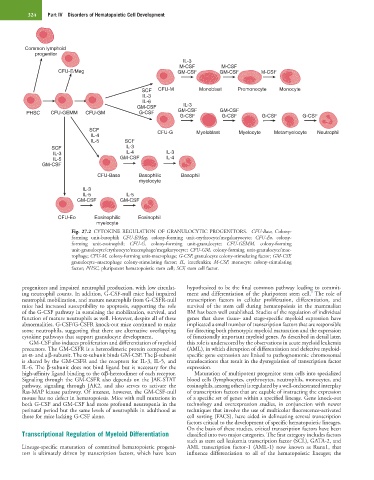
                        Fig.  27.2  CYTOKINE  REGULATION  OF  GRANULOCYTIC  PROGENITORS.    CFU-Baso,  Colony-
                        forming  unit-basophil;  CFU-E/Meg,  colony-forming  unit-erythrocyte/megakaryocyte;  CFU-Eo,  colony-
                        forming  unit-eosinophil;  CFU-G,  colony-forming  unit-granulocyte;  CFU-GEMM,  colony-forming
                        unit-granulocyte/erythrocyte/macrophage/megakaryocyte;  CFU-GM,  colony-forming  unit-granulocyte/mac-
                        rophage; CFU-M, colony-forming unit-macrophage; G-CSF, granulocyte colony-stimulating factor; GM-CSF,
                        granulocyte–macrophage  colony-stimulating  factor;  IL,  interleukin;  M-CSF,  monocyte  colony-stimulating
                        factor; PHSC, pluripotent hematopoietic stem cell; SCF, stem cell factor.


        progenitors and impaired neutrophil production, with low circulat-  hypothesized to be the final common pathway leading to commit-
                                                                                                       9
        ing neutrophil counts. In addition, G-CSF-null mice had impaired   ment and differentiation of the pluripotent stem cell.  The role of
        neutrophil mobilization, and mature neutrophils from G-CSFR-null   transcription  factors  in  cellular  proliferation,  differentiation,  and
        mice had increased susceptibility to apoptosis, supporting the role   survival  of  the  stem  cell  during  hematopoiesis  in  the  mammalian
        of the G-CSF pathway in sustaining the mobilization, survival, and   BM has been well established. Studies of the regulation of individual
        function of mature neutrophils as well. However, despite all of these   genes  that  show  tissue-  and  stage-specific  myeloid  expression  have
        abnormalities, G-CSF/G-CSFR knock-out mice continued to make   implicated a small number of transcription factors that are responsible
        some neutrophils, suggesting that there are alternative overlapping   for directing both phenotypic myeloid maturation and the expression
        cytokine pathways that support granulocyte development.  of functionally important myeloid genes. As described in detail later,
           GM-CSF also induces proliferation and differentiation of myeloid   this role is underscored by the observations in acute myeloid leukemia
        precursors. The GM-CSFR is a heterodimeric protein composed of   (AML), in which disruption of differentiation and defective myeloid-
        an α- and a β-subunit. The α-subunit binds GM-CSF. The β-subunit   specific gene expression are linked to pathognomonic chromosomal
        is shared by the GM-CSFR and the receptors for IL-3, IL-5, and   translocations that result in the dysregulation of transcription factor
        IL-6. The β-subunit does not bind ligand but is necessary for the   expression.
        high-affinity ligand binding to the αβ-heterodimer of each receptor.   Maturation of multipotent progenitor stem cells into specialized
        Signaling through the GM-CSFR also depends on the JAK-STAT   blood cells (lymphocytes, erythrocytes, neutrophils, monocytes, and
        pathway,  signaling  through  JAK2,  and  also  serves  to  activate  the   eosinophils, among others) is regulated by a well-orchestrated interplay
        Ras-MAP kinase pathway. Of interest, however, the GM-CSF-null   of transcription factors that are capable of instructing the expression
        mouse has no defect in hematopoiesis. Mice with null mutations in   of a specific set of genes within a specified lineage. Gene knock-out
        both G-CSF and GM-CSF had more profound neutropenia in the   technology  and  overexpression  studies,  in  conjunction  with  newer
        perinatal period but the same levels of neutrophils in adulthood as   techniques that involve the use of multicolor fluorescence-activated
        those for mice lacking G-CSF alone.                   cell sorting (FACS), have aided in delineating several transcription
                                                              factors critical to the development of specific hematopoietic lineages.
                                                              On the basis of these studies, critical transcription factors have been
        Transcriptional Regulation of Myeloid Differentiation  classified into two major categories. The first category includes factors
                                                              such as stem cell leukemia transcription factor (SCL), GATA-2, and
        Lineage-specific  maturation  of  committed  hematopoietic  progeni-  AML  transcription  factor-1  (AML-1)  now  known  as  Runx1,  that
        tors is ultimately driven by transcription factors, which have been   influence  differentiation  to  all  of  the  hematopoietic  lineages;  the

