


Page 400 - Hematology_ Basic Principles and Practice ( PDFDrive )
P. 400
322    Part IV  Disorders of Hematopoietic Cell Development


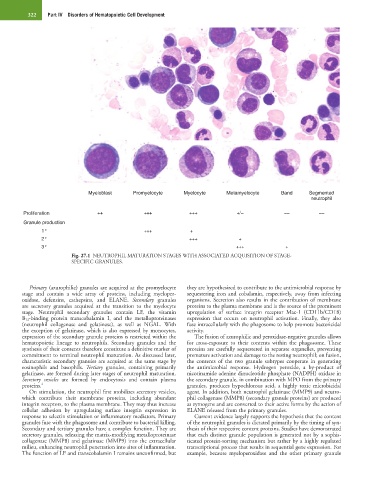
                              Myeloblast     Promyelocyte    Myelocyte     Metamyelocyte     Band     Segmented
                                                                                                       neutrophil

         Proliferation           ++             +++            +++            +/−             −−         −−
         Granule production
               1°                               +++            +
               2°                                              +++             +
               3°                                                             +++             +
                        Fig. 27.1  NEUTROPHIL MATURATION STAGES WITH ASSOCIATED ACQUISITION OF STAGE-
                        SPECIFIC GRANULES.


           Primary (azurophilic) granules are acquired at the promyelocyte   they are hypothesized to contribute to the antimicrobial response by
        stage  and  contain  a  wide  array  of  proteins,  including  myeloper-  sequestering iron and cobalamin, respectively, away from infecting
        oxidase,  defensins,  cathepsins,  and  ELANE.  Secondary  granules   organisms. Secretion also results in the contribution of membrane
        are  secretory  granules  acquired  at  the  transition  to  the  myelocyte   proteins to the plasma membrane and is the source of the prominent
        stage.  Neutrophil  secondary  granules  contain  LF,  the  vitamin   upregulation  of  surface  integrin  receptor  Mac-1  (CD11b/CD18)
        B 12 -binding  protein  transcobalamin  I,  and  the  metalloproteinases   expression  that  occurs  on  neutrophil  activation.  Finally,  they  also
        (neutrophil  collagenase  and  gelatinase),  as  well  as  NGAL.  With   fuse intracellularly with the phagosome to help promote bactericidal
        the exception of gelatinase, which is also expressed by monocytes,   activity.
        expression of the secondary granule proteins is restricted within the   The fusion of azurophilic and peroxidase-negative granules allows
        hematopoietic  lineage  to  neutrophils.  Secondary  granules  and  the   for  cross-exposure  to  their  contents  within  the  phagosome. These
        synthesis of their contents therefore constitute a definitive marker of   proteins are carefully sequestered in separate organelles, preventing
        commitment to terminal neutrophil maturation. As discussed later,   premature activation and damage to the resting neutrophil; on fusion,
        characteristic secondary granules are acquired at the same stage by   the  contents  of  the  two  granule  subtypes  cooperate  in  generating
        eosinophils  and  basophils.  Tertiary  granules,  containing  primarily   the  antimicrobial  response.  Hydrogen  peroxide,  a  by-product  of
        gelatinase, are formed during later stages of neutrophil maturation.   nicotinamide adenine dinucleotide phosphate (NADPH) oxidase in
        Secretory  vesicles  are  formed  by  endocytosis  and  contain  plasma   the secondary granule, in combination with MPO from the primary
        proteins. 4                                           granules,  produces  hypochlorous  acid,  a  highly  toxic  microbicidal
           On stimulation, the neutrophil first mobilizes secretory vesicles,   agent. In addition, both neutrophil gelatinase (MMP9) and neutro-
        which  contribute  their  membrane  proteins,  including  abundant   phil collagenase (MMP8) (secondary granule proteins) are produced
        integrin receptors, to the plasma membrane. They may thus increase   as zymogens and are converted to their active forms by the action of
        cellular  adhesion  by  upregulating  surface  integrin  expression  in   ELANE released from the primary granules.
        response to selectin stimulation or inflammatory mediators. Primary   Current evidence largely supports the hypothesis that the content
        granules fuse with the phagosome and contribute to bacterial killing.   of the neutrophil granules is dictated primarily by the timing of syn-
        Secondary and tertiary granules have a complex function. They are   thesis of their respective content proteins. Studies have demonstrated
        secretory granules, releasing the matrix-modifying metalloproteinase   that each distinct granule population is generated not by a sophis-
        collagenase (MMP8) and gelatinase (MMP9) into the extracellular   ticated protein-sorting mechanism but rather by a highly regulated
        milieu, enhancing neutrophil penetration into sites of inflammation.   transcriptional process that results in sequential gene expression. For
        The function of LF and transcobalamin I remains unconfirmed, but   example,  because  myeloperoxidase  and  the  other  primary  granule

