


Page 403 - Hematology_ Basic Principles and Practice ( PDFDrive )
P. 403
Chapter 27  Granulocytopoiesis and Monocytopoiesis  325


                                                                                            Erythrocyte
                                                                   GATA-1
                          HSC                                                               Megakaryocyte
                                  TAL-1
                                  Rbtn-2
                                                                                            Mast cell

                         GATA-2                                                             Neutrophil
                                                        PU.1            C/EBPα,ε
                                              Ikaros
                                                                        PU.1, C/EBPβ
                                                     E2A, Pax5                              Monocyte

                                                                        C/EBPα,β,ε
                                                                                            Eosinophil
                                             T         B
                                              Lymphocytes
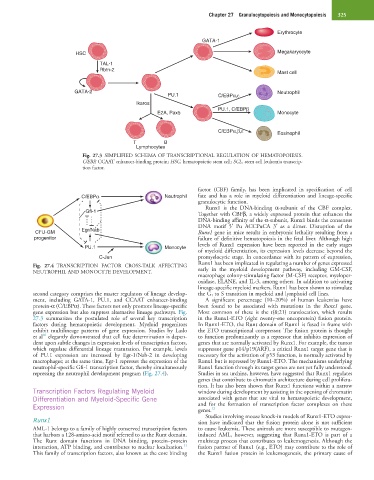
                            Fig. 27.3  SIMPLIFIED SCHEMA OF TRANSCRIPTIONAL REGULATION OF HEMATOPOIESIS.
                            C/EBP, CCAAT enhancer-binding protein; HSC, hematopoietic stem cell; SCL, stem cell leukemia transcrip-
                            tion factor.


                                                                  factor  (CBF)  family,  has  been  implicated  in  specification  of  cell
                            C/EBPα                     Neutrophil  fate  and  has  a  role  in  myeloid  differentiation  and  lineage-specific
                                                                  granulocytic function.
                                                                    Runx1  is  the  DNA-binding  α-subunit  of  the  CBF  complex.
                             Gfi-1
                                                                  Together with CBFβ, a widely expressed protein that enhances the
                                                                  DNA-binding affinity of the α-subunit, Runx1 binds the consensus
                                                                  DNA  motif  5′  Pu  ACCPuCA  3′  as  a  dimer.  Disruption  of  the
                            Egr/Nab
             CFU-GM                                               Runx1 gene in mice results in embryonic lethality resulting from a
            progenitor                                            failure of definitive hematopoiesis in the fetal liver. Although high
                             PU.1                      Monocyte   levels  of  Runx1  expression  have  been  reported  in  the  early  stages
                                                                  of myeloid differentiation, its expression levels decrease beyond the
                                 C-Jun                            promyelocytic stage. In concordance with its pattern of expression,
                                                                  Runx1 has been implicated in regulating a number of genes expressed
            Fig.  27.4  TRANSCRIPTION  FACTOR  CROSS-TALK  AFFECTING   early  in  the  myeloid  development  pathway,  including  GM-CSF,
            NEUTROPHIL AND MONOCYTE DEVELOPMENT.
                                                                  macrophage colony-stimulating factor (M-CSF) receptor, myeloper-
                                                                  oxidase, ELANE, and IL-3, among others. In addition to activating
                                                                  lineage-specific myeloid markers, Runx1 has been shown to stimulate
            second category comprises the master regulators of lineage develop-  the G 1  to S transition in myeloid and lymphoid cell lines.
            ment,  including  GATA-1,  PU.1,  and  CCAAT  enhancer-binding   A  significant  percentage  (10–20%)  of  human  leukemias  have
            protein-α (C/EBPα). These factors not only promote lineage-specific   been  found  to  be  associated  with  mutations  in  the  Runx1  gene.
            gene expression but also suppress alternative lineage pathways. Fig.   Most  common  of  these  is  the  t(8;21)  translocation,  which  results
            27.3  summarizes  the  postulated  role  of  several  key  transcription   in the Runx1-ETO (eight twenty-one oncoprotein) fusion protein.
            factors  during  hematopoietic  development.  Myeloid  progenitors   In Runx1-ETO, the Runt domain of Runx1 is fused in frame with
            exhibit  multilineage  patterns  of  gene  expression.  Studies  by  Laslo     the ETO transcriptional corepressor. The fusion protein is thought
               10
            et al  elegantly demonstrated that cell fate determination is depen-  to function predominantly as a repressor that inhibits expression of
            dent upon subtle changes in expression levels of transcription factors,   genes that are normally activated by Runx1. For example, the tumor
            which  regulate  differential  lineage  maturation.  For  example,  levels   suppressor gene p14/p19(ARF), a critical Runx1 target gene that is
            of  PU.1  expression  are  increased  by  Egr-1/Nab-2  in  developing   necessary for the activation of p53 function, is normally activated by
            macrophages; at the same time, Egr-1 represses the expression of the   Runx1 but is repressed by Runx1-ETO. The mechanisms underlying
            neutrophil-specific Gfi-1 transcription factor, thereby simultaneously   Runx1 function through its target genes are not yet fully understood.
            repressing the neutrophil development program (Fig. 27.4).  Studies in sea urchins, however, have suggested that Runx1 regulates
                                                                  genes that contribute to chromatin architecture during cell prolifera-
                                                                  tion. It has also been shown that Runx1 functions within a narrow
            Transcription Factors Regulating Myeloid              window during development by assisting in the opening of chromatin
            Differentiation and Myeloid-Specific Gene             associated with genes that are vital to hematopoietic development,
            Expression                                            and  for  the  formation  of  transcription  factor  complexes  on  these
                                                                      12
                                                                  genes.
                                                                    Studies involving mouse knock-in models of Runx1-ETO expres-
            Runx1                                                 sion  have  indicated  that  the  fusion  protein  alone  is  not  sufficient
            AML-1 belongs to a family of highly conserved transcription factors   to cause leukemia. These animals are more susceptible to mutagen-
            that harbors a 128-amino-acid motif referred to as the Runt domain.   induced  AML,  however,  suggesting  that  Runx1-ETO  is  part  of  a
            The  Runt  domain  functions  in  DNA  binding,  protein–protein   multistep process that contributes to leukemogenesis. Although the
                                                             11
            interaction, ATP binding, and contributes to nuclear localization.    fusion partner of Runx1 (e.g., ETO) may contribute to the role of
            This family of transcription factors, also known as the core binding   the Runx1 fusion protein in leukemogenesis, the primary cause of

