


Page 401 - Hematology_ Basic Principles and Practice ( PDFDrive )
P. 401
Chapter 27  Granulocytopoiesis and Monocytopoiesis  323

                                                                  CONTROL OF GRANULOPOIESIS
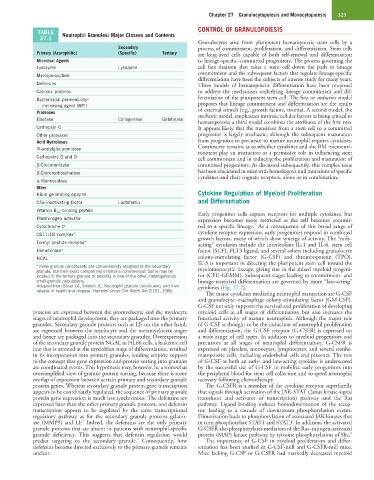
             TABLE   Neutrophil Granules: Major Classes and Contents
              27.1
                                                                  Granulocytes  arise  from  pluripotent  hematopoietic  stem  cells  by  a
                                        Secondary                 process of commitment, proliferation, and differentiation. Stem cells
             Primary (Azurophilic)      (Specific)    Tertiary    are  long-lived  cells  capable  of  both  self-renewal  and  differentiation
             Microbial Agents                                     to lineage-specific–committed progenitors. The process governing the
             Lysozyme                   Lysozyme                  cell  fate  decision  that  takes  a  stem  cell  down  the  path  to  lineage
                                                                  commitment and the subsequent factors that regulate lineage-specific
             Myeloperoxidase
                                                                  differentiation have been the subjects of intense study for many years.
             Defensins                                            Three  models  of  hematopoietic  differentiation  have  been  proposed
             Cationic proteins                                    to address the mechanism underlying lineage commitment and dif-
             Bactericidal permeability–                           ferentiation of the pluripotent stem cell. The first or inductive model
               increasing agent (BPI)                             proposes that lineage commitment and differentiation are the results
             Proteases                                            of external stimuli (e.g., growth factors, stroma). A second model, the
                                                                  stochastic model, emphasizes intrinsic cellular factors as being critical to
             Elastase                   Collagenase   Gelatinase
                                                                  hematopoiesis; a third model combines the attributes of the first two.
             Cathepsin G                                          It appears likely that the transition from a stem cell to a committed
             Other proteases                                      progenitor is largely stochastic, although the subsequent maturation
             Acid Hydrolases                                      from progenitor to precursor to mature neutrophil requires cytokines.
             N-acetylglucuronidase                                Controversy remains as to whether cytokines and the BM microenvi-
                                                                  ronment play an instructive or a permissive role in influencing stem
             Cathepsins B and D                                   cell commitment and in inducing the proliferation and maturation of
             β-Glucuronidase                                      committed progenitors. As discussed subsequently, this complex issue
             β-Glycerophosphatase                                 has been elucidated in mice with homologous null mutations of specific
             α-Mannosidase                                        cytokines and their cognate receptors, alone or in combination.
             Other
             Kinin-generating enzyme                              Cytokine Regulation of Myeloid Proliferation
             C5a-inactivating factor    Lactoferrin               and Differentiation
             Vitamin B 12 –binding protein
                                                                  Early progenitor cells express receptors for multiple cytokines, but
             Plasminogen activator                                expression  becomes  more  restricted  as  the  cell  becomes  commit-
                                                                                    7
             Cytochrome b a                                       ted to a specific lineage.  As a consequence of this broad range of
             CD11/1B complex a                                    cytokine receptor expression, early progenitors respond to combined
                                                                  growth factors, many of which show synergy of activity. The “early-
             Formyl peptide receptor a                            acting” cytokines include the interleukins IL-1 and IL-6, stem cell
             Histaminase a                                        factor (SCF), FLT3 ligand, and several others including granulocyte
             NGAL                                                 colony-stimulating  factor  (G-CSF)  and  thrombopoietin  (TPO).
                                                                  IL-3 is important in directing the pluripotent stem cell toward the
             a These granule constituents are conventionally assigned to the secondary
             granule, but their exact compartment remains controversial. Some may be   myelomonocytic lineage, giving rise to the mixed myeloid progeni-
             located in the tertiary granule or possibly in one of the other, heterogeneous   tor (CFU-GEMM). Subsequent stages leading to commitment- and
             small-granule populations.                           lineage-restricted differentiation are governed by more “late-acting”
             Adapted from Boxer LA, Smolen JE: Neutrophil granule constituents and their   cytokines (Fig. 27.2).
             release in health and disease. Hematol Oncol Clin North Am 2:101, 1988.
                                                                    The major cytokines mediating neutrophil maturation are G-CSF
                                                                  and granulocyte–macrophage colony-stimulating factor (GM-CSF).
                                                                  G-CSF not only supports the survival and proliferation of developing
            proteins are expressed between the promyelocyte and the myelocyte   myeloid  cells  at  all  stages  of  differentiation  but  also  increases  the
            stages of neutrophil development, they are packaged into the primary   functional activity of mature neutrophils. Although the major role
            granules. Secondary granule proteins such as LF, on the other hand,   of G-CSF is thought to be the induction of neutrophil proliferation
            are expressed between the myelocyte and the metamyelocyte stages   and differentiation, the G-CSF receptor (G-CSFR) is expressed on
            and hence are packaged into the secondary granules. Overexpression   a wide range of cell types. In addition to myeloid progenitors and
            of the secondary granule protein NGAL in HL60 cells, a leukemic cell   precursors  at  all  stages  of  neutrophil  differentiation,  G-CSFR  is
            line that is arrested at the myeloblast stage of differentiation, resulted   expressed on platelets, monocytes, lymphocytes, and several nonhe-
            in its incorporation into primary granules, lending empiric support   matopoietic cells, including endothelial cells and placenta. The role
            to the concept that gene expression and protein sorting into granules   of G-CSF as both an early- and late-acting cytokine is underscored
            are coordinated events. This hypothesis may, however, be a somewhat   by the successful use of G-CSF to mobilize early progenitors into
            oversimplified view of granule protein sorting, because there is some   the peripheral blood for stem cell collection and to speed neutrophil
            overlap of expression between certain primary and secondary granule   recovery following chemotherapy.
            protein genes. Whereas secondary granule protein gene transcription   The G-CSFR is a member of the cytokine receptor superfamily
            appears to be coordinately regulated, the sequence of primary granule   that signals through activation of the JAK-STAT (Janus kinase-signal
            protein gene expression is much less synchronous. The defensins are   transducer  and  activator  of  transcription)  pathway  and  the  Ras
            expressed later than the other primary granule proteins, and defensin   pathway.  Ligand  binding  induces  homodimerization  of  the  recep-
            transcription  appears  to  be  regulated  by  the  same  transcriptional   tor,  leading  to  a  cascade  of  downstream  phosphorylation  events.
            regulatory  pathway  as  for  the  secondary  granule  proteins  gelatin-  Dimerization leads to phosphorylation of associated JAK kinases that
                            5
            ase  (MMP9)  and  LF.   Indeed,  the  defensins  are  the  only  primary   in turn phosphorylate STAT1 and STAT3. In addition, the activated
            granule proteins that are absent in patients with neutrophil-specific   G-CSFR also phosphorylates mediators of the Ras–mitogen-activated
            granule  deficiency.  This  suggests  that  defensin  regulation  would   protein (MAP) kinase pathway by tyrosine phosphorylation of Shc. 8
                                              6
            predict  targeting  to  the  secondary  granule.   Consequently,  how   The importance of G-CSF in myeloid proliferation and differ-
            defensins become directed exclusively to the primary granule remains    entiation has been studied in G-CSF-null and G-CSFR-null mice.
            unclear.                                              Mice lacking G-CSF or G-CSFR had markedly decreased myeloid

