


Page 423 - Hematology_ Basic Principles and Practice ( PDFDrive )
P. 423
344    Part IV  Disorders of Hematopoietic Cell Development


        mutation  (GATA1 V205M )  significantly  impairs  FOG-1  binding,  but   ATG  ATG
        retains  normal  DNA  affinity  based  on  electromobility  shift  assays
        using synthetic oligonucleotides. This is consistent with the location
        of this residue on the surface of the zinc finger opposite the DNA   AD       N    C              GATA-1
        binding face.
           Several  other  GATA1  mutations  have  been  linked  to  cases  of   1
        familial X-linked macrothrombocytopenia with or without anemia.
        These substitutions all impair FOG-1 binding, although to different           N    C              GATA-1s
        degrees. Substitution of glycine by serine at codon 208 (GATA1 G208S )
        results in moderate to severe thrombocytopenia and mild dyseryth-  84                        414
        ropoiesis, but no anemia. Substitution of the same residue by arginine
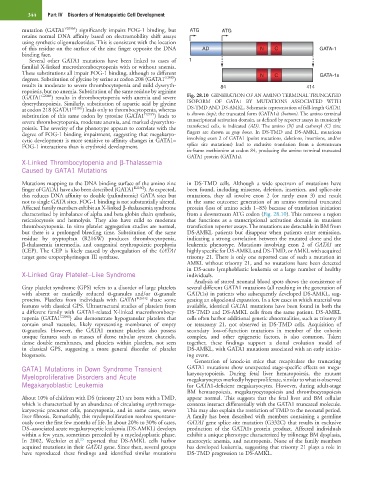
        (GATA1 G208R ) results in thrombocytopenia with anemia and severe   Fig. 28.10  GENERATION OF AN AMINO TERMINAL TRUNCATED
        dyserythropoiesis. Similarly, substitution of aspartic acid by glycine   ISOFORM  OF  GATA1  BY  MUTATIONS  ASSOCIATED  WITH
        at codon 218 (GATA1 D218G ) leads only to thrombocytopenia, whereas   DS-TMD AND DS-AMKL. Schematic representation of full-length GATA1
        substitution of this same codon by tyrosine (GATA1 D218Y ) leads to   is shown (top); the truncated form (GATA1s) (bottom). The amino terminal
        severe thrombocytopenia, moderate anemia, and marked dyserythro-  transcriptional activation domain, as defined by reporter assays in transiently
        poiesis. The severity of the phenotype appears to correlate with the   transfected cells, is indicated (AD). The amino (N) and carboxyl (C) zinc
        degree of FOG-1 binding impairment, suggesting that megakaryo-  fingers  are  shown  as  gray  boxes.  In  DS-TMD  and  DS-AMKL,  mutations
        cytic development is more sensitive to affinity changes in GATA1–  involving exon 2 of GATA1 (point mutations, deletions, insertions, and/or
        FOG-1 interactions than is erythroid development.     splice  site  mutations)  lead  to  exclusive  translation  from  a  downstream
                                                              in-frame methionine at codon 84, producing the amino terminal truncated
                                                              GATA1 protein (GATA1s).
        X-Linked Thrombocytopenia and β-Thalassemia
        Caused by GATA1 Mutations

        Mutations mapping to the DNA binding surface of the amino zinc   in  DS-TMD  cells.  Although  a  wide  spectrum  of  mutations  have
        finger of GATA1 have also been described (GATA1 R216Q ). As expected,   been found, including missense, deletion, insertion, and splice-site
        this reduces DNA affinity to double (palindromic) GATA sites but   mutations,  they  all  involve  exon  2  (or  rarely  exon  3)  and  result
        not to single GATA sites. FOG-1 binding is not substantially altered.   in  the  same  outcome:  generation  of  an  amino  terminal  truncated
        Affected family members exhibit an X-linked β-thalassemia syndrome   protein (loss of amino acids 1−83) because of translation initiation
        characterized by imbalance of alpha and beta globin chain synthesis,   from a downstream ATG codon (Fig. 28.10). This removes a region
        reticulocytosis  and  hemolysis.  They  also  have  mild  to  moderate   that  functions  as  a  transcriptional  activation  domain  in  transient
        thrombocytopenia. In vitro platelet aggregation studies are normal,   transfection reporter assays. The mutations are detectable in BM from
        but  there  is  a  prolonged  bleeding  time.  Substitution  of  the  same   DS-AMKL  patients  but  disappear  when  patients  enter  remission,
        residue  by  tryptophan  (R216W)  produces  thrombocytopenia,   indicating a strong correlation between the mutated clone and the
        β-thalassemia  intermedia,  and  congenital  erythropoietic  porphyria   leukemic  phenotype.  Mutations  involving  exon  2  of  GATA1  are
        (CEP). The  CEP  is  likely  caused  by  dysregulation  of  the  GATA1   highly specific for DS-AMKL and DS-TMD, or AMKL with acquired
        target gene uroporphyrinogen III synthase.            trisomy 21. There is only one reported case of such a mutation in
                                                              AMKL without trisomy 21, and no mutations have been detected
                                                              in DS-acute lymphoblastic leukemia or a large number of healthy
        X-Linked Gray Platelet–Like Syndrome                  individuals.
                                                                 Analysis of stored neonatal blood spots shows the coexistence of
        Gray platelet syndrome (GPS) refers to a disorder of large platelets   several different GATA1 mutations (all resulting in the generation of
        with  absent  or  markedly  reduced  α-granules  and/or  α-granule   GATA1s) in patients who subsequently developed DS-AMKL, sug-
        proteins.  Platelets  from  individuals  with  GATA1 R261Q   share  some   gesting an oligoclonal expansion. In a few cases in which material was
        features with classical GPS. Ultrastructural studies of platelets from   available, identical GATA1 mutations have been found in both the
        a different  family  with GATA1-related  X-linked  macrothrombocy-  DS-TMD and DS-AMKL cells from the same patient. DS-AMKL
        topenia (GATA1 G208S ) also demonstrate hypogranular platelets that   cells often harbor additional genetic abnormalities, such as trisomy 8
        contain  small  vacuoles,  likely  representing  membranes  of  empty   or  tetrasomy  21,  not  observed  in  DS-TMD  cells.  Acquisition  of
        α-granules.  However,  the  GATA1  mutant  platelets  also  possess   secondary  loss-of-function  mutations  in  member  of  the  cohesin
        unique  features  such  as  masses  of  dense  tubular  system  channels,   complex,  and  other  epigenetic  factors,  is  also  common.  Taken
        dense  double  membranes,  and  platelets  within  platelets,  not  seen   together,  these  findings  support  a  clonal  evolution  model  of
        in  classical  GPS,  suggesting  a  more  general  disorder  of  platelet     DS-AMKL, with GATA1 mutations associated with an early initiat-
        biogenesis.                                           ing event.
                                                                 Generation  of  knock-in  mice  that  recapitulate  the  truncating
        GATA1 Mutations in Down Syndrome Transient            GATA1 mutations show unexpected stage-specific effects on mega-
        Myeloproliferative Disorders and Acute                karyocytopoiesis.  During  fetal  liver  hematopoiesis,  the  mutant
                                                              megakaryocytes markedly hyperproliferate, similar to what is observed
        Megakaryoblastic Leukemia                             for  GATA1-deficient  megakaryocytes.  However,  during  adult-stage
                                                              BM  hematopoiesis,  megakaryocytopoiesis  and  thrombocytopoiesis
        About 10% of children with DS (trisomy 21) are born with a TMD,   appear  normal. This  suggests  that  the  fetal  liver  and  BM  cellular
        which is characterized by an abundance of circulating erythromega-  contexts interact differentially with the GATA1 truncated molecule.
        karyocytic precursor cells, pancytopenia, and in some cases, severe   This may also explain the restriction of TMD to the neonatal period.
        liver fibrosis. Remarkably, this myeloproliferation resolves spontane-  A  family  has  been  described  with  members  containing  a  germline
        ously over the first few months of life. In about 20% to 30% of cases,   GATA1 gene splice site mutation (G332C) that results in exclusive
        DS–associated acute megakaryocytic leukemia (DS-AMKL) develops   production  of  the  GATA1s  protein  product.  Affected  individuals
        within a few years, sometimes preceded by a myelodysplastic phase.   exhibit a unique phenotype characterized by trilineage BM dysplasia,
                           23
        In  2002,  Wechsler  et al.   reported  that  DS-AMKL  cells  harbor   macrocytic anemia, and neutropenia. None of the family members
        acquired mutations in their GATA1 gene. Since then, several groups   has developed leukemia, suggesting that trisomy 21 plays a role in
        have  reproduced  these  findings  and  identified  similar  mutations   DS-TMD progression to DS-AMKL.

