


Page 418 - Hematology_ Basic Principles and Practice ( PDFDrive )
P. 418
Chapter 28  Thrombocytopoiesis  339


                                                                  TPO-mediated megakaryocytic progenitor proliferation and possibly
                                                                  terminal  megakaryocyte  size  determination,  ploidy,  and  cellular
                                TPO                               maturation.
                                                                  Negative Regulation of TPO Signaling
                                                                  As with other receptor-mediated signaling processes, feedback mecha-
                                                                  nisms  exist  to  limit  or  turn  off  the  signal  once  initiated  to  avoid
                                                                  uncontrolled growth. Lnk, an adaptor protein implicated in immu-
                                                                  noreceptor  and  cytokine  receptor  signaling  negatively  modulates
                                                  Cytoplasmic     TPO signaling in megakaryocytes. Overexpression of Lnk decreases
                                                  membrane        TPO-dependent  megakaryocyte  growth  and  polyploidization  in
                                                                  BM–derived  cultures.  Conversely,  loss  of  Lnk  expression  by  gene
                                                                  targeting results in increased numbers of megakaryocytes, accentu-
                        P                 P                       ated megakaryocyte polyploidization, and a myeloproliferative disor-
                          JAK2  1  1  JAK2                        der  in  mice.   This  correlates  with  enhanced  and  prolonged
                                                                            15
                           P 591 Y  Y 591  P                      TPO-mediated  induction  of  STAT3,  STAT5,  AKT,  and  MAPK
                                                                  signaling pathways.
                                2  2
                                                                    Following TPO  binding,  the TPO  receptor  is  internalized  and
                           P 625 Y  Y 625  P                      subsequently degraded. This process depends on dileucine repeats,
                                                                                625
                                                                        591
                           P 630     630  P                       and Tyr  and Tyr  within the TPO receptor cytoplasmic tail, and
                               Y   Y
                                                                  involves ubiquitinylation via the E3 ubiquitin ligase c-Cbl.
                                                pAKT
                                                                  TPO Signaling in Hematopoietic Stem Cells
                     pSTAT3,5  pERK1/2  PI-3K
                                                mTOR              The TPO-TPO receptor signaling system is not only important for
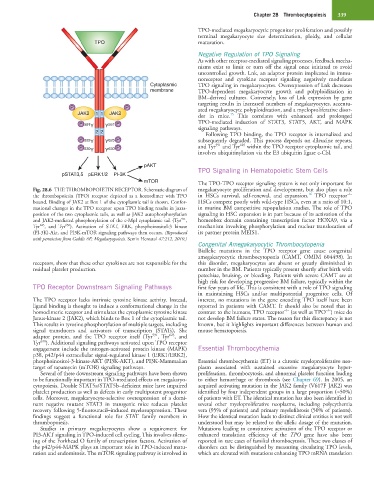
            Fig. 28.6  THE THROMBOPOIETIN RECEPTOR. Schematic diagram of   megakaryocyte proliferation and development, but also plays a role
                                                                                                                   −/−
                                                                                                      16
            the  thrombopoietin  (TPO)  receptor  depicted  as  a  homodimer  with TPO   in  HSCs  survival,  self-renewal,  and  expansion.   TPO  receptor
            bound. Binding of JAK2 at Box 1 of the cytoplasmic tail is shown. Confor-  HSCs compete poorly with wild-type HSCs, even at a ratio of 10:1,
            mational changes in the TPO receptor upon TPO binding results in juxta-  in murine BM competitive repopulation studies. The role of TPO
            position of the two cytoplasmic tails, as well as JAK2 autophosphorylation   signaling in HSC expansion is in part because of its activation of the
                                                            591
            and JAK2-mediated phosphorylation of the c-Mpl cytoplasmic tail (Tyr ,   homeobox  domain  containing  transcription  factor  HOXA9,  via  a
                      630
              625
            Tyr ,  and  Tyr ).  Activation  of  STAT,  ERK,  phosphoinositol-3  kinase   mechanism involving phosphorylation and nuclear translocation of
            (PI-3K)-Akt, and PI3K-mTOR signaling pathways then occurs. (Reproduced   its partner protein MEIS1.
            with permission from Geddis AE: Megakaryopoiesis. Semin Hematol 47:212, 2010.)
                                                                  Congenital Amegakaryocytic Thrombocytopenia
                                                                  Biallelic  mutations  in  the  TPO  receptor  gene  cause  congenital
                                                                  amegakaryocytic  thrombocytopenia  (CAMT,  OMIM  604498).  In
            receptors, show that these other cytokines are not responsible for the   this  disorder,  megakaryocytes  are  absent  or  greatly  diminished  in
            residual platelet production.                         number in the BM. Patients typically present shortly after birth with
                                                                  petechiae, bruising, or bleeding. Patients with severe CAMT are at
                                                                  high risk for developing progressive BM failure, typically within the
            TPO Receptor Downstream Signaling Pathways            first few years of life. This is consistent with a role of TPO signaling
                                                                  in  maintaining  HSCs  and/or  multipotential  progenitor  cells.  Of
            The TPO  receptor  lacks  intrinsic  tyrosine  kinase  activity.  Instead,   interest, no mutations in the gene encoding TPO itself have been
            ligand binding is thought to induce a conformational change in the   reported  in  patients  with  CAMT.  It  should  also  be  noted  that  in
                                                                                                            −/−
                                                                                              −/−
            homodimeric receptor and stimulates the cytoplasmic tyrosine kinase   contrast to the humans, TPO receptor  (as well as TPO ) mice do
            Janus-kinase 2 (JAK2), which binds to Box 1 of the cytoplasmic tail.   not develop BM failure states. The reason for this discrepancy is not
            This results in tyrosine phosphorylation of multiple targets, including   known, but it highlights important differences between human and
            signal  transducers  and  activators  of  transcription  (STATs),  Shc   mouse hematopoiesis.
                                                   591
                                                        625
            adaptor  protein,  and  the  TPO  receptor  itself  (Tyr ,  Tyr ,  and
              630
            Tyr ). Additional signaling pathways activated upon TPO receptor
            engagement include the mitogen-activated protein kinase (MAPK)   Essential Thrombocythemia
            p38, p42/p44 extracellular signal-regulated kinase 1 (ERK1/ERK2),
            phosphoinositol-3-kinase-AKT (PI3K-AKT), and PI3K-Mammalian   Essential thrombocythemia (ET) is a chronic myeloproliferative neo-
            target of rapamycin (mTOR) signaling pathways.        plasm  associated  with  sustained  excessive  megakaryocyte  hyper-
              Several of these downstream signaling pathways have been shown   proliferation, thrombocytosis, and abnormal platelet function leading
            to be functionally important in TPO-mediated effects on megakaryo-  to  either  hemorrhage  or  thrombosis  (see  Chapter  69).  In  2005,  an
            cytopoiesis. Double STAT5a/STAT5b–deficient mice have impaired   acquired activating mutation in the JAK2 family (V617F JAK2) was
            platelet production as well as defects in early multipotent progenitor   identified by four independent groups in a large proportion (≈50%)
            cells.  Moreover,  megakaryocyte-selective  overexpression  of  a  domi-  of patients with ET. The identical mutation has also been identified in
            nant  negative  mutant  STAT3  in  transgenic  mice  reduces  platelet   several  other  myeloproliferative  neoplasms,  including  polycythemia
            recovery following 5-fluorouracil–induced myelosuppression. These   vera (95% of patients) and primary myelofibrosis (50% of patients).
            findings  suggest  a  functional  role  for  STAT  family  members  in   How the identical mutation leads to distinct clinical entities is not well
            thrombopoiesis.                                       understood but may be related to the allelic dosage of the mutation.
              Studies  in  primary  megakaryocytes  show  a  requirement  for   Mutations leading to constitutive activation of the TPO receptor or
            PI3-AKT signaling in TPO-induced cell cycling. This involves silenc-  enhanced  translation  efficiency  of  the  TPO  gene  have  also  been
            ing of the Forkhead O family of transcription factors. Activation of   reported in rare cases of familial thrombocytosis. These two classes of
            the p42/p44-MAPK plays an important role in TPO-induced matu-  disorders can be distinguished by measuring circulating TPO levels,
            ration and endomitosis. The mTOR signaling pathway is involved in   which are elevated with mutations enhancing TPO mRNA translation

