


Page 420 - Hematology_ Basic Principles and Practice ( PDFDrive )
P. 420
Chapter 28  Thrombocytopoiesis  341


                                      4N          4N         4N          4N                 4N
                            2N    early prophase late prophase  metaphase  anaphase A    anaphase B
                                                                               Normal
                                                                               mitosis


                                                                                                 4N
                                  8N                8N             4N      Endomitosis        cytokinesis
                              late prophase    early prophase    Gap phase


                                                                                        2N        2N


                            8N                       8N                  8N
                         metaphase       Uneven   anaphase A          (gap phase)
                                        chromosome
                                        segregation
                                                                                   16N and etc.


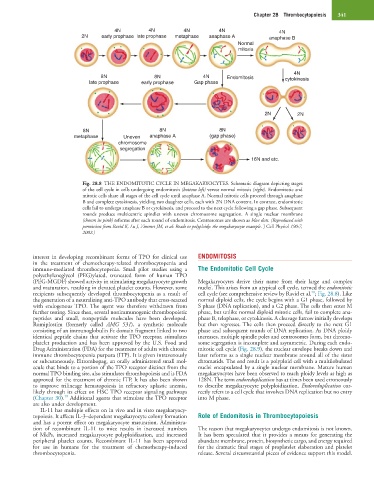
                            Fig. 28.8  THE ENDOMITOTIC CYCLE IN MEGAKARYOCYTES. Schematic diagram depicting stages
                            of the cell cycle in cells undergoing endomitosis (bottom left) versus normal mitosis (right). Endomitotic and
                            mitotic cells share all stages of the cell cycle until anaphase A. Normal mitotic cells proceed through anaphase
                            B and complete cytokinesis, yielding two daughter cells, each with 2N DNA content. In contrast, endomitotic
                            cells fail to undergo anaphase B or cytokinesis, and proceed to the next cycle following a gap phase. Subsequent
                            rounds  produce  multicentric  spindles  with  uneven  chromosome  segregation.  A  single  nuclear  membrane
                            (shown in pink) reforms after each round of endomitosis. Centrosomes are shown as blue dots. (Reproduced with
                            permission from Ravid K, Lu J, Zimmet JM, et al: Roads to polyploidy: the megakaryocyte example. J Cell Physiol 190:7,
                            2002.)


            interest  in  developing  recombinant  forms  of TPO  for  clinical  use   ENDOMITOSIS
            in  the  treatment  of  chemotherapy-related  thrombocytopenia  and
            immune-mediated  thrombocytopenia.  Small  pilot  studies  using  a   The Endomitotic Cell Cycle
            polyethyleneglycol  (PEG)ylated,  truncated  form  of  human  TPO
            (PEG-MGDF) showed activity in stimulating megakaryocyte growth   Megakaryocytes  derive  their  name  from  their  large  and  complex
            and maturation, resulting in elevated platelet counts. However, some   nuclei. This arises from an atypical cell cycle, termed the endomitotic
                                                                                                       20
            recipients  subsequently  developed  thrombocytopenia  as  a  result  of   cell cycle (see comprehensive review by Ravid et al. ; Fig. 28.8). Like
            the generation of a neutralizing anti-TPO antibody that cross-reacted   normal diploid cells, the cycle begins with a G1 phase, followed by
            with  endogenous TPO. The  agent  was  therefore  withdrawn  from   S phase (DNA replication), and a G2 phase. The cells then enter M
            further testing. Since then, several nonimmunogenic thrombopoietic   phase, but unlike normal diploid mitotic cells, fail to complete ana-
            peptides  and  small,  nonpeptide  molecules  have  been  developed.   phase B, telophase, or cytokinesis. A cleavage furrow initially develops
            Romiplostim  (formerly  called  AMG  531),  a  synthetic  molecule   but then regresses. The cells then proceed directly to the next G1
            consisting of an immunoglobulin Fc domain fragment linked to two   phase and subsequent rounds of DNA replication. As DNA ploidy
            identical peptide chains that activate the TPO receptor, stimulates   increases, multiple spindle poles and centrosomes form, but chromo-
            platelet  production  and  has  been  approved  by  the  U.S.  Food  and   some segregation is incomplete and asymmetric. During each endo-
            Drug Administration (FDA) for the treatment of adults with chronic   mitotic cell cycle (Fig. 28.9), the nuclear envelope breaks down and
            immune thrombocytopenia purpura (ITP). It is given intravenously   later reforms as a single nuclear membrane around all of the sister
            or subcutaneously. Eltrombopag, an orally administered small mol-  chromatids. The end result is a polyploid cell with a multilobulated
            ecule that binds to a portion of the TPO receptor distinct from the   nuclei encapsulated by a single nuclear membrane. Mature human
            normal TPO binding site, also stimulates thrombopoiesis and is FDA   megakaryocytes have been observed to reach ploidy levels as high as
            approved for the treatment of chronic ITP. It has also been shown   128N. The term endoreduplication has at times been used erroneously
            to  improve  trilineage  hematopoiesis  in  refractory  aplastic  anemia,   to  describe  megakaryocyte  polyploidization.  Endoreduplication  cor-
            likely through its effect on HSC TPO receptor signaling pathways   rectly refers to a cell cycle that involves DNA replication but no entry
                      19
            (Chapter 30).  Additional agents that stimulate the TPO receptor   into M phase.
            are also under development.
              IL-11 has multiple effects on in vivo and in vitro megakaryocy-
            topoiesis. It affects IL-3–dependent megakaryocyte colony formation   Role of Endomitosis in Thrombocytopoiesis
            and has a potent effect on megakaryocyte maturation. Administra-
            tion  of  recombinant  IL-11  to  mice  results  in  increased  numbers   The reason that megakaryocytes undergo endomitosis is not known.
            of  MkPs,  increased  megakaryocyte  polyploidization,  and  increased   It has been speculated that it provides a means for generating the
            peripheral  platelet  counts.  Recombinant  IL-11  has  been  approved   abundant membrane, protein, biosynthetic cargo, and energy required
            for  use  in  humans  for  the  treatment  of  chemotherapy-induced   for the dramatic final stages of proplatelet elaboration and platelet
            thrombocytopenia.                                     release. Several circumstantial pieces of evidence support this model.

