


Page 421 - Hematology_ Basic Principles and Practice ( PDFDrive )
P. 421
342    Part IV  Disorders of Hematopoietic Cell Development


                      A                        B                         C

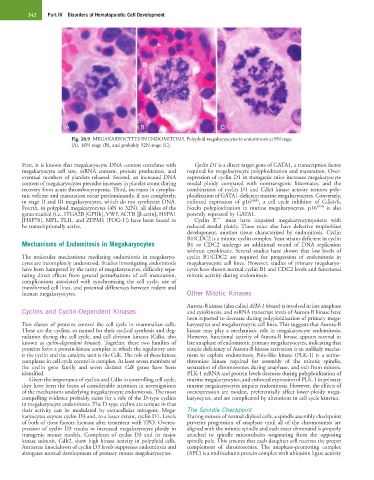
                        Fig. 28.9  MEGAKARYOCYTES IN ENDOMITOSIS. Polyploid megakaryocytes in endomitosis at 8N stage
                        (A), 16N stage (B), and probably 32N stage (C).


        First, it is known that megakaryocyte DNA content correlates with   Cyclin D1 is a direct target gene of GATA1, a transcription factor
        megakaryocyte  cell  size,  mRNA  content,  protein  production,  and   required for megakaryocyte polyploidization and maturation. Over-
        eventual numbers of platelets released. Second, an increased DNA   expression of cyclin D1 in transgenic mice increases megakaryocyte
        content of megakaryocytes precedes increases in platelet count during   modal  ploidy  compared  with  nontransgenic  littermates,  and  the
        recovery from acute thrombocytopenia. Third, increases in cytoplas-  combination of cyclin D1 and Cdk4 kinase activity restores poly-
        mic volume and maturation occur predominantly, if not completely,   ploidization of GATA1-deficient murine megakaryocytes. Conversely,
        in stage II and III megakaryocytes, which do not synthesize DNA.   enforced  expression  of  p16 ink4a ,  a  cell  cycle  inhibitor  of  Cdk4/6,
        Fourth, in polyploid megakaryocytes (4N to 32N), all alleles of the   blocks  polyploidization  in  murine  megakaryocytes.  p16 ink4a   is  also
        genes studied (i.e., ITGA2B [GPIIb], VWF, ACTB [β-actin], HSPA1   potently repressed by GATA1.
                                                                        −/−
        [HSP70], MPL, FLI1, and ZFPM1 [FOG-1]) have been found to   Cyclin  E   mice  have  impaired  megakaryocytopoiesis  with
        be transcriptionally active.                          reduced  modal  ploidy. These  mice  also  have  defective  trophoblast
                                                              development,  another  tissue  characterized  by  endomitosis.  Cyclin
                                                              B1/CDC2 is a mitotic cyclin complex. Yeast strains deficient in cyclin
        Mechanisms of Endomitosis in Megakaryocytes           B1  or  CDC2  undergo  an  additional  round  of  DNA  replication
                                                              without  cytokinesis.  Several  studies  have  shown  that  low  levels  of
        The  molecular  mechanisms  mediating  endomitosis  in  megakaryo-  cyclin  B1/CDC2  are  required  for  progression  of  endomitosis  in
        cytes are incompletely understood. Studies investigating endomitosis   megakaryocytic cell lines. However, studies of primary megakaryo-
        have been hampered by the rarity of megakaryocytes, difficulty sepa-  cytes have shown normal cyclin B1 and CDC2 levels and functional
        rating direct effects from general perturbations of cell maturation,   mitotic activity during endomitosis.
        complications  associated  with  synchronizing  the  cell  cycle,  use  of
        transformed cell lines, and potential differences between rodent and
        human megakaryocytes.                                 Other Mitotic Kinases

                                                              Aurora-B kinase (also called AIM-1 kinase) is involved in late anaphase
        Cyclins and Cyclin-Dependent Kinases                  and cytokinesis, and mRNA transcript levels of Aurora-B kinase have
                                                              been reported to decrease during polyploidization of primary mega-
        Two  classes  of  proteins  control  the  cell  cycle  in  mammalian  cells.   karyocytes and megakaryocytic cell lines. This suggests that Aurora-B
        These are the cyclins, so named for their cyclical synthesis and deg-  kinase may play a mechanistic role in megakaryocyte endomitosis.
        radation during the cell cycle, and cell division kinases (Cdks, also   However, functional activity of Aurora-B kinase appears normal in
        known  as  cyclin-dependent  kinases). Together,  these  two  families  of   late anaphase of endomitotic primary megakaryocytes, indicating that
        proteins form a protein-kinase complex in which the regulatory unit   simple deficiency of Aurora-B kinase activation is an unlikely mecha-
        is the cyclin and the catalytic unit is the Cdk. The role of these kinase   nism to explain endomitosis. Polo-like kinase (PLK-1) is a serine-
        complexes in cell cycle control is complex. At least seven members of   threonine  kinase  required  for  assembly  of  the  mitotic  spindle,
        the  cyclin  gene  family  and  seven  distinct  Cdk  genes  have  been   separation of chromosomes during anaphase, and exit from mitosis.
        identified.                                           PLK-1 mRNA and protein levels decrease during polyploidization of
           Given the importance of cyclins and Cdks in controlling cell cycle,   murine megakaryocytes, and enforced expression of PLK-1 in primary
        they have been the focus of considerable attention in investigations   murine megakaryocytes impairs endomitosis. However, the effects of
        of the mechanisms underlying megakaryocyte endomitosis. The most   overexpression  are  modest,  preferentially  affect  lower-ploidy  mega-
        compelling evidence probably exists for a role of the D-type cyclins   karyocytes, and are complicated by alterations in cell cycle kinetics.
        in megakaryocyte endomitosis. The D-type cyclins are unique in that
        their  activity  can  be  modulated  by  extracellular  mitogens.  Mega-  The Spindle Checkpoint
        karyocytes express cyclin D3 and, to a lesser extent, cyclin D1. Levels   During mitosis of normal diploid cells, a spindle assembly checkpoint
        of both of these factors increase after treatment with TPO. Overex-  prevents progression of anaphase until all of the chromosomes are
        pression of cyclin D3 results in increased megakaryocyte ploidy in   aligned with the mitotic spindle and each sister chromatid is properly
        transgenic  mouse  models.  Complexes  of  cyclin  D3  and  its  major   attached  to  spindle  microtubules  originating  from  the  opposing
        kinase subunit, Cdk2, show high kinase activity in polyploid cells.   spindle pole. This ensures that each daughter cell receives the proper
        Antisense knockdown of cyclin D3 levels suppresses endomitosis and   complement  of  chromosomes.  The  anaphase-promoting  complex
        abrogates normal development of primary mouse megakaryocytes.  (APC) is a multisubunit protein complex with ubiquitin ligase activity

