


Page 419 - Hematology_ Basic Principles and Practice ( PDFDrive )
P. 419
340    Part IV  Disorders of Hematopoietic Cell Development


                         Liver (hepatocytes)
                         Kidney ?                                Bloodstream
                                                           Binding to platelets


                        Platelet flow
                          TPO flow                                                   Spleen
                        TPO protein
                                                        Platelet
                            c-MPL
                                                       production
                          Multipotential
                          progenitors


                                      Megakaryocytopoiesis
                                                                               Bone marrow
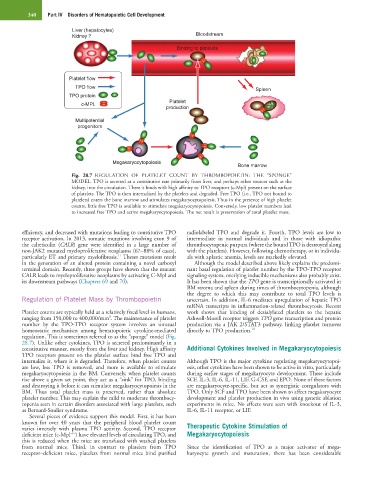
                        Fig.  28.7  REGULATION  OF  PLATELET  COUNT  BY  THROMBOPOIETIN:  THE  “SPONGE”
                        MODEL. TPO is secreted at a constitutive rate primarily from liver, and perhaps other sources such as the
                        kidney, into the circulation. There it binds with high affinity to TPO receptors (c-Mpl) present on the surface
                        of platelets. The TPO is then internalized by the platelets and degraded. Free TPO (i.e., TPO not bound to
                        platelets) enters the bone marrow and stimulates megakaryocytopoiesis. Thus in the presence of high platelet
                        counts, little free TPO is available to stimulate megakaryocytopoiesis. Conversely, low platelet numbers lead
                        to increased free TPO and active megakaryocytopoiesis. The net result is preservation of total platelet mass.


        efficiency, and decreased with mutations leading to constitutive TPO   radiolabeled TPO  and  degrade  it.  Fourth, TPO  levels  are  low  to
        receptor activation. In 2013, somatic mutations involving exon 9 of   intermediate  in  normal  individuals  and  in  those  with  idiopathic
        the  calreticulin  (CALR)  gene  were  identified  in  a  large  number  of   thrombocytopenic purpura (where the bound TPO is destroyed along
        non-JAK2 mutated myeloproliferative neoplasms (67−88% of cases),   with the platelets). However, following chemotherapy, or in individu-
                                        17
        particularly ET and primary myelofibrosis.  Theses mutations result   als with aplastic anemia, levels are markedly elevated.
        in  the  generation  of  an  altered  protein  containing  a  novel  carboxyl   Although the model described above likely explains the predomi-
        terminal domain. Recently, three groups have shown that the mutant   nant basal regulation of platelet number by the TPO-TPO receptor
        CALR leads to myeloproliferative neoplasms by activating C-Mpl and   signaling system, overlying inducible mechanisms also probably exist.
        its downstream pathways (Chapters 69 and 70).         It has been shown that the TPO gene is transcriptionally activated in
                                                              BM stroma and spleen during times of thrombocytopenia, although
                                                              the  degree  to  which  this  may  contribute  to  total  TPO  levels  is
        Regulation of Platelet Mass by Thrombopoietin         uncertain. In addition, IL-6 mediates upregulation of hepatic TPO
                                                              mRNA transcripts in inflammation-related thrombocytosis. Recent
        Platelet counts are typically held at a relatively fixed level in humans,   work  shows  that  binding  of  desialylated  platelets  to  the  hepatic
                                     3
        ranging from 150,000 to 400,000/mm . The maintenance of platelet   Ashwell-Morell receptor triggers TPO gene transcription and protein
        number  by  the  TPO-TPO  receptor  system  involves  an  unusual   production  via  a JAK 2/STAT3  pathway,  linking  platelet turnover
        homeostatic  mechanism  among  hematopoietic  cytokine-mediated   directly to TPO production. 18
        regulation. This is sometimes referred to as the “sponge” model (Fig.
        28.7). Unlike other cytokines, TPO is secreted predominantly in a
        constitutive manner, mostly from the liver and kidney. High affinity   Additional Cytokines Involved in Megakaryocytopoiesis
        TPO receptors present on the platelet surface bind free TPO and
        internalize it, where it is degraded. Therefore, when platelet counts   Although TPO is the major cytokine regulating megakaryocytopoi-
        are  low,  less TPO  is  removed,  and  more  is  available  to  stimulate   esis, other cytokines have been shown to be active in vitro, particularly
        megakaryocytopoiesis in the BM. Conversely, when platelet counts   during earlier stages of megakaryocyte development. These include
        rise above a given set point, they act as a “sink” for TPO, binding   SCF, IL-3, IL-6, IL-11, LIF, G-CSF, and EPO. None of these factors
        and destroying it before it can stimulate megakaryocytopoiesis in the   are megakaryocyte-specific, but act as synergistic coregulators with
        BM.  Thus  total  platelet  mass  is  preserved,  rather  than  absolute   TPO. Only SCF and TPO have been shown to affect megakaryocyte
        platelet number. This may explain the mild to moderate thrombocy-  development and platelet production in vivo using genetic ablation
        topenia seen in certain disorders associated with large platelets, such   experiments in mice. No effects were seen with knockout of IL-3,
        as Bernard-Soulier syndrome.                          IL-6, IL-11 receptor, or LIF.
           Several pieces of evidence support this model. First, it has been
        known  for  over  40  years  that  the  peripheral  blood  platelet  count
        varies  inversely  with  plasma  TPO  activity.  Second,  TPO  receptor   Therapeutic Cytokine Stimulation of
                        −/−
        deficient mice (c-Mpl ) have elevated levels of circulating TPO, and   Megakaryocytopoiesis
        this is reduced when the mice are transfused with washed platelets
        from  normal  mice.  Third,  in  contrast  to  platelets  from  TPO   Since  the  identification  of  TPO  as  a  major  activator  of  mega-
        receptor–deficient  mice,  platelets  from  normal  mice  bind  purified   karyocyte  growth  and  maturation,  there  has  been  considerable

