


Page 454 - Hematology_ Basic Principles and Practice ( PDFDrive )
P. 454
Chapter 29  Inherited Bone Marrow Failure Syndromes  375


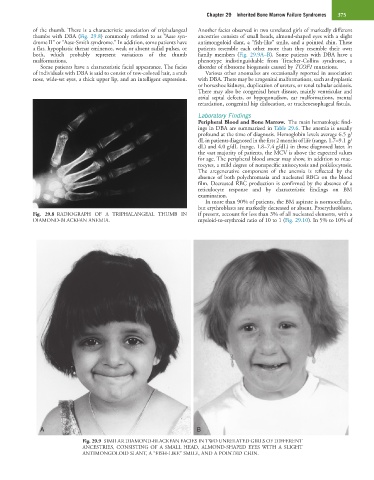
            of the thumb. There is a characteristic association of triphalangeal   Another facies observed in two unrelated girls of markedly different
            thumbs with DBA (Fig. 29.8) commonly referred to as “Aase syn-  ancestries consists of small heads, almond-shaped eyes with a slight
            drome II” or “Aase-Smith syndrome.” In addition, some patients have   antimongoloid slant, a “fish-like” smile, and a pointed chin. These
            a flat, hypoplastic thenar eminence, weak or absent radial pulses, or   patients  resemble  each  other  more  than  they  resemble  their  own
            both,  which  probably  represent  variations  of  the  thumb   family  members  (Fig.  29.9A–B).  Some  patients  with  DBA  have  a
            malformations.                                        phenotype  indistinguishable  from  Treacher-Collins  syndrome,  a
              Some patients have a characteristic facial appearance. The facies   disorder of ribosome biogenesis caused by TCOF1 mutations.
            of individuals with DBA is said to consist of tow-colored hair, a snub   Various other anomalies are occasionally reported in association
            nose, wide-set eyes, a thick upper lip, and an intelligent expression.   with DBA. There may be urogenital malformations, such as dysplastic
                                                                  or horseshoe kidneys, duplication of ureters, or renal tubular acidosis.
                                                                  There may also be congenital heart disease, mainly ventricular and
                                                                  atrial  septal  defects,  or  hypogonadism,  ear  malformations,  mental
                                                                  retardation, congenital hip dislocation, or tracheoesophageal fistula.

                                                                  Laboratory Findings
                                                                  Peripheral Blood and Bone Marrow.  The main hematologic find-
                                                                  ings in DBA are summarized in Table 29.6. The anemia is usually
                                                                  profound at the time of diagnosis. Hemoglobin levels average 6.5 g/
                                                                  dL in patients diagnosed in the first 2 months of life (range, 1.7–9.1 g/
                                                                  dL) and 4.0 g/dL (range, 1.8–7.4 g/dL) in those diagnosed later. In
                                                                  the vast majority of patients, the MCV is above the expected values
                                                                  for age. The peripheral blood smear may show, in addition to mac-
                                                                  rocytes, a mild degree of nonspecific anisocytosis and poikilocytosis.
                                                                  The  aregenerative  component  of  the  anemia  is  reflected  by  the
                                                                  absence of both polychromasia and nucleated RBCs on the blood
                                                                  film. Decreased RBC production is confirmed by the absence of a
                                                                  reticulocyte  response  and  by  characteristic  findings  on  BM
                                                                  examination.
                                                                    In more than 90% of patients, the BM aspirate is normocellular,
                                                                  but erythroblasts are markedly decreased or absent. Proerythroblasts,
            Fig.  29.8  RADIOGRAPH  OF  A  TRIPHALANGEAL  THUMB  IN   if present, account for less than 3% of all nucleated elements, with a
            DIAMOND-BLACKFAN ANEMIA.                              myeloid-to-erythroid ratio of 10 to 1 (Fig. 29.10). In 5% to 10% of


              A                                                  B
                            Fig. 29.9  SIMILAR DIAMOND-BLACKFAN FACIES IN TWO UNRELATED GIRLS OF DIFFERENT
                            ANCESTRIES,  CONSISTING  OF  A  SMALL  HEAD,  ALMOND-SHAPED  EYES  WITH  A  SLIGHT
                            ANTIMONGOLOID SLANT, A “FISH-LIKE” SMILE, AND A POINTED CHIN.

