


Page 455 - Hematology_ Basic Principles and Practice ( PDFDrive )
P. 455
376    Part IV  Disorders of Hematopoietic Cell Development


                  Hematologic Features in Diamond-Blackfan Anemia at   31% and 11% of patients, respectively, either at presentation or at
          TABLE   Diagnosis Based on Data on 21 Toronto Cases and on   follow-up. Progression of the single-lineage erythroid deficiency of
          29.6    41 Cases From the Canadian Inherited Marrow Failure   DBA into pancytopenia and severe aplastic anemia is rare but occurs.
                  Registry                                    Of 36 deaths reported to the American DBA Registry, one died from
                                                              severe aplastic anemia.
         Hematologic Parameters         Laboratory Findings
         Mean hemoglobin value (range)                        Erythrocyte  Findings.  Erythrocytes in DBA express a number of
            Newborns younger than 2 months of   6.5 g/dL (1.7–9.1 g/dL)  fetal characteristics. The level of HbF is increased persistently even
             age                                              during remission. It remains at a level of about 10% after the age of
            Children 2 months of age or older  4.0 g/dL (1.8–7.4 g/dL)  6 months and has a heterogeneous distribution in RBCs. The HbF
                                                              has a specifically fetal amino-acid profile with a high glycine-to-alanine
         High MCV for age after the age of 1 year  87%        ratio (G-γ:A-γ). Similarly, the i antigen, which normally disappears
         Low reticulocyte for the degree of anemia  100% (usually markedly   from the erythrocyte surface by 1 year of age, is expressed at near fetal
                                          decreased to <1%)   levels in older patients with DBA.
         Increased HbF for age after 1 year of age  100%         The precise cause of this fetal-like erythropoiesis is unclear. It is
                                                              clearly  distinct  from  the  fetal  erythropoiesis  implicated  in  various
         RBC adenosine deaminase activity  77%                types of leukemia, notably in juvenile myelomonocytic leukemia in
         RBC i antigen                  Expression increased   which the fetal RBCs presumably arise from the leukemic clone. The
                                          beyond first year of life  situation in DBA may be analogous to that in other forms of BM
         RBC enzymes                    Fetal pattern         failure and in the hematologic recovery phase after BMT. In all of
                                                              these conditions, the fetal (or “stress”) erythropoiesis may represent
         Neutropenia                    31%
                                                              an  accelerated  recapitulation  of  RBC  ontogeny  in  the  face  of  an
         Thrombocytopenia               11%                   increased demand for new RBCs in peripheral blood.
         BM cellularity                 Normal or increased in   Red  blood  cell  enzymes  often  display  an  abnormal  pattern  of
                                          90%; mildly reduced   activity that reflects a fetal expression pattern of RBC glycolytic and
                                          in 10%              hexose  monophosphate  shunt  enzyme  activities.  Enzymes,  such  as
                                                              enolase, glyceraldehyde-3-phosphate dehydrogenase, phosphofructo-
         BM erythropoiesis              Markedly reduced/absent   kinase, and glutathione peroxidase, have increased activity in patients
                                          erythroid precursors in   with DBA compared with those in normal children and adults and
                                          >90% of cases       in  patients  with  transient  erythroblastopenia  of  childhood  (TEC).
         BM myeloid and megakaryocytic lineages  Normal in 100% of the   For some enzymes, this increased activity is comparable to cord blood
                                          cases               RBCs. In apparent contradiction, carbonic anhydrase isoenzyme B,
         BM, Bone marrow; HbF, fetal hemoglobin; MCV, mean corpuscular volume;   which is not normally present in fetal RBCs, was detected in hemo-
         RBC, red blood cell.                                 lysates from three patients with DBA. Also, the RBCs of two of the
                                                              three patients had adult hexokinase isoenzyme distribution by iso-
                                                              electric focusing.
                                                                 Abnormalities  in  purine  and  pyrimidine  metabolism  are
                                                              reflected by increased activity of RBC adenosine deaminase (ADA)
                                                              in  60%  to  90%  of  patients  with  DBA.  Also,  increased  orotidine
                                                              decarboxylase (ODC) activity is seen in some patients. ADA activity
                                                              is  raised  in  DBA  erythrocytes  but  not  in  cord  blood  RBCs  from
                                                              normal newborns or from patients with any of several hematologic
                                                              conditions associated with “stress” erythropoiesis. Thus this enzymatic
                                                              abnormality cannot be simply attributable to a “reversion” to fetal
                                                              erythropoiesis. Raised ADA activity may also be detected in some
                                                              hemolytic anemias and acute leukemias, which limits the utility of
                                                              this assay as a specific diagnostic marker for DBA. However, increased
                                                              ADA activity does appear to be useful in differentiating DBA from
                                                              acquired  pure  cell  anemias  such  as  TEC  and  for  epidemiologic
                                                              testing of DBA pedigrees to identify family members with a mild
                                                              phenotype.
                                                              Miscellaneous  Findings.  Serum  levels  of  various  factors  involved
                                                              in RBC production, such as erythropoietin, iron, vitamin B 12 , and
                                                              folate, are appropriately elevated in DBA. These findings are compat-
                                                              ible with any form of chronic hypoplastic anemia. Riboflavin levels
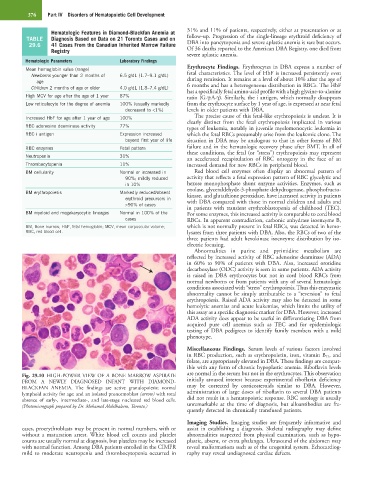
        Fig. 29.10  HIGH-POWER VIEW OF A BONE MARROW ASPIRATE   are normal in the serum but not in the erythrocytes. This observation
        FROM  A  NEWLY  DIAGNOSED  INFANT  WITH  DIAMOND-     initially aroused interest because experimental riboflavin deficiency
        BLACKFAN  ANEMIA.  The  findings  are  active  granulopoiesis;  normal   may  be  corrected  by  corticosteroids  similar  to  DBA.  However,
        lymphoid activity for age; and an isolated pronormoblast (arrow) with total   administration of large doses of riboflavin to several DBA patients
        absence  of  early-,  intermediate-,  and  late-stage  nucleated  red  blood  cells.   did not result in a hematopoietic response. RBC serology is usually
        (Photomicrograph prepared by Dr. Mohamed Abdelhaleem, Toronto.)  unremarkable  at  the  time  of  diagnosis,  but  alloantibodies  are  fre-
                                                              quently detected in chronically transfused patients.

                                                              Imaging  Studies.  Imaging  studies  are  frequently  informative  and
        cases, proerythroblasts may be present in normal numbers, with or   assist  in  establishing  a  diagnosis.  Skeletal  radiography  may  define
        without  a  maturation  arrest. White  blood  cell  counts  and  platelet   abnormalities  suspected  from  physical  examination,  such  as  hypo-
        counts are usually normal at diagnosis, but platelets may be increased   plastic, absent, or extra phalanges. Ultrasound of the abdomen may
        with normal function. Among DBA patients enrolled in the CIMFR   reveal malformations such as of the urogenital system. Echocardiog-
        mild  to  moderate  neutropenia  and  thrombocytopenia  occurred  in   raphy may reveal undiagnosed cardiac defects.

