


Page 456 - Hematology_ Basic Principles and Practice ( PDFDrive )
P. 456
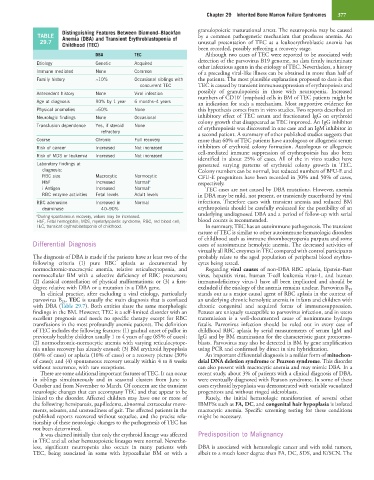
Chapter 29  Inherited Bone Marrow Failure Syndromes  377


                     Distinguishing Features Between Diamond–Blackfan   granulopoietic maturational arrest. The neutropenia may be caused
             TABLE   Anemia (DBA) and Transient Erythroblastopenia of   by  a  common  pathogenetic  mechanism  that  produces  anemia.  An
              29.7   Childhood (TEC)                              unusual  presentation  of TEC  as  a  leukoerythroblastic  anemia  has
                                                                  been recorded, possibly reflecting a recovery stage.
                                DBA          TEC                    Although two cases of TEC were reported to be associated with
                                                                  detection of the parvovirus B19 genome, no data firmly incriminate
             Etiology           Genetic      Acquired
                                                                  other infectious agents in the etiology of TEC. Nevertheless, a history
             Immune mediated    None         Common               of a preceding viral-like illness can be obtained in more than half of
             Family history     ≈10%         Occasional siblings with   the patients. The most plausible explanation proposed to date is that
                                               concurrent TEC     TEC is caused by transient immunosuppression of erythropoiesis and
             Antecedent history  None        Viral infection      possibly  of  granulopoiesis  in  those  with  neutropenia.  Increased
                                                                               +
                                                                  numbers of CD10  lymphoid cells in BM of TEC patients might be
             Age at diagnosis   90% by 1 year  6 months–4 years   an indication for such a mechanism. Most supportive evidence for
             Physical anomalies  ≈50%        None                 this hypothesis comes from in vitro studies. Two reports described an
             Neurologic findings  None       Occasional           inhibitory effect of TEC serum and fractionated IgG on erythroid
                                                                  colony growth that disappeared as TEC improved. An IgG inhibitor
             Transfusion dependence  Yes, if steroid   None       of erythropoiesis was discovered in one case and an IgM inhibitor in
                                  refractory
                                                                  a second patient. A summary of other published studies suggests that
             Course             Chronic      Full recovery        more than 60% of TEC patients have autologous or allogeneic serum
             Risk of cancer     Increased    Not increased        inhibitors of erythroid colony formation. Autologous or allogeneic
             Risk of MDS or leukemia  Increased  Not increased    cell-mediated  immune  suppression  of  erythropoiesis  has  also  been
                                                                  identified  in  about  25%  of  cases.  All  of  the  in  vitro  studies  have
             Laboratory findings at                               generated  varying  patterns  of  erythroid  colony  growth  in  TEC.
               diagnosis:                                         Colony numbers can be normal, but reduced numbers of BFU-E and
               RBC size         Macrocytic   Normocytic           CFU-E progenitors have been recorded in 30% and 50% of cases,
               HbF              Increased    Normal a             respectively.
               i Antigen        Increased    Normal a               TEC cases are not caused by DBA mutations. However, anemia
               RBC enzyme activities  Fetal levels  Adult levels  in DBA may be mild, not present, or transiently exacerbated by viral
             RBC adenosine      Increased in   Normal             infections. Therefore cases with transient anemia and reduced BM
               deaminase          40–90%                          erythropoiesis should be carefully evaluated for the possibility of an
                                                                  underlying undiagnosed DBA and a period of follow-up with serial
             a During spontaneous recovery, values may be increased.
             HbF, Fetal hemoglobin; MDS, myelodysplastic syndrome; RBC, red blood cell;   blood counts is recommended.
             TEC, transient erythroblastopenia of childhood.        In summary, TEC has an autoimmune pathogenesis. The transient
                                                                  nature of TEC is similar to other autoimmune hematologic disorders
                                                                  of childhood such as immune thrombocytopenia purpura and some
            Differential Diagnosis                                cases of autoimmune hemolytic anemia. The decreased activities of
                                                                  virtually all RBC enzymes in TEC compared with control participants
            The diagnosis of DBA is made if the patients have at least two of the   probably relate to the aged population of peripheral blood erythro-
            following  criteria  (1)  pure  RBC  aplasia  as  documented  by   cytes being tested.
            normochromic-macrocytic  anemia,  relative  reticulocytopenia,  and   Regarding viral causes of non-DBA RBC aplasia, Epstein-Barr
            normocellular  BM  with  a  selective  deficiency  of  RBC  precursors;    virus,  hepatitis  virus,  human  T-cell  leukemia  virus-1,  and  human
            (2) classical constellation of physical malformations; or (3) a first-  immunodeficiency virus-1 have all been implicated and should be
            degree relative with DBA or a mutation in a DBA gene.  excluded if the etiology of the anemia remains unclear. Parvovirus B 19
              In  clinical  practice,  after  excluding  a  viral  etiology,  particularly   stands out as a major causal agent of RBC aplasia in the context of
            parvovirus B 19 , TEC is usually the main diagnosis that is confused   an underlying chronic hemolytic anemia in infants and children with
            with DBA (Table 29.7). Both entities share the same morphologic   chronic  congenital  and  acquired  forms  of  immunosuppression.
            findings in the BM. However, TEC is a self-limited disorder with an   Fetuses are uniquely susceptible to parvovirus infection, and in utero
            excellent  prognosis  and  needs  no  specific  therapy  except  for  RBC   transmission  is  a  well-documented  cause  of  nonimmune  hydrops
            transfusions in the most profoundly anemic patients. The definition   fetalis.  Parvovirus  infection  should  be  ruled  out  in  every  case  of
            of TEC includes the following features: (1) gradual onset of pallor in   childhood RBC aplasia by serial measurements of serum IgM and
            previously healthy children usually 1 to 4 years of age (85% of cases);   IgG and by BM examination for the characteristic giant pronormo-
            (2) normochromic-normocytic anemia with varying reticulocytope-  blasts. Parvovirus may also be detected in BM by gene amplification
            nia unless recovery has already ensued; (3) BM erythroid hypoplasia   using PCR and confirmed by direct in situ hybridization.
            (60% of cases) or aplasia (10% of cases) or a recovery picture (30%   An important differential diagnosis is a milder form of mitochon-
            of cases); and (4) spontaneous recovery usually within 4 to 8 weeks   drial DNA deletion syndrome or Pearson syndrome. This disorder
            without recurrence, with rare exceptions.             can also present with macrocytic anemia and may mimic DBA. In a
              There are some additional important features of TEC. It can occur   recent study, about 3% of patients with a clinical diagnosis of DBA,
            in  siblings  simultaneously  and  in  seasonal  clusters  from  June  to   were eventually diagnosed with Pearson syndrome. In some of these
            October and from November to March. Of concern are the transient   cases erythroid hypoplasia was demonstrated with variable vacuolated
            neurologic changes that can accompany TEC and that appear to be   progenitors and without ringed sideroblasts.
            linked to the disorder. Affected children may have one or more of   Rarely,  the  initial  hematologic  manifestation  of  several  other
            the following: hemiparesis, papilledema, abnormal extraocular move-  IBMFSs such as FA, DC, and congenital hair hypoplasia is isolated
            ments, seizures, and unsteadiness of gait. The affected patients in the   macrocytic  anemia.  Specific  screening  testing  for  these  conditions
            published reports recovered without sequelae, and the precise rela-  might be necessary.
            tionship of these neurologic changes to the pathogenesis of TEC has
            not been determined.
              It was claimed initially that only the erythroid lineage was affected   Predisposition to Malignancy
            in TEC and all other hematopoietic lineages were normal. Neverthe-
            less,  significant  neutropenia  also  occurs  in  many  patients  with     DBA is associated with hematologic cancer and with solid tumors,
            TEC,  being  associated  in  some  with  hypocellular  BM  or  with  a   albeit to a much lesser degree than FA, DC, SDS, and K/SCN. The

