


Page 461 - Hematology_ Basic Principles and Practice ( PDFDrive )
P. 461
382    Part IV  Disorders of Hematopoietic Cell Development


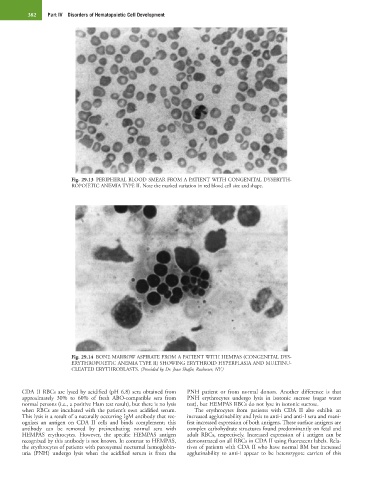
                        Fig. 29.13  PERIPHERAL BLOOD SMEAR FROM A PATIENT WITH CONGENITAL DYSERYTH-
                        ROPOIETIC ANEMIA TYPE II. Note the marked variation in red blood cell size and shape.


                        Fig. 29.14  BONE MARROW ASPIRATE FROM A PATIENT WITH HEMPAS (CONGENITAL DYS-
                        ERYTHROPOIETIC ANEMIA TYPE II) SHOWING ERYTHROID HYPERPLASIA AND MULTINU-
                        CLEATED ERYTHROBLASTS. (Provided by Dr. Jean Shafer, Rochester, NY.)


        CDA II RBCs are lysed by acidified (pH 6.8) sera obtained from   PNH  patient  or  from  normal  donors.  Another  difference  is  that
        approximately  30%  to  60%  of  fresh  ABO-compatible  sera  from   PNH  erythrocytes  undergo  lysis  in  isotonic  sucrose  (sugar  water
        normal persons (i.e., a positive Ham test result), but there is no lysis   test), but HEMPAS RBCs do not lyse in isotonic sucrose.
        when RBCs are incubated with the patient’s own acidified serum.   The  erythrocytes  from  patients  with  CDA  II  also  exhibit  an
        This lysis is a result of a naturally occurring IgM antibody that rec-  increased agglutinability and lysis to anti-i and anti-I sera and mani-
        ognizes  an  antigen  on  CDA  II  cells  and  binds  complement;  this   fest increased expression of both antigens. These surface antigens are
        antibody  can  be  removed  by  preincubating  normal  sera  with   complex carbohydrate structures found predominantly on fetal and
        HEMPAS  erythrocytes.  However,  the  specific  HEMPAS  antigen   adult  RBCs,  respectively.  Increased  expression  of  i  antigen  can  be
        recognized by this antibody is not known. In contrast to HEMPAS,   demonstrated on all RBCs in CDA II using fluorescent labels. Rela-
        the erythrocytes of patients with paroxysmal nocturnal hemoglobin-  tives of patients with CDA II who have normal BM but increased
        uria  (PNH)  undergo  lysis  when  the  acidified  serum  is  from  the   agglutinability  to  anti-i  appear  to  be  heterozygote  carriers  of  this

