


Page 47 - Hematology_ Basic Principles and Practice ( PDFDrive )
P. 47
Chapter 2  Epigenetics and Epigenomics  19


            structure is the nucleosome, consisting of 147 bp of DNA double   citrullination, ubiquitination, and ADP-ribosylation) that alter their
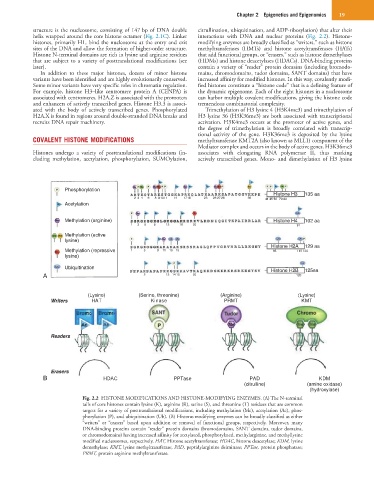
            helix wrapped around the core histone octamer (Fig. 2.1C). Linker   interactions  with  DNA  and  nuclear  proteins  (Fig.  2.2).  Histone-
            histones, primarily H1, bind the nucleosome at the entry and exit   modifying enzymes are broadly classified as “writers,” such as histone
            sites of the DNA and allow the formation of higher-order structure.   methyltransferases  (HMTs)  and  histone  acetyltransferases  (HATs)
            Histone N-terminal domains are rich in lysine and arginine residues   that add functional groups, or “erasers,” such as histone demethylases
            that are subject to a variety of posttranslational modifications (see   (HDMs) and histone deacetylases (HDACs). DNA-binding proteins
            later).                                               contain a variety of “reader” protein domains (including bromodo-
              In  addition  to  these  major  histones,  dozens  of  minor  histone   mains, chromodomains, tudor domains, SANT domains) that have
            variants have been identified and are highly evolutionarily conserved.   increased affinity for modified histones. In this way, covalently modi-
            Some minor variants have very specific roles in chromatin regulation.   fied histones constitute a “histone code” that is a defining feature of
            For  example,  histone  H3–like  centromere  protein  A  (CENPA)  is   the dynamic epigenome. Each of the eight histones in a nucleosome
            associated with centromeres. H2A.Z is associated with the promoters   can harbor multiple covalent modifications, giving the histone code
            and enhancers of actively transcribed genes. Histone H3.3 is associ-  tremendous combinatorial complexity.
            ated  with  the  body  of  actively  transcribed  genes.  Phosphorylated   Trimethylation of H3 lysine 4 (H3K4me3) and trimethylation of
            H2A.X is found in regions around double-stranded DNA breaks and   H3 lysine 36 (H3K36me3) are both associated with transcriptional
            recruits DNA repair machinery.                        activation. H3K4me3 occurs at the promoter of active genes, and
                                                                  the  degree  of  trimethylation  is  broadly  correlated  with  transcrip-
                                                                  tional  activity  of  the  gene.  H3K36me3  is  deposited  by  the  lysine
            COVALENT HISTONE MODIFICATIONS                        methyltransferase KMT2A (also known as MLL1) component of the
                                                                  Mediator complex and occurs in the body of active genes. H3K36me3
            Histones  undergo  a  variety  of  posttranslational  modifications  (in-  associates  with  elongating  RNA  polymerase  II,  thus  marking
            cluding  methylation,  acetylation,  phosphorylation,  SUMOylation,   actively transcribed genes. Mono- and dimethylation of H3 lysine


                      Phosphorylation
                                                                                          Histone H3  135 aa
                                             2  3 4  6  8 9 10 11  14  1718  23  26 27 28  36  41 45 56  79 80
                      Acetylation

                      Methylation (arginine)                                              Histone H4  102 aa
                                            1  3  5  8  12  16  20                                91
                      Methylation (active
                      lysine)
                                                                                          Histone H2A  129 aa
                      Methylation (repressive  1  5  9  11  13  15                        63      119 120
                      lysine)
                      Ubiquitination                                                      Histone H2B  125aa
               A                                5      12 14 15  20                               120


                              (Lysine)        (Serine, threonine)        (Arginine)                (Lysine)
                  Writers      HAT                Kinase                  PRMT                      KMT


                  Readers


                  Erasers
               B                   HDAC                   PPTase                   PAD                   KDM
                                                                                 (citrulline)        (amine oxidase)
                                                                                                      (hydroxylase)
                            Fig. 2.2  HISTONE MODIFICATIONS AND HISTONE-MODIFYING ENZYMES. (A) The N-terminal
                            tails of core histones contain lysine (K), arginine (R), serine (S), and threonine (T) residues that are common
                            targets for a variety of posttranslational modifications, including methylation (Me), acetylation (Ac), phos-
                            phorylation (P), and ubiquitination (Ub). (B) Histone-modifying enzymes can be broadly classified as either
                            “writers”  or  “erasers”  based  upon  addition  or  removal  of  functional  groups,  respectively.  Moreover,  many
                            DNA-binding proteins contain “reader” protein domains (bromodomains, SANT domains, tudor domains,
                            or chromodomains) having increased affinity for acetylated, phosphorylated, methylarginine, and methyllysine
                            modified nucleosomes, respectively. HAT, Histone acetyltransferase; HDAC, histone deacetylase; KDM, lysine
                            demethylase; KMT, lysine methyltransferase; PAD, peptidylarginine deiminase; PPTase, protein phosphatase;
                            PRMT, protein arginine methyltransferase.

