


Page 46 - Hematology_ Basic Principles and Practice ( PDFDrive )
P. 46
18    Part I  Molecular and Cellular Basis of Hematology


                           H3K4me1
                            H3K27ac     H3K4me3      H3K36me3       CTCF       H3K27me3            H3K9me3
                             p300


                         Enhancer      Promoter      Gene         Insulator     Gene cluster       Repeats
                                                  Euchromatin                    Facultative     Constitutive
                       A                                                       heterochromatin  heterochromatin


                                Nucleosomes
                Length: 2 m                      DNA    11 nm


                             Histone modifications
                                 Histone H1


                                                        30 nm


                             Domain organization
                                                                    C


                                                        300-700 nm
                                                                                    Enhancer


                             Mitotic condensation                                                       eRNA
                                                                            Cohesin
                                                                                                        mRNA
            Length: <10 µm                              1.5 µm
                                                                    D             Gene promoter
                       B        Chromosome
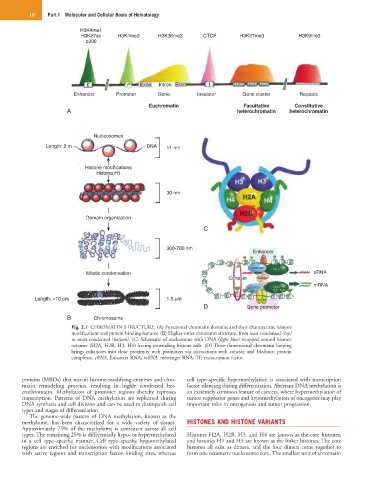
                        Fig. 2.1  CHROMATIN STRUCTURE. (A) Functional chromatin domains and their characteristic histone
                        modifications and protein-binding features. (B) Higher-order chromatin structure, from least condensed (top)
                        to most condensed (bottom). (C) Schematic of nucleosome with DNA (light blue) wrapped around histone
                        octamer (H2A, H2B, H3, H4) having protruding histone tails. (D) Three-dimensional chromatin looping
                        brings enhancers into close proximity with promoters via interactions with cohesin and Mediator protein
                        complexes. eRNA, Enhancer RNA; mRNA, messenger RNA; TF, transcription factor.


        proteins (MBDs) that recruit histone-modifying enzymes and chro-  cell type–specific hypermethylation is associated with transcription
        matin  remodeling  proteins,  resulting  in  highly  condensed  het-  factor silencing during differentiation. Aberrant DNA methylation is
        erochromatin.  Methylation  of  promoter  regions  thereby  represses   an extremely common feature of cancers, where hypermethylation of
        transcription.  Patterns  of  DNA  methylation  are  replicated  during   tumor suppressor genes and hypomethylation of oncogenes may play
        DNA synthesis and cell division and can be used to distinguish cell   important roles in oncogenesis and tumor progression.
        types and stages of differentiation.
           The  genome-wide  pattern  of  DNA  methylation,  known  as  the
        methylome,  has  been  characterized  for  a  wide  variety  of  tissues.   HISTONES AND HISTONE VARIANTS
        Approximately  75%  of  the  methylome  is  consistent  across  all  cell
        types. The remaining 25% is differentially hypo- or hypermethylated   Histones H2A, H2B, H3, and H4 are known as the core histones,
        in  a  cell  type–specific  manner.  Cell  type–specific  hypomethylated   and histones H1 and H5 are known as the linker histones. The core
        regions are enriched for nucleosomes with modifications associated   histones all exist as dimers, and the four dimers come together to
        with  active  regions  and  transcription  factor–binding  sites,  whereas   form one octameric nucleosome core. The smallest unit of chromatin

