


Page 50 - Hematology_ Basic Principles and Practice ( PDFDrive )
P. 50
22    Part I  Molecular and Cellular Basis of Hematology


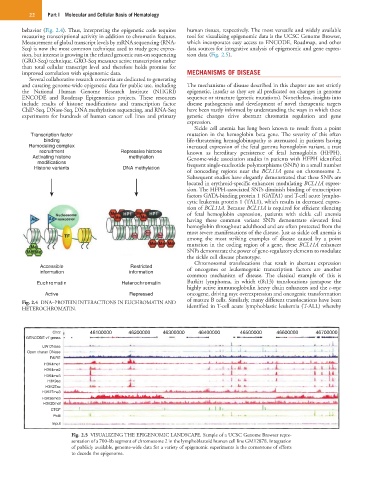
        behavior (Fig. 2.4). Thus, interpreting the epigenetic code requires   human tissues, respectively. The most versatile and widely available
        measuring transcriptional activity in addition to chromatin features.   tool for visualizing epigenomic data is the UCSC Genome Browser,
        Measurement of global transcript levels by mRNA sequencing (RNA-  which incorporates easy access to ENCODE, Roadmap, and other
        Seq) is now the most common technique used to study gene expres-  data sources for integrative analysis of epigenomic and gene expres-
        sion, but interest is growing in the related genomic run-on sequencing   sion data (Fig. 2.5).
        (GRO-Seq) technique. GRO-Seq measures active transcription rather
        than  total  cellular  transcript  level  and  therefore  holds  promise  for
        improved correlation with epigenomic data.            MECHANISMS OF DISEASE
           Several collaborative research consortia are dedicated to generating
        and curating genome-wide epigenetic data for public use, including   The mechanisms of disease described in this chapter are not strictly
        the  National  Human  Genome  Research  Institute  (NHGRI)   epigenetic, insofar as they are all predicated on changes in genome
        ENCODE  and  Roadmap  Epigenomics  projects.  These  resources   sequence or structure (genetic mutations). Nonetheless, insights into
        include  results  of  histone  modifications  and  transcription  factor   disease  pathogenesis  and  development  of  novel  therapeutic  targets
        ChIP-Seq, DNase-Seq, DNA methylation sequencing, and RNA-Seq   have been vastly informed by understanding the ways in which these
        experiments  for  hundreds  of  human  cancer  cell  lines  and  primary   genetic  changes  drive  aberrant  chromatin  regulation  and  gene
                                                              expression.
                                                                 Sickle cell anemia has long been known to result from a point
           Transcription factor                               mutation  in  the  hemoglobin  beta  gene. The  severity  of  this  often
               binding                                        life-threatening hemoglobinopathy is attenuated in patients having
          Remodeling complex                                  increased expression of the fetal gamma hemoglobin variant, a trait
              recruitment               Repressive histone    known  as  hereditary  persistence  of  fetal  hemoglobin  (HFPH).
            Activating histone             methylation        Genome-wide association studies in patients with HFPH identified
             modifications                                    frequent single-nucleotide polymorphisms (SNPs) in a small number
            Histone variants             DNA methylation
                                                              of  noncoding  regions  near  the  BCL11A  gene  on  chromosome  2.
                                                              Subsequent studies have elegantly demonstrated that these SNPs are
                                                              located in erythroid-specific enhancers modulating BCL11A expres-
                                                              sion. The HFPH-associated SNPs diminish binding of transcription
                                                              factors GATA-binding protein 1 (GATA1) and T-cell acute lympho-
                                                              cytic leukemia protein 1 (TAL1), which results in decreased expres-
                                                              sion of BCL11A. Because BCL11A is required for efficient silencing
                                                              of  fetal  hemoglobin  expression,  patients  with  sickle  cell  anemia
                                                              having  these  common  variant  SNPs  demonstrate  elevated  fetal
                                                              hemoglobin throughout adulthood and are often protected from the
                                                              most severe manifestations of the disease. Just as sickle cell anemia is
                                                              among  the  most  striking  examples  of  disease  caused  by  a  point
                                                              mutation in the coding region of a gene, these BCL11A enhancer
                                                              SNPs demonstrate the power of gene-regulatory elements to modulate
                                                              the sickle cell disease phenotype.
                                                                 Chromosomal  translocations  that  result  in  aberrant  expression
              Accessible                    Restricted        of  oncogenes  or  leukemogenic  transcription  factors  are  another
              information                  information
                                                              common  mechanism  of  disease.  The  classical  example  of  this  is
             Euchromatin                 Heterochromatin      Burkitt  lymphoma,  in  which  t(8;13)  translocations  juxtapose  the
                                                              highly active immunoglobulin heavy chain enhancers and the c-myc
                Active                     Repressed          oncogene, driving myc overexpression and oncogenic transformation
                                                              of mature B cells. Similarly, many different translocations have been
        Fig. 2.4  DNA–PROTEIN INTERACTIONS IN EUCHROMATIN AND   identified in T-cell acute lymphoblastic leukemia (T-ALL) whereby
        HETEROCHROMATIN.


                  Chr2        46100000     46200000   46300000    46400000      46500000   46600000     46700000
          GENCODE v7 genes
               UW DNase
          Open charan DNase
                 FAIRE
                H3K4me1
                H3K4me2
                H3K4me3
                 H3K9ac
                H3K27ac
               H3K27me3
               H3K36me3
               H3K20mef
                  CTCF
                  PolII
                  Input
                        Fig. 2.5  VISUALIZING THE EPIGENOMIC LANDSCAPE. Sample of a UCSC Genome Browser repre-
                        sentation of a 700-kb segment of chromosome 2 in the lymphoblastoid human cell line GM12878. Integration
                        of publicly available, genome-wide data for a variety of epigenomic experiments is the cornerstone of efforts
                        to decode the epigenome.

