


Page 483 - Hematology_ Basic Principles and Practice ( PDFDrive )
P. 483
404    Part IV  Disorders of Hematopoietic Cell Development


        diagnosis.  Patients  with  severe  liver  disease  and  splenomegaly,  sys-  specimen should be at least 1 cm long. There should no hesitation
        temic  lupus  erythematosus,  or  overwhelming  sepsis  can  have  low   in performing a second procedure if required.
        blood cell counts, but the clinical presentation is not subtle. Similarly,   BM cellularity is best estimated from the core biopsy. Point count-
        BM aplasia following cytotoxic drug therapy for cancers and a variety   ing under microscopic cross hairs in many parts of a histologic section
        of  nonmalignant  diseases  is  anticipated.  In  the  challenging  case,   is the most accurate method of determining cellularity, but hematolo-
        obvious  medical  causes  of  pancytopenia  have  usually  already  been   gists  commonly  rely  on  visual  estimation  only.  A  crude  “eyeball”
        excluded. Pancytopenia almost never results from peripheral blood   approximation is almost always adequate in severe aplasia, because
        cell destruction alone. In AA, the blood smear does not show reticu-  the hematopoietic content of the BM specimen is usually close to
        locytes, band forms, or the large platelets typical of increased com-  zero. Estimates of BM cellularity based on examination of the aspirate
        pensatory BM efforts.                                 smear and biopsy specimen are correlated, but dilution of the aspirate
           Acquired AA is a disease of the young, as is constitutional aplasia.   by sinusoidal blood often occurs, and the aspirate can be hypocellular
        Patients with FA often, but not always, have physical abnormalities.   when the biopsy specimen is hypercellular or can show focal areas of
        In  the  absence  of  a  suggestive  family  history  or  the  presence  of   active hematopoiesis. Normal BM cellularity decreases considerably
        physical anomalies, the distinction between acquired and constitu-  with age, a variation that is of some importance in assessing the older
        tional disease depends on the results of a clastogenic-stress culture of   patient  with  aplasia  or  myelodysplasia.  In  autopsy  samples  from
        peripheral lymphocytes (for FA) and telomere length of leukocytes   normal, young children, approximately 80% of the BM space of the
        (for DKC and the telomeropathies).                    iliac crest is cellular. BM cellularity gradually decreases from age 20
           In older patients the major differential diagnosis is between AA   to 70 years and more precipitously in the very elderly, to approxi-
        and myelodysplasia. There is a gray area between hypocellular myelo-  mately 30% in the eighth decade of life. For practical purposes, the
        dysplasia and moderate AA, and even competent hematologists might   lower limit of normal BM cellularity in adults is accepted at approxi-
        not agree on the final diagnosis. BM cytogenetics can help in estab-  mately  30%,  but  the  differences  at  the  extremes  of  life  should  be
        lishing the proper diagnosis.                         recalled when evaluating infants and the elderly. In most patients with
           Myelofibrosis can also produce pancytopenia, but the BM is not   AA, total BM cellularity is extremely low, but there can be significant
        aspirable, the spleen is often enlarged, and the peripheral blood smear   residual lymphocytosis. The increase in BM fat in aplasia is caused
        shows characteristic abnormalities. Acute leukemia in children and   by  increases  in  the  size  and  number  of  individual  fat  cells.  “Hot
        the elderly can manifest as BM hypocellularity, requiring a careful   pockets” of hematopoiesis can be present. The BM tends to contract
        search for lymphoblasts or myeloblasts, including phenotypic analysis   centripetally  with  age,  and  a  similar  process  can  be  observed  in
        by flow cytometry. Blood flow cytometry for glycophosphoinositol-  pathologic states, so the sternal BM can be more cellular than iliac
        anchored  proteins  should  be  performed  to  diagnose  PNH  (see   crest samples.
        Chapter 31).                                             Examination of the BM (Fig. 30.9, and see also Figs. 30.1 and
           The patient’s history can provide clues, such as benzene exposure   30.8) is basic for the diagnosis of most primary hematologic causes
        for myelodysplasia and acute leukemia or a suspicious drug history   of pancytopenia (see Table 30.1 and box on Diagnostic Algorithm
        for AA. Discontinuation of exposure to the incriminated drugs or   in Aplastic Anemia). A fatty, even watery specimen can usually be
        chemicals is mandatory, and in some instances, patients may then   aspirated without difficulty from an aplastic patient, whereas a truly
        recover. However, given the difficulty of assigning blame with abso-  dry tap is more typical of a packed or fibrotic BM. The morphol-
        lute certainty to environmental agents, we treat all patients similarly   ogy  of  individual  cells  is  best  seen  in  the  Wright-Giemsa–stained
        and do not advocate protracted observation for possible spontaneous   aspirate  smear,  and  the  architecture  of  the  BM  is  appreciated  in
        recovery. For patients with severe disease (see Table 30.6), suitable   a  biopsy  section.  In  acellular  specimens,  the  only  cells  visible  are
        and  early  preparation  for  BM  transplant  should  be  undertaken  or   usually  lymphocytes,  plasma  cells,  and  stromal  elements  (fibro-
        immunosuppression begun, whereas for those with moderate disease,   blastoid  and  histiocytic  cells).  Some  degree  of  dyserythropoiesis  is
        the clinical status should be evaluated, and serial blood cell counts   common,  usually  the  megaloblastoid  features  of  macrocytosis  and
        are required to assess progression of the disease.    some  nuclear-cytoplasmic  maturation  asynchrony,  but  sometimes
                                                              more  complex  degenerative  changes  in  nuclei  and  cytoplasm  can
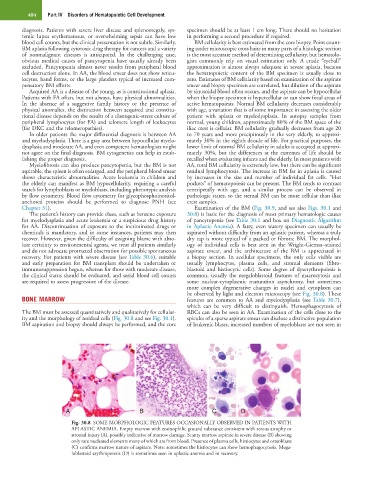
                                                              be observed by light and electron microscopy (see Fig. 30.8). These
        BONE MARROW                                           features  are  common  to  AA  and  myelodysplasia  (see Table  30.7),
                                                              which  can  be  very  difficult  to  distinguish.  Hemophagocytosis  of
        The BM must be assessed quantitatively and qualitatively for cellular-  RBCs can also be seen in AA. Examination of the cells close to the
        ity and the morphology of residual cells (Fig. 30.8 and see Fig. 30.1).   spicules of a sparse aspirate smear can disclose a distinctive population
        BM aspiration and biopsy should always be performed, and the core   of leukemic blasts; increased numbers of myeloblasts are not seen in


                       A                       B                      C         D

                        Fig. 30.8  SOME MORPHOLOGIC FEATURES OCCASIONALLY OBSERVED IN PATIENTS WITH
                        APLASTIC ANEMIA. Empty marrow with eosinophilic ground substance consistent with serous atrophy or
                        stromal injury (A), possibly indicative of marrow damage. Scanty marrow aspirate in severe disease (B) showing
                        only rare nucleated elements many of which are from blood. Presence of plasma cells, histiocytes and osteoblasts
                        (C) confirms marrow nature of aspirate. Note: sometimes the histiocytes can show hemophagocytosis. Mega-
                        loblastoid erythropoiesis (D) is sometimes seen in aplastic anemia and in recovery.

