


Page 506 - Hematology_ Basic Principles and Practice ( PDFDrive )
P. 506
426    Part IV  Disorders of Hematopoietic Cell Development


          TABLE   Classification of Pure Red Cell Aplasia           Autoantibodies
          32.1                                                                             Cytokine inhibition
         Congenital (DBA)                                                                        FasL
         Primary      Autoimmune                                                                 IFN, TNF
                      Idiopathic
         Secondary    Thymoma 1–5       CLL 6,7
                      Hematologic       T-LGL/chronic NK-LGL
                        malignancies      leukemia 8–15
                                                                Erythroid
                                        Myeloma 16            progenitors
                                        NHL 17,18                                             TCR  Direct cytotoxicity
                                        MDS 19
                                        ALL 20–22                PRCA                     Myeloid progenitors
                      Solid tumors      Renal cell carcinoma 23                           granulocytes
                                        Thyroid cancer 24
                                        Various                                               AIN
                                          adenocarcinomas 25,26
                      Infections        Parvovirus B19 27
                                            28
                                        EBV,  mumps
                                           29
                                        HIV,  HTLV-1 12
                                        CMV 30
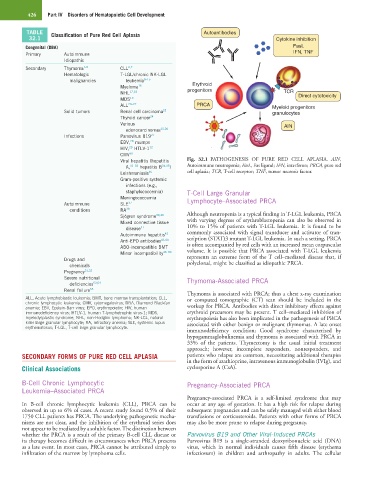
                                        Viral hepatitis (hepatitis   Fig.  32.1  PATHOGENESIS  OF  PURE  RED  CELL  APLASIA.  AIN,
                                          A, 31–33  hepatitis B 34,35 )  Autoimmune neutropenia; FasL, Fas ligand; IFN, interferon; PRCA, pure red
                                        Leishmaniasis 36      cell aplasia; TCR, T-cell receptor; TNF, tumor necrosis factor.
                                        Gram-positive systemic
                                          infections (e.g.,
                                          staphylococcemia)   T-Cell Large Granular
                                        Meningococcemia
                      Autoimmune        SLE 37                Lymphocyte–Associated PRCA
                        conditions      RA 38
                                        Sjögren syndrome 39,40  Although neutropenia is a typical finding in T-LGL leukemia, PRCA
                                        Mixed connective tissue   with varying degrees of erythroblastopenia can also be observed in
                                          disease 41          10%  to  15%  of  patients  with T-LGL  leukemia.  It  is  found  to  be
                                        Autoimmune hepatitis 42  commonly associated with signal transducer and activator of tran-
                                        Anti-EPO antibodies 43,44  scription (STAT)3 mutant T-LGL leukemia. In such a setting, PRCA
                                        ABO-incompatible BMT  is often accompanied by red cells with an increased mean corpuscular
                                        Minor incompatibility 45–50  volume. It is possible that PRCA associated with T-LGL leukemia
                      Drugs and                               represents an extreme form of the T cell–mediated disease that, if
                                                              polyclonal, might be classified as idiopathic PRCA.
                        chemicals
                      Pregnancy 51,52
                      Severe nutritional                      Thymoma-Associated PRCA
                        deficiencies 53,54
                      Renal failure 55
                                                              Thymoma is associated with PRCA; thus a chest x-ray examination
         ALL, Acute lymphoblastic leukemia; BMT, bone marrow transplantation; CLL,   or  computed  tomographic  (CT)  scan  should  be  included  in  the
         chronic lymphocytic leukemia; CMV, cytomegalovirus; DBA, Diamond-Blackfan   workup for PRCA. Antibodies with direct inhibitory effects against
         anemia; EBV, Epstein-Barr virus; EPO, erythropoietin; HIV, human
         immunodeficiency virus; HTLV-1, human T-lymphotrophic virus-1; MDS,   erythroid precursors may be present. T cell–mediated inhibition of
         myelodysplastic syndrome; NHL, non-Hodgkin lymphoma; NK-LGL, natural   erythropoiesis has also been implicated in the pathogenesis of PRCA
         killer large granular lymphocyte; RA, refractory anemia; SLE, systemic lupus   associated with either benign or malignant thymomas. A late onset
         erythematosus; T-LGL, T-cell large granular lymphocyte.
                                                              immunodeficiency  condition;  Good  syndrome  characterized  by
                                                              hypogammaglobulinemia and thymoma is associated with PRCA in
                                                              33%  of  the  patients.  Thymectomy  is  the  usual  initial  treatment
                                                              approach;  however,  incomplete  responders,  nonresponders,  and
        SECONDARY FORMS OF PURE RED CELL APLASIA              patients who relapse are common, necessitating additional therapies
                                                              in the form of azathioprine, intravenous immunoglobulin (IVIg), and
        Clinical Associations                                 cyclosporine A (CsA).

        B-Cell Chronic Lymphocytic                            Pregnancy-Associated PRCA
        Leukemia–Associated PRCA
                                                              Pregnancy-associated  PRCA  is  a  self-limited  syndrome  that  may
        In  B-cell  chronic  lymphocytic  leukemia  (CLL),  PRCA  can  be   occur at any age of gestation. It has a high risk for relapse during
        observed in up to 6% of cases. A recent study found 0.5% of their   subsequent pregnancies and can be safely managed with either blood
        1750 CLL patients has PRCA. The underlying pathogenetic mecha-  transfusions or corticosteroids. Patients with other forms of PRCA
        nisms are not clear, and the inhibition of the erythroid series does   may also be more prone to relapse during pregnancy.
        not appear to be mediated by a soluble factor. The distinction between
        whether the PRCA is a result of the primary B-cell CLL disease or   Parvovirus B19 and Other Viral-Induced PRCAs
        its therapy becomes difficult in circumstances when PRCA presents   Parvovirus  B19  is  a  single-stranded  deoxyribonucleic  acid  (DNA)
        as a late event. In most cases, PRCA cannot be attributed simply to   virus,  which  in  normal  individuals  causes  fifth  disease  (erythema
        infiltration of the marrow by lymphoma cells.         infectiosum)  in  children  and  arthropathy  in  adults.  The  cellular

