


Page 507 - Hematology_ Basic Principles and Practice ( PDFDrive )
P. 507
Chapter 32  Acquired Disorders of Red Cell, White Cell, and Platelet Production  427


            receptor for the virus is the P antigen, a blood group antigen also   pathogenesis  of  the  PRCA  in  this  setting  may  vary  and  includes
                                                                                                   66
            responsible for the agglutination reaction that occurs in the presence   autoantibody-mediated erythroid inhibition,  autoantibody directed
                                                                                   67
            of  the  virus.  Detection  of  parvovirus  B19–specific  IgM  without   against  erythropoietin,   and  CTL-mediated  killing  of  erythroid
            antiparvovirus B19 IgG, supports the diagnosis of acute infection,   precursors. 64
            whereas the parvovirus B19–specific IgG suggests immunity. Addi-
            tion of parvovirus B19 in vitro to cultures of erythroid progenitor
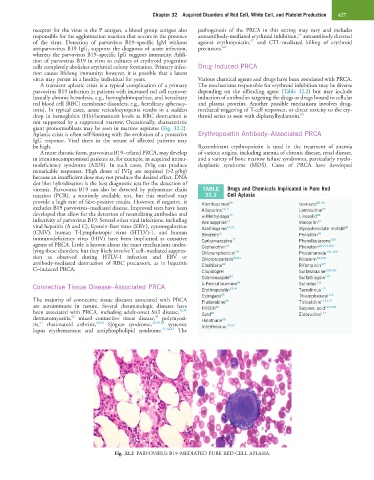
            cells completely abolishes erythroid colony formation. Primary infec-  Drug-Induced PRCA
            tion causes lifelong immunity; however, it is possible that a latent
            virus may persist in a healthy individual for years.  Various chemical agents and drugs have been associated with PRCA.
              A transient aplastic crisis is a typical complication of a primary   The mechanisms responsible for erythroid inhibition may be diverse
            parvovirus B19 infection in patients with increased red cell turnover   depending  on  the  offending  agent  (Table  32.2)  but  may  include
            (usually chronic hemolysis, e.g., hemoglobinopathies, and hereditary   induction of antibodies targeting the drugs or drugs bound to cellular
            red blood cell [RBC] membrane disorders, e.g., hereditary spherocy-  and  plasma  proteins.  Another  possible  mechanism  involves  drug-
            tosis).  In  typical  cases,  acute  reticulocytopenia  results  in  a  sudden   mediated triggering of T-cell responses, or direct toxicity to the ery-
            drop in hemoglobin (Hb)/hematocrit levels as RBC destruction is   throid series as seen with diphenylhydantoin. 68
            not supported by a suppressed marrow. Occasionally, characteristic
            giant pronormoblasts may be seen in marrow aspirates (Fig. 32.2).
            Aplastic crisis is often self-limiting with the evolution of a protective   Erythropoietin Antibody–Associated PRCA
            IgG  response.  Viral  titers  in  the  serum  of  affected  patients  may
            be high.                                              Recombinant  erythropoietin  is  used  in  the  treatment  of  anemia
              A more chronic form, parvovirus B19–related PRCA, may develop   of various origins, including anemia of chronic disease, renal disease,
            in immunocompromised patients as, for example, in acquired immu-  and a variety of bone marrow failure syndromes, particularly myelo-
            nodeficiency  syndrome  (AIDS).  In  such  cases,  IVIg  can  produce   dysplastic  syndrome  (MDS).  Cases  of  PRCA  have  developed
            remarkable  responses.  High  doses  of  IVIg  are  required  (>2 g/kg)
            because an insufficient dose may not produce the desired effect. DNA
            dot blot hybridization is the best diagnostic test for the detection of
            viremia. Parvovirus B19 can also be detected by polymerase chain   TABLE   Drugs and Chemicals Implicated in Pure Red
            reaction  (PCR),  a  routinely  available  test,  but  this  method  may   32.2   Cell Aplasia
            provide a high rate of false-positive results. However, if negative, it   Alemtuzumab 69  Isoniazid 92–94
            excludes B19 parvovirus–mediated disease. Improved tests have been   Allopurino 70,71  Lamivudine 95
            developed that allow for the detection of neutralizing antibodies and   α-Methyldopa 72  Linezolid 96
            infectivity of parvovirus B19. Several other viral infections, including   Aminopyrine 73  Maloprim 97
            viral hepatitis (A and C), Epstein-Barr virus (EBV), cytomegalovirus   Azathioprine 74,75  Mycophenolate mofetil 98
            (CMV),  human  T-Lymphotropic  virus  (HTLV)-1,  and  human   Benzene 76               Penicillin 99
            immunodeficiency  virus  (HIV)  have  been  implicated  as  causative   Carbamazepine 77  Phenylbutazone 100
            agents of PRCA. Little is known about the exact mechanisms under-  Cephalothin 78      Phenytoin 68,101,102
            lying these disorders, but they likely involve T cell–mediated suppres-  Chloramphenicol 79  Procainamide 103–105
            sion  as  observed  during  HTLV-1  infection  and  EBV  or   Chlorpropamide 80,81     Ribavirin 98,106
            antibody-mediated  destruction  of  RBC  precursors,  as  in  hepatitis   Cladribine 82  Rifampicin 107
            C–induced PRCA.                                        Clopidogrel                     Sulfasalazine 108,109
                                                                   Cotrimoxazole 83                Sulfathiozole 110
            Connective Tissue Disease–Associated PRCA              D-Penicillinamine 84            Sulindac 111 112
                                                                   Erythropoietin
                                                                                                   Tacrolimus
                                                                            43,44
                                                                   Estrogens 85                    Thiamphenicol 113
            The  majority  of  connective  tissue  diseases  associated  with  PRCA   Fludarabine 86  Ticlopidine 114,115
            are  autoimmune  in  nature.  Several  rheumatologic  diseases  have   FK506 87        Valproic acid 116,106
            been associated with PRCA, including adult-onset Still disease, 58,59    Gold 88       Zidovudine 117
                        60
                                                    41
            dermatomyositis,   mixed  connective  tissue  disease,   polymyosi-  Halothane 89
              61
            tis,   rheumatoid  arthritis, 38,62   Sjögren  syndrome, 39,40,63   systemic   Interferon-α  90,91
            lupus  erythematosus  and  antiphospholipid  syndrome. 37,64,65   The


                                       Fig. 32.2  PARVOVIRUS B19–MEDIATED PURE RED CELL APLASIA.

