


Page 535 - Hematology_ Basic Principles and Practice ( PDFDrive )
P. 535
450    Part V  Red Blood Cells


                                          ALA  PRO                       Tyr HC2
                                     LYS
             C-Terminus      ASN  ALA  GLN  ALA  PRO
                        HIS ALA  ALA GLY   GLN  THR
                      LYS    ALA   VAL VAL  TYR  VAL  PHE                              FG2           Val E11
                HIS TYR         VAL
                           LEU                                               F9
                              140   H   130         GLU                                          CD2
                                                 120  LYS
                                                                                          C7
                                     G        ALA   GLY                              C3   M P  CDI
                                      ASN  CYS  HIS                                  F8
                                          VAL       PHE        H16             G1            C5
                              GLU ARG LEU  VAL  VAL LEU  HIS                                          CD7
                           100        GLY                                           V
                              PROASN  LEU  LEU                                                  E7
                                  PHE                                              M
                             ASP          110                               F1        C1                  E1
                                                                                 G5                    D1
                              VAL  HIS                                                                        D7
             VAL  N – Terminus       LEU LYS ASP                                   V
                                      F  90                                          M
                                   ALA
             HIS                        GLU  CYS                                                      E5
                                     THR SER
                             GLY THR PHE  LEU HIS
             LEU           LYS
                                     LEU
           THR           LEU                   Proximal to Heme
         GLU  PRO     80  ASN           HEME                    EF3          EF1             G15  B5
         GLU  LYS        ASP                                   NA1
            SER                     E                             +
         ALA   A           LEU HIS  GLY  70                    NH 3              E20              A16  B1
           VAL                 ALA  ASP       Distal to Heme
             THR                      ALA                       NA2
          ALA                  LEU  PHE                              H5                         G19
        LEU  TRP                  SER  GLY  LYS                                                      AB1
            GLY                         VAL  HIS
         LYS                         LEU  LYS
          VAL  20      Close Spatial Contact  GLY  ALA  LYS       A1
            VALASP  GLY                     LYS VAL                        H1
                      LEU  LEU                  PRO
           ASN  VAL  GLY  ALA  LEU            60                                    GH4
              GLU     GLY   VAL                 ASN
                   GLU  ARG   TYR  TRP  C         GLY
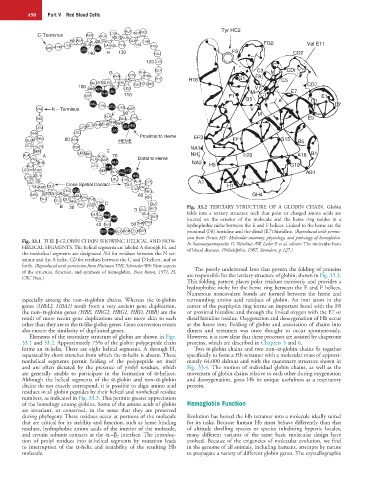
                     B  30  VAL  PRO  THR         MET         Fig.  33.2  TERTIARY  STRUCTURE  OF  A  GLOBIN  CHAIN.  Globin
                                             D  VAL
                               GLN  PHE         ALA  ASP      folds  into  a  tertiary  structure  such  that  polar  or  charged  amino  acids  are
                                ARG  PHE                      located  on  the  exterior  of  the  molecule  and  the  heme  ring  resides  in  a
                                40  GLU     50 THR  PRO       hydrophobic niche between the E and F helices. Linked to the heme are the
                                  SER PHE GLY  ASP LEU SER    proximal (F8) histidine and the distal (E7) histidine. (Reproduced with permis-
                                                              sion from Perutz MF: Molecular anatomy, physiology, and pathology of hemoglobin.
        Fig. 33.1  THE β-GLOBIN CHAIN SHOWING HELICAL AND NON-  In Stamatoyannopoulos G, Neinhuis AW, Leder P, et al, editors: The molecular basis
        HELICAL SEGMENTS. The helical segments are labeled A through H, and   of blood diseases. Philadelphia, 1987, Saunders, p 127.)
        the nonhelical segments are designated NA for residues between the N ter-
        minus and the A helix, CD for residues between the C and D helices, and so
        forth. (Reproduced with permission from Huisman THJ, Schroeder WA: New aspects   The poorly understood laws that govern the folding of proteins
        of the structure, function, and synthesis of hemoglobin. Boca Raton, 1971, Fl,   are responsible for the tertiary structure of globin, shown in Fig. 33.3.
        CRC Press.)
                                                              This folding pattern places polar residues exteriorly and provides a
                                                              hydrophobic niche for the heme ring between the E and F helices.
                                                              Numerous  noncovalent  bonds  are  formed  between  the  heme  and
        especially  among  the  non–α-globin  chains.  Whereas  the  α-globin   surrounding  amino  acid  residues  of  globin.  An  iron  atom  in  the
        genes (HBA2, HBA1) result from a very ancient gene duplication,   center of the porphyrin ring forms an important bond with the F8
        the non–α-globin genes (HBE, HBG2, HBG1, HBD, HBB) are the   or proximal histidine and through the linked oxygen with the E7 or
        result of more recent gene duplications and are more akin to each   distal histidine residue. Oxygenation and deoxygenation of Hb occur
        other than they are to the α-like globin genes. Gene conversion events   at the heme iron. Folding of globin and association of chains into
        also ensure the similarity of duplicated genes.       dimers  and  tetramers  was  once  thought  to  occur  spontaneously.
           Elements of the secondary structure of globin are shown in Figs.   However, it is now clear that these processes are assisted by chaperone
        33.1 and 33.2. Approximately 75% of the globin polypeptide chain   proteins, which are described in Chapters 5 and 6.
        forms  an  α-helix. There  are  eight  helical  segments,  A  through  H,   Two α-globin chains and two non–α-globin chains fit together
        separated by short stretches from which the α-helix is absent. These   specifically to form a Hb tetramer with a molecular mass of approxi-
        nonhelical  segments  permit  folding  of  the  polypeptide  on  itself   mately 64,000 daltons and with the quaternary structure shown in
        and  are  often  dictated  by  the  presence  of  prolyl  residues,  which   Fig.  33.4. The  motion  of  individual  globin  chains,  as  well  as  the
        are  generally  unable  to  participate  in  the  formation  of  α-helices.   movement of globin chains relative to each other during oxygenation
        Although  the  helical  segments  of  the  α-globin  and  non–α-globin   and deoxygenation, gives Hb its unique usefulness as a respiratory
        chains do not exactly correspond, it is possible to align amino acid   protein.
        residues in all globin peptides by their helical and nonhelical residue
        numbers, as indicated in Fig. 33.3. This permits greater appreciation
        of the homology among globins. Some of the amino acids of globin   Hemoglobin Function
        are  invariant,  or  conserved,  in  the  sense  that  they  are  preserved
        during phylogeny. These residues occur at portions of the molecule   Evolution has honed the Hb tetramer into a molecule ideally suited
        that are critical for its stability and function, such as heme binding   for its tasks. Because human Hb must behave differently than that
        residues, hydrophobic amino acids of the interior of the molecule,   of  altitude  dwelling  species  or  species  inhabiting  hypoxic  locales,
        and certain subunit contacts at the α 1–β 2 interface. The introduc-  many  different  variants  of  the  same  basic  molecular  design  have
        tion  of  prolyl  residues  into  α-helical  segments  by  mutation  leads   evolved. Because of the exigencies of molecular evolution, we find
        to  interruption  of  the  α-helix  and  instability  of  the  resulting  Hb   in the genome of all animals, including humans, attempts by nature
        molecule.                                             to propagate a variety of different globin genes. The crystallographic

