


Page 539 - Hematology_ Basic Principles and Practice ( PDFDrive )
P. 539
454    Part V  Red Blood Cells


        polymerase  complexes  that  catalyze  gene  transcription.  Mutations   The  α-globin  genes  (HBA2,  HBA1)  are  duplicated  and  their
        within the promoter can affect the level of gene transcription and the   encoded amino acid sequences are identical; therefore, only a single
        amount of globin made. Surrounding and within each gene are other   α-globin  polypeptide  results.  Minor  differences  within  the  second
        sequence  elements  that  play  important  roles  in  its  transcriptional   intervening sequence and the 3′ flanking regions of the α-globin gene
        regulation (see Fig. 33.6). These clusters, called enhancers and silencers   permit identification of transcripts from each gene. The 5′ or α 2-gene
        (see Chapter 1), may lie within introns or 5′ and 3′ to the coding   is expressed more efficiently than the 3′ or α 1-gene, so abnormalities
        sequences; in some instances, they are quite remote from the gene.   of this gene are more likely to be clinically apparent. Both clusters
        The higher order structure of DNA in chromatin may permit close   contain  genes  that  are  actively  transcribed,  as  well  as  pseudogenes
        approximation of these remote enhancers to the gene during tran-  whose defective structures prohibit expression at any time.
        scription. Enhancers play important roles in the tissue-specific regula-  The gene 3′ to the α 1-gene is the Θ-gene (HBQ1), a somewhat
        tion of globin gene expression. Representative regulatory sequences   mysterious  element  of  the  α-gene  cluster.  Although  Θ-gene  tran-
        near the globin genes are shown in Fig. 33.6 (enhancer-like element).   scripts  are  found  in  fetal  tissue  and  adult  erythroid  marrow,  it  is
        DNA elements controlling globin genes are described in more detail   unclear whether this gene’s translation product is able to participate
        later.                                                in the formation of a functional tetramer. The Θ-globin protein has
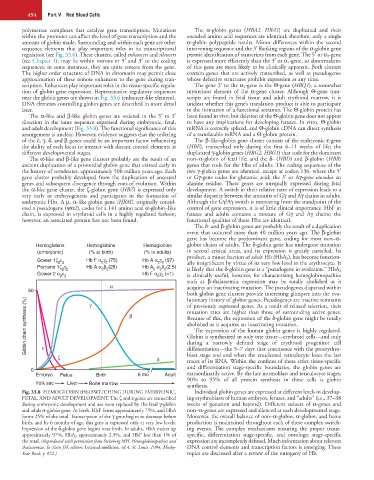
           The α-like and β-like globin genes are ordered in the 5′ to 3′   been found in vivo, but deletion of the Θ-globin gene does not appear
        direction  in  the  same  sequence  expressed  during  embryonic,  fetal,   to have any implications for developing fetuses. In vitro, Θ-globin
        and adult development (Fig. 33.8). The functional significance of this   mRNA is correctly spliced, and Θ-globin cDNA can direct synthesis
        arrangement is unclear. However, evidence suggests that the ordering   of a translatable mRNA and a Θ-globin protein.
        of the ε, γ, δ, and β genes could be an important factor influencing   The β-like–globin gene cluster consists of the embryonic ε-gene
        the ability of each locus to interact with distant control elements at   (HBE),  transcribed  only  during  the  first  6–11  weeks  of  life;  the
        different developmental stages.                       duplicated γ-globin genes (HBG2, HBG1) that code for the dominant
           The α-like and β-like gene clusters probably are the result of an   non–α-globin of fetal life; and the δ- (HBD) and β-globin (HBB)
        ancient duplication of a primordial globin gene that existed early in   genes that code for the Hbs of adults. The coding sequences of the
        the history of vertebrates, approximately 500 million years ago. Each   two γ-globin genes are identical, except at codon 136, where the 5′
        gene  cluster  probably  developed  from  the  duplication  of  ancestral   or Gγ-gene codes for glutamic acid; the 3′ or Aγ-gene encodes an
        genes and subsequent divergence through eons of evolution. Within   alanine  residue.  These  genes  are  unequally  expressed  during  fetal
        the α-like gene cluster, the ζ-globin gene (HBZ) is expressed only   development. A switch in their relative rates of expression leads to a
        very  early  in  embryogenesis  and  participates  in  the  formation  of   similar disparity between the amounts of Gγ and Aγ chains in adults.
        embryonic Hbs. A µ, α-like globin gene (HBM), originally consid-  Although the Gγ/Aγ switch is interesting from the standpoint of the
        ered a pseudogene (ψα2), codes for a 141 amino acid α-globin–like   control of gene expression, it is of little clinical importance. HbF in
        chain, is expressed in erythroid cells in a highly regulated fashion;   fetuses  and  adults  contains  a  mixture  of  Gγ  and  Aγ  chains;  the
        however, an associated protein has not been found.    functional qualities of these Hbs are identical.
                                                                 The δ- and β-globin genes are probably the result of a duplication
                                                              event that occurred more than 40 million years ago. The β-globin
                                                              gene  has  become  the  predominant  gene,  coding  for  most  non–α-
             Hemoglobins     Hemoglobins        Hemoglobins   globin chains of adults. The δ-globin gene has undergone mutation
             (embryonic)      (% at birth)      (% in adults)  in  several  critical  areas,  and  its  expression  is  greatly  curtailed.  Its
             Gower 1ζ ε      Hb F α γ  (75)     Hb A α γ  (97)  product, a minor fraction of adult Hb (HbA 2 ), has become function-
                                  2 2
                                                     2 2
                                                              ally insignificant by virtue of its very low level in the erythrocyte. It
                    2 2
             Portland 1ζ γ   Hb A α β (25)      Hb A  α δ (2.5)
                     2 2          2 2              2  2 2     is likely that the δ-globin gene is a “pseudogene in evolution.” HbA 2
             Gower 2 α ε                        Hb F α γ  (<1)
                     2 2                             2 2      is clinically useful, however, for characterizing hemoglobinopathies
                                                              such  as  β-thalassemia.  expression  may  be  totally  abolished  as  it
                                     α                        acquires an inactivating mutation. The pseudogenes dispersed within
          50
                                                              both globin gene clusters provide interesting glimpses into the evo-
                                                              lutionary history of globin genes. Pseudogenes are inactive remnants
          Globin chain synthesis (%)       β                  mutation  rates  are  higher  than  those  of  surrounding  active  genes.
                              γ
                                                              of previously expressed genes. As a result of relaxed selection, their
                                                              Because of this, the expression of the δ-globin gene might be totally
                                                              abolished as it acquires an inactivating mutation.
                                                                 The  expression  of  the  human  globin  genes  is  highly  regulated.
                                                              Globin is synthesized in only one tissue—erythroid cells—and only
               ε
                                                              differentiation—the 5–7 days that commence with the proerythro-
                                                              blast stage and end when the enucleated reticulocyte loses the last
                    ζ                               δ         during  a  narrowly  defined  stage  of  erythroid  progenitor  cell
                                                              traces of its RNA. Within the confines of these strict tissue-specific
           0                                                  and  differentiation  stage-specific  boundaries,  the  globin  genes  are
             Embryo  Fetus      Birth         6 mo     Adult  extraordinarily active. By the late normoblast and reticulocyte stages,
                                                              90%  to  95%  of  all  protein  synthesis  in  these  cells  is  globin
             Yolk sac  Liver  Bone marrow                     synthesis.
        Fig. 33.8  HEMOGLOBIN (Hb) SWITCHING DURING EMBRYONIC,   Individual globin genes are expressed at different levels in develop-
        FETAL, AND ADULT DEVELOPMENT. The ζ and ε genes are transcribed   ing erythroblasts of human embryos, fetuses, and “adults” (i.e., 37–38
        during embryonic development and are soon replaced by the fetal γ-globin   weeks  of  gestation  and  beyond).  Different  subsets  of  α-genes  and
        and adult α-globin gene. At birth, HbF forms approximately 75%, and HbA   non–α-genes are expressed and silenced at each developmental stage.
        forms 25% of the total. Transcription of the γ gene begins to decrease before   Moreover, the overall balance of non–α-globin, α-globin, and heme
        birth, and by 6 months of age, this gene is expressed only at very low levels.   production is maintained throughout each of these complex switch-
        Expression of the δ-globin gene begins near birth. In adults, HbA makes up   ing  events.  The  complex  mechanisms  ensuring  the  proper  tissue-
        approximately 97%, HbA 2  approximately 2.5%, and HbF less than 1% of   specific,  differentiation  stage-specific,  and  ontologic  stage-specific
        the total. (Reproduced with permission from Steinberg MH: Hemoglobinopathies and   expression are incompletely defined. Much information about relevant
        thalassemias. In Stein JH, editors: Internal medicine, ed 4, St. Louis, 1994, Mosby-  DNA control elements and transcription factors is emerging. These
        Year Book, p 852.)                                    topics are discussed after a review of the ontogeny of Hb.

