


Page 536 - Hematology_ Basic Principles and Practice ( PDFDrive )
P. 536
Chapter 33  Pathobiology of the Human Erythrocyte and Its Hemoglobins  451


                               Hb variants with:                  saturated).  It  therefore  has  an  extremely  high  oxygen  affinity  and
                                  oxygen affinity                 would not be useful for delivering oxygen to tissues. The oxygen in
                                 pH                               myoglobin is passed on to the mitochondria, where oxidative metabo-
             100                 BPG, PCO , or Temp               lism occurs. The sigmoidal shape of the oxygen dissociation curve of
                                        2
                                                                  Hb indicates that the totally deoxygenated Hb tetramer is slow to
                                                                  become  oxygenated,  but  as  oxygenation  proceeds,  the  reaction  of
                     Methemoglobin
                                                                  heme with oxygen accelerates. Perutz has drawn an analogy in which
                                                                  the  “appetite”  of  heme  for  oxygen  grows  with  the  “eating,”  and
              80                                                  conversely, loss of oxygen by heme lowers the oxygen affinity of the
                                             Hb variants with:    remaining heme groups. The Hill coefficient, n, which can be calcu-
                                                oxygen affinity   lated  from  plots  of  oxygen  equilibrium  curves,  is  a  description  of
                                               pH                 heme–heme  interaction  or  cooperativity  that  explains  in  part  the
                                               BPG, PCO , or Temp  oxygen-binding properties of Hb and myoglobin. The Hill coefficient
              60                                     2            for myoglobin is 1, indicating no cooperativity; n is approximately 3
             % saturation                                         for the normal human HbA molecule.
                                                                    The oxygen affinity of Hb within the erythrocyte does not depend
                                                                  solely on the intrinsic properties of the tetramer. The position of the
              40
                                                                  Hb oxygen dissociation curve, and therefore the P 50 , can be influenced
                                                                  by a number of heterotropic modifiers, including temperature, pH,
                                                                  and small organic phosphate molecules in the cell. The effects of these
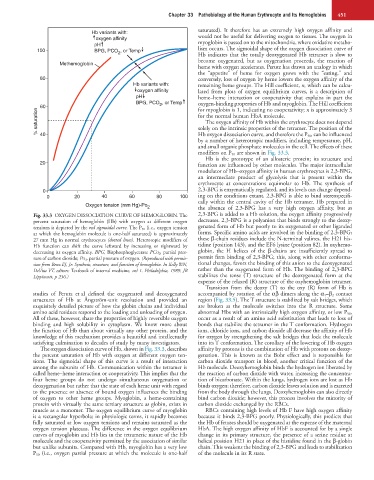
                                                                  modifiers on P 50 are shown in Fig. 33.3.
                                                                    Hb  is  the  prototype  of  an  allosteric  protein;  its  structure  and
                20                                                function are influenced by other molecules. The major intracellular
                                                                  modulator of Hb–oxygen affinity in human erythrocytes is 2,3-BPG,
                                                                  an  intermediate  product  of  glycolysis  that  is  present  within  the
                                                                  erythrocyte  at  concentrations  equimolar  to  Hb.  The  synthesis  of
               0                                                  2,3-BPG is enzymatically regulated, and its levels can change depend-
                0        20       40       60       80      100   ing on the conditions extant. 2,3-BPG is able to bind stereospecifi-
                                                                  cally within the central cavity of the Hb tetramer. Hb prepared in
                             Oxygen tension (mm Hg)-Po 2          the  absence  of  2,3-BPG  has  a  very  high  oxygen  affinity,  but  as
            Fig. 33.3  OXYGEN DISSOCIATION CURVE OF HEMOGLOBIN. The   2,3-BPG is added to a Hb solution, the oxygen affinity progressively
            percent  saturation  of  hemoglobin  (Hb)  with  oxygen  at  different  oxygen   decreases. 2,3-BPG is a polyanion that binds strongly to the deoxy-
            tensions is depicted by the red sigmoidal curve. The P 50  (i.e., oxygen tension   genated form of Hb but poorly to its oxygenated or other liganded
            at  which  the  hemoglobin  molecule  is  one-half  saturated)  is  approximately   forms. Specific amino acids are involved in the binding of 2,3-BPG;
            27 mm Hg in normal erythrocytes (dotted lines). Heterotopic modifiers of   these β-chain residues include the N-terminal valines, the H21 his-
            Hb  function  can  shift  the  curve  leftward  by  increasing  or  rightward  by   tidine (position 143), and the EF6 lysine (position 82). In oxyhemo-
            decreasing its oxygen affinity. BPG, Bisphosphoglycerate PCO 2 , partial pres-  globin,  the  H  helices  of  the  β-chains  are  insufficiently  spread  to
            sure of carbon dioxide; PO 2 , partial pressure of oxygen. (Reproduced with permis-  permit firm binding of 2,3-BPG; this, along with other conforma-
            sion from Benz EJ, Jr: Synthesis, structure, and function of hemoglobin. In Kelly WN,   tional changes, favors the binding of this anion to the deoxygenated
            DeVita VT, editors: Textbook of internal medicine, vol 1. Philadelphia, 1989, JB   rather than the oxygenated form of Hb. The binding of 2,3-BPG
            Lippincott, p 236.)                                   stabilizes  the  tense  (T)  structure  of  the  deoxygenated  form  at  the
                                                                  expense of the relaxed (R) structure of the oxyhemoglobin tetramer.
                                                                    Transition  from  the  deoxy  (T)  to  the  oxy  (R)  form  of  Hb  is
            studies  of  Perutz  et al  defined  the  oxygenated  and  deoxygenated   accompanied by rotation of the αβ dimers along the α 1 –β 2  contact
            structures  of  Hb  at  Ångström-unit  resolution  and  provided  an   region (Fig. 33.5). The T structure is stabilized by salt bridges, which
            exquisitely detailed picture of how the globin chains and individual   are  broken  as  the  molecule  switches  into  the  R  structure.  Some
            amino acid residues respond to the loading and unloading of oxygen.   abnormal Hbs with an intrinsically high oxygen affinity, or low P 50 ,
            All of these, however, share the properties of highly reversible oxygen   occur as a result of an amino acid substitution that leads to loss of
            binding  and  high  solubility  in  cytoplasm.  We  know  more  about   bonds that stabilize the tetramer in the T conformation. Hydrogen
            the function of Hb than about virtually any other protein, and the   ions, chloride ions, and carbon dioxide all decrease the affinity of Hb
            knowledge of this mechanism provides a beautiful and intellectually   for oxygen by strengthening the salt bridges that lock the molecule
            satisfying culmination to decades of study by many investigators.  into its T conformation. The corollary of the lowering of Hb oxygen
              The oxygen dissociation curve of Hb, shown in Fig. 33.3, describes   affinity by protons is the combination of Hb with protons on deoxy-
            the percent saturation of Hb with oxygen at different oxygen ten-  genation. This  is  known  as  the  Bohr  effect  and  is  responsible  for
            sions. The  sigmoidal  shape  of  this  curve  is  a  result  of  interaction   carbon dioxide transport in blood, another critical function of the
            among the subunits of Hb. Communication within the tetramer is   Hb molecule. Deoxyhemoglobin binds the hydrogen ion liberated by
            called heme–heme interaction or cooperativity. This implies that the   the reaction of carbon dioxide with water, increasing the concentra-
            four  heme  groups  do  not  undergo  simultaneous  oxygenation  or   tion of bicarbonate. Within the lungs, hydrogen ions are lost as Hb
            deoxygenation but rather that the state of each heme unit with regard   binds oxygen; therefore, carbon dioxide leaves solution and is excreted
            to the presence or absence of bound oxygen influences the binding   from the body through the lungs. Deoxyhemoglobin can also directly
            of  oxygen  to  other  heme  groups.  Myoglobin,  a  heme-containing   bind carbon dioxide; however, this process involves the minority of
            protein with virtually the same tertiary structure as globin, exists in   carbon dioxide exchanged by the RBCs.
            muscle as a monomer. The oxygen equilibrium curve of myoglobin   RBCs containing high levels of Hb F have high oxygen affinity
            is a rectangular hyperbola; in physiologic terms, it rapidly becomes   because it binds 2,3-BPG poorly. Physiologically, this predicts that
            fully saturated at low oxygen tensions and remains saturated as the   the Hb of fetuses should be oxygenated at the expense of the maternal
            oxygen tension plateaus. The difference in the oxygen equilibrium   HbA. The high oxygen affinity of HbF is accounted for by a single
            curves of myoglobin and Hb lies in the tetrameric nature of the Hb   change in its primary structure, the presence of a serine residue at
            molecule and the cooperativity permitted by the association of similar   helical position H21 in place of the histidine found in the β-globin
            but unlike subunits. Compared with Hb, myoglobin has a very low   chain. This weakens the binding of 2,3-BPG and leads to stabilization
            P 50  (i.e., oxygen partial pressure at which the molecule is one-half   of the molecule in its R state.

