


Page 537 - Hematology_ Basic Principles and Practice ( PDFDrive )
P. 537
452    Part V  Red Blood Cells


                             β 2                                β 1


                                 α 2                           α 1


                                                                   β 2                     β 1

                          A


                                                                  α 1                     α 2


                          B
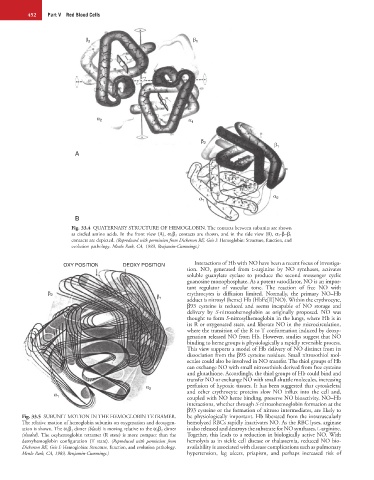
                        Fig. 33.4  QUATERNARY STRUCTURE OF HEMOGLOBIN. The contacts between subunits are shown
                        as circled amino acids. In the front view (A), α 1 β 2  contacts are shown, and in the side view (B), α 1 -β–β 1
                        contacts are depicted. (Reproduced with permission from Dickerson RE, Geis I: Hemoglobin: Structure, function, and
                        evolution pathology. Menlo Park, CA, 1983, Benjamin-Cummings.)

                      OXY POSITION       DEOXY POSITION          Interactions of Hb with NO have been a recent focus of investiga-
                                                              tion.  NO,  generated  from  L-arginine  by  NO  synthases,  activates
                                                              soluble  guanylate  cyclase  to  produce  the  second  messenger  cyclic
                                                              guanosine monophosphate. As a potent vasodilator, NO is an impor-
                                                              tant  regulator  of  vascular  tone.  The  reaction  of  free  NO  with
                 β 2                                β 1       erythrocytes  is  diffusion  limited.  Normally,  the  primary  NO–Hb
                                                              adduct is nitrosyl (heme) Hb (HbFe[II]NO). Within the erythrocyte,
                                                              β93  cysteine  is  reduced  and  seems  incapable  of  NO  storage  and
                                                              delivery  by  S-nitrosohemoglobin  as  originally  proposed.  NO  was
                                                              thought to form S-nitrosylhemoglobin in the lungs, where Hb is in
                                                              its R or oxygenated state, and liberate NO in the microcirculation,
                                                              where the transition of the R to T conformation induced by deoxy-
                                                              genation released NO from Hb. However, studies suggest that NO
                                                              binding to heme groups is physiologically a rapidly reversible process.
                                                              This view supports a model of Hb delivery of NO distinct from its
                                                              dissociation from the β93 cysteine residues. Small nitrosothiol mol-
                                                              ecules could also be involved in NO transfer. The thiol groups of Hb
                                                              can exchange NO with small nitrosothiols derived from free cysteine
                                                              and glutathione. Accordingly, the thiol groups of Hb could bind and
                                                              transfer NO or exchange NO with small shuttle molecules, increasing
                                                 α 2          perfusion of hypoxic tissues. It has been suggested that cytoskeletal
                   α 1                                        and  other  erythrocyte  proteins  slow  NO  influx  into  the  cell  and,
                                                              coupled with NO heme binding, preserve NO bioactivity. NO–Hb
                                                              interactions, whether through S-nitrosohemoglobin formation at the
                                                              β93 cysteine or the formation of nitroso intermediates, are likely to
        Fig. 33.5  SUBUNIT MOTION IN THE HEMOGLOBIN TETRAMER.   be physiologically important. Hb liberated from the intravascularly
        The relative motion of hemoglobin subunits on oxygenation and deoxygen-  hemolyzed RBCs rapidly inactivates NO. As the RBC lyses, arginase
        ation is shown. The α 1 β 1  dimer (black) is moving relative to the α 2 β 2  dimer   is also released and destroys the substrate for NO synthases, L-arginine.
        (shaded). The oxyhemoglobin tetramer (R state) is more compact than the   Together, this leads to a reduction in biologically active NO. With
        deoxyhemoglobin  configuration  (T  state).  (Reproduced  with  permission  from   hemolysis as in sickle cell disease or thalassemia, reduced NO bio-
        Dickerson RE, Geis I: Hemoglobin: Structure, function, and evolution pathology.   availability is associated with disease complications such as pulmonary
        Menlo Park, CA, 1983, Benjamin-Cummings.)             hypertension,  leg  ulcers,  priapism,  and  perhaps  increased  risk  of

