


Page 538 - Hematology_ Basic Principles and Practice ( PDFDrive )
P. 538
Chapter 33  Pathobiology of the Human Erythrocyte and Its Hemoglobins  453


                         A


             B
                enhancer-like
                  element
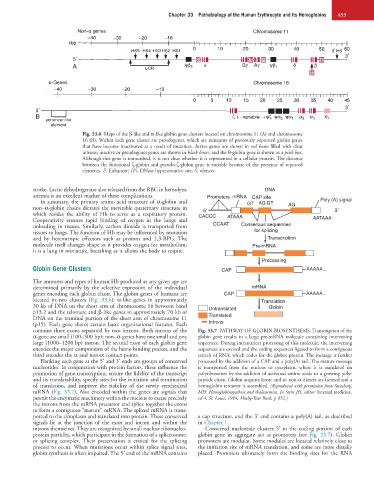
                            Fig. 33.6  Maps of the β-like and α-like globin gene clusters located on chromosome 11 (A) and chromosome
                            16 (B). Within each gene cluster are pseudogenes, which are remnants of previously expressed globin genes
                            that have become inactivated as a result of mutation. Active genes are shown in red boxes filled with clear
                            introns; inactive or pseudogenes genes are shown in black boxes, and the θ-globin gene is shown as a pink box.
                            Although this gene is transcribed, it is not clear whether it is represented in a cellular protein. The distance
                            between the functional ζ-globin and pseudo-ζ-globin gene is variable because of the presence of repeated
                            elements. E, Enhancer; HS, DNase hypersensitive site; S, silencer.


            stroke. Lactic dehydrogenase also released from the RBC in hemolytic        DNA
            anemia is an excellent marker of these complications.    Promoters mRNA  CAP site
              In summary, the primary amino acid structure of α-globin and        GT AG GT                Poly (A) signal
            non–α-globin chains dictates the inevitable quaternary structure in   5′           AG              3′
            which  resides  the  ability  of  Hb  to  serve  as  a  respiratory  protein.   CACCC  ATAAA
            Cooperativity  ensures  rapid  binding  of  oxygen  in  the  lungs  and                    AATAAA
            unloading in tissues. Similarly, carbon dioxide is transported from   CCAAT  Consensus sequences
            tissues to lungs. The function of Hb may be influenced by mutation      for splicing
            and  by  heterotropic  effectors  such  as  protons  and  2,3-BPG.  The      Transcription
            molecule itself changes shape as it provides oxygen for metabolism;     Pre-mRNA
            it is a lung in miniature, breathing as it allows the body to respire.
                                                                                       Processing
            Globin Gene Clusters                                         CAP                         AAAAA...

            The amounts and types of human Hb produced at any given age are
            determined  primarily  by  the  selective  expression  of  the  individual   mRNA
            genes encoding each globin chain. The globin genes of humans are   CAP                   AAAAA...
            located  in  two  clusters  (Fig.  33.6):  α-like  genes  in  approximately   Translation
            30 kb of DNA on the short arm of chromosome 16 between band   Untranslated   Globin
            p13.2 and the telomere and β-like genes in approximately 70 kb of
            DNA on the terminal portion of the short arm of chromosome 11   Translated
            (p15). Each gene shares certain basic organizational features. Each   Introns
            contains three exons separated by two introns. Both introns of the   Fig. 33.7  PATHWAY OF GLOBIN BIOSYNTHESIS. Transcription of the
            α-gene are small (100–300 bp); non–α-genes have one small and one   globin gene results in a large pre-mRNA molecule containing intervening
            large (1000–1200 bp) intron. The second exon of each globin gene   sequences. During intranuclear processing of this molecule, the intervening
            encodes the major components of the heme-binding pocket, and the   sequences are excised and the coding sequences ligated to form a contiguous
            third encodes the α and non-α contact points.         stretch of RNA, which codes for the globin protein. The message is further
              Flanking each gene at the 5′ and 3′ ends are groups of conserved   processed by the addition of a CAP and a poly(A) tail. The mature message
            nucleotides. In conjunction with protein factors, these influence the   is  transported  from  the  nucleus  to  cytoplasm,  where  it  is  translated  on
            promotion of gene transcription, ensure the fidelity of the transcript   polyribosomes by the addition of activated amino acids to a growing poly-
            and its translatability, specify sites for the initiation and termination   peptide chain. Globin acquires heme and α: non-α dimers are formed and a
            of  translation,  and  improve  the  stability  of  the  newly  synthesized   hemoglobin tetramer is assembled. (Reproduced with permission from Steinberg,
            mRNA (Fig. 33.7). Also encoded within the genes are signals that   MH: Hemoglobinopathies and thalassemias. In Stein JH, editor: Internal medicine,
            permit the enzymatic machinery within the nucleus to excise precisely   ed 4, St. Louis, 1994, Mosby-Year Book, p 852.)
            the introns from the mRNA precursor and splice together the exons
            to form a contiguous “mature” mRNA. The spliced mRNA is trans-
            ported to the cytoplasm and translated into protein. These conserved   a cap structure, and the 3′ end contains a poly(A) tail, as described
            signals  lie  at  the  junction  of  the  exon  and  intron  and  within  the   in Chapter 1.
            introns themselves. They are recognized by small nuclear ribonucleo-  Conserved nucleotide clusters 5′ to the coding portion of each
            protein particles, which participate in the formation of a spliceosome,   globin  gene  in  aggregate  act  as  promoters  (see  Fig.  33.7).  Globin
            or  splicing  complex. Their  preservation  is  critical  for  the  splicing   promoters are modular. Some modules are located relatively close to
            process to occur. When mutations occur within splice signal sites,   the initiation site of mRNA translation, and some are more distally
            globin synthesis is often impaired. The 5′ end of the mRNA contains   placed.  Promoters  ultimately  form  the  binding  sites  for  the  RNA

