


Page 572 - Hematology_ Basic Principles and Practice ( PDFDrive )
P. 572
Chapter 36  Disorders of Iron Homeostasis  487


            5th decade of life with a triad of diabetes mellitus, progressive neu-
            rologic  disease  (dementia,  dysarthria,  and  dystonia),  and  retinal
            degeneration.
              Patients  with  autosomal  dominant  hemochromatosis  resulting
            from mutations in the ferroportin gene that compromise iron export,
            such as those resulting in ferroportins that are unable to reach the
            cell surface to interact with hepcidin, have iron deposition predomi-
            nantly in macrophages, are almost devoid of clinical manifestations,
                                           18
            and apparently do not require treatment.  Patients with mutations
            that  result  in  ferroportins  that  reach  the  cell  surface  but  do  not
            respond to hepcidin develop a parenchymal pattern of iron overload
            that resembles that found in patients with the autosomal recessive
            forms of hemochromatosis. 18


            Acquired Iron Overload

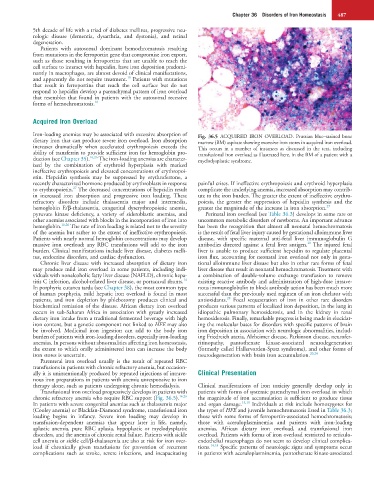
            Iron-loading anemias may be associated with excessive absorption of   Fig.  36.5  ACQUIRED  IRON  OVERLOAD.  Prussian  blue–stained  bone
            dietary iron that can produce severe iron overload. Iron absorption   marrow (BM) aspirate showing excessive iron stores in acquired iron overload.
            increases  dramatically  when  accelerated  erythropoiesis  exceeds  the   This  occurs  in  a  number  of  instances  as  discussed  in  the  text,  including
            ability of transferrin to provide sufficient iron for hemoglobin pro-  transfusional iron overload as illustrated here, in the BM of a patient with a
            duction (see Chapter 35). 16,26  The iron-loading anemias are character-  myelodysplastic syndrome.
            ized  by  the  combination  of  erythroid  hyperplasia  with  marked
            ineffective erythropoiesis and elevated concentrations of erythropoi-
            etin.  Hepcidin  synthesis  may  be  suppressed  by  erythroferrone,  a
            recently characterized hormone produced by erythroblasts in response   painful crises. If ineffective erythropoiesis and erythroid hyperplasia
                         27
            to erythropoietin.  The decreased concentrations of hepcidin result   complicate the underlying anemia, increased absorption may contrib-
            in  increased  iron  absorption  and  progressive  iron  loading.  These   ute to the iron burden. The greater the extent of ineffective erythro-
            refractory  disorders  include  thalassemia  major  and  intermedia,   poiesis,  the  greater  the  suppression  of  hepcidin  synthesis  and  the
            hemoglobin  E/β-thalassemia,  congenital  dyserythropoietic  anemia,   greater the magnitude of the increase in iron absorption. 27
            pyruvate  kinase  deficiency,  a  variety  of  sideroblastic  anemias,  and   Perinatal iron overload (see Table 36.3) develops in some rare or
            other anemias associated with blocks in the incorporation of iron into   uncommon metabolic disorders of newborns. An important advance
            hemoglobin. 16,26  The rate of iron loading is related not to the severity   has been the recognition that almost all neonatal hemochromatosis
            of the anemia but rather to the extent of ineffective erythropoiesis.   is the result of fetal liver injury caused by gestational alloimmune liver
            Patients with nearly normal hemoglobin concentrations may develop   disease,  with  specific  maternal  anti-fetal  liver  immunoglobulin  G
                                                                                                      28
            massive  iron  overload;  any  RBC  transfusions  will  add  to  the  iron   antibodies directed against a fetal liver antigen.  The injured fetal
            burden. Clinical manifestations include liver disease, diabetes melli-  liver  is  unable  to  produce  sufficient  hepcidin  to  regulate  placental
            tus, endocrine disorders, and cardiac dysfunction.    iron flux, accounting for neonatal iron overload not only in gesta-
              Chronic  liver  disease  with  increased  absorption  of  dietary  iron   tional alloimmune liver disease but also in other rare forms of fetal
            may produce mild iron overload in some patients, including indi-  liver disease that result in neonatal hemochromatosis. Treatment with
            viduals with nonalcoholic fatty liver disease (NAFLD), chronic hepa-  a  combination  of  double-volume  exchange  transfusion  to  remove
                                                             14
            titis C infection, alcohol-related liver disease, or portacaval shunts.    existing reactive antibody and administration of high-dose intrave-
            In porphyria cutanea tarda (see Chapter 38), the most common type   nous immunoglobulin to block antibody action has been much more
            of human porphyria, mild hepatic iron overload is found in most   successful than the previously used regimen of an iron chelator with
                                                                           28
            patients,  and  iron  depletion  by  phlebotomy  produces  clinical  and   antioxidants.   Focal  sequestration  of  iron  in  other  rare  disorders
            biochemical remission of the disease. African dietary iron overload   produces various patterns of localized iron deposition, in the lung in
            occurs  in  sub-Saharan  Africa  in  association  with  greatly  increased   idiopathic  pulmonary  hemosiderosis,  and  in  the  kidney  in  renal
            dietary iron intake from a traditional fermented beverage with high   hemosiderosis. Finally, remarkable progress is being made in elucidat-
            iron content, but a genetic component not linked to HFE may also   ing the molecular bases for disorders with specific patterns of brain
            be  involved.  Medicinal  iron  ingestion  can  add  to  the  body  iron   iron deposition in association with neurologic abnormalities, includ-
            burden of patients with iron-loading disorders, especially iron-loading   ing Friedreich ataxia, Alzheimer disease, Parkinson disease, neurofer-
            anemias. In persons without abnormalities affecting iron homeostasis,   ritinopathy,  pantothenate  kinase-associated  neurodegeneration
            the extent to which orally administered iron can increase the body   (formerly called Hallervorden-Spatz syndrome), and other forms of
            iron stores is uncertain.                             neurodegeneration with brain iron accumulation. 20,24
              Parenteral  iron  overload  usually  is  the  result  of  repeated  RBC
            transfusions in patients with chronic refractory anemia, but occasion-
            ally it is unintentionally produced by repeated injections of intrave-  Clinical Presentation
            nous iron preparations in patients with anemia unresponsive to iron
            therapy alone, such as patients undergoing chronic hemodialysis.  Clinical  manifestations  of  iron  toxicity  generally  develop  only  in
              Transfusional iron overload progressively develops in patients with   patients with forms of systemic parenchymal iron overload in which
            chronic refractory anemia who require RBC support (Fig. 36.5). 16,26    the magnitude of iron accumulation is sufficient to produce tissue
            In patients with severe congenital anemias such as thalassemia major   and organ damage. 14,18  Individuals at risk include homozygotes for
            (Cooley anemia) or Blackfan-Diamond syndrome, transfusional iron   the types of HFE and juvenile hemochromatosis listed in Table 36.3;
            loading  begins  in  infancy.  Severe  iron  loading  may  develop  in   those with some forms of ferroportin-associated hemochromatosis;
            transfusion-dependent  anemias  that  appear  later  in  life,  namely,   those  with  aceruloplasminemia;  and  patients  with  iron-loading
            aplastic  anemia,  pure  RBC  aplasia,  hypoplastic  or  myelodysplastic   anemias,  African  dietary  iron  overload,  and  transfusional  iron
            disorders, and the anemia of chronic renal failure. Patients with sickle   overload. Patients with forms of iron overload restricted to reticulo-
            cell anemia or sickle cell/β-thalassemia are also at risk for iron over-  endothelial macrophages do not seem to develop clinical complica-
            load  if  chronically  given  transfusions  for  prevention  of  recurrent   tions. 14,18  Specific patterns of neurologic signs and symptoms occur
            complications  such  as  stroke,  severe  infections,  and  incapacitating   in patients with aceruloplasminemia, pantothenate kinase-associated

