


Page 567 - Hematology_ Basic Principles and Practice ( PDFDrive )
P. 567
482    Part V  Red Blood Cells


        iron therapy. Iron deficiency has other nonhematologic consequences,   restricted, frank iron-deficiency anemia develops (see box on Plasma
        including impaired immunity and resistance to infection, diminished   Iron Concentration and Transferrin Saturation).
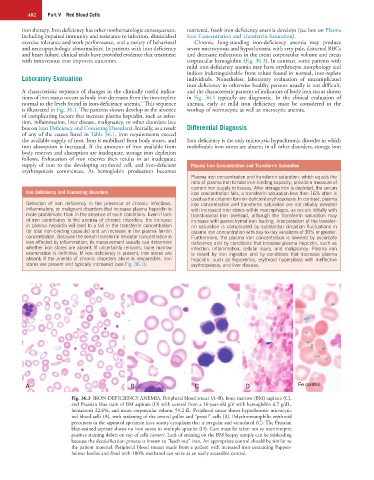
        exercise tolerance and work performance, and a variety of behavioral   Chronic,  long-standing  iron-deficiency  anemia  may  produce
        and neuropsychologic abnormalities. In patients with iron deficiency   severe microcytosis and hypochromia, with very pale, distorted RBCs
        and heart failure, clinical trials have provided evidence that treatment   and dramatic reductions in the mean corpuscular volume and mean
        with intravenous iron improves outcomes.              corpuscular hemoglobin (Fig. 36.3). In contrast, some patients with
                                                              mild iron-deficiency anemia may have erythrocyte morphology and
                                                              indices indistinguishable from values found in normal, iron-replete
        Laboratory Evaluation                                 individuals.  Nonetheless,  laboratory  evaluation  of  uncomplicated
                                                              iron deficiency in otherwise healthy persons usually is not difficult,
        A characteristic sequence of changes in the clinically useful indica-  and the characteristic patterns of indicators of body iron status shown
        tions of iron status occurs as body iron decreases from the iron-replete   in  Fig.  36.1  typically  are  diagnostic.  In  the  clinical  evaluation  of
                                               6
        normal to the levels found in iron-deficiency anemia.  This sequence   anemia,  early  or  mild  iron  deficiency  must  be  considered  in  the
        is illustrated in Fig. 36.1. The patterns shown develop in the absence   workup of normocytic as well as microcytic anemia.
        of complicating factors that increase plasma hepcidin, such as infec-
        tion, inflammation, liver disease, malignancy, or other disorders (see
        box on Iron Deficiency and Coexisting Disorders). Initially, as a result   Differential Diagnosis
        of any of the causes listed in Table 36.1, iron requirements exceed
        the available supply of iron. Iron is mobilized from body stores, and   Iron deficiency is the only microcytic hypochromic disorder in which
        iron absorption is increased. If the amounts of iron available from   mobilizable iron stores are absent; in all other disorders, storage iron
        body reserves and absorption are inadequate, storage iron depletion
        follows.  Exhaustion  of  iron  reserves  then  results  in  an  inadequate
        supply  of  iron  to  the  developing  erythroid  cell,  and  iron-deficient   Plasma Iron Concentration and Transferrin Saturation
        erythropoiesis  commences.  As  hemoglobin  production  becomes
                                                                Plasma iron concentration and transferrin saturation, which equals the
                                                                ratio of plasma iron to total iron-binding capacity, provide a measure of
                                                                current iron supply to tissues. After storage iron is depleted, the serum
         Iron Deficiency and Coexisting Disorders               iron concentration falls; a transferrin saturation less than 16% often is
                                                                used as the criterion for iron-deficient erythropoiesis. In contrast, plasma
          Detection  of  iron  deficiency  in  the  presence  of  chronic  infectious,   iron concentration and transferrin saturation are not reliably elevated
          inflammatory, or malignant disorders that increase plasma hepcidin is   with increased iron stores within macrophages, as occurs initially with
          more problematic than in the absence of such conditions. Even if lack   transfusional  iron  overload,  although  the  transferrin  saturation  may
          of  iron  contributes  to  the  anemia  of  chronic  disorders,  the  increase   increase with parenchymal iron loading. Interpretation of the transfer-
          in plasma hepcidin will lead to a fall in the transferrin concentration   rin  saturation  is  complicated  by  substantial  circadian  fluctuations  in
          (or total iron-binding capacity) and an increase in the plasma ferritin   plasma iron concentration with day-to-day variations of 30% or greater.
          concentration. Because the serum transferrin receptor concentration is   Furthermore, the plasma iron concentration is lowered by ascorbate
          less affected by inflammation, its measurement usually can determine   deficiency and by conditions that increase plasma hepcidin, such as
          whether iron stores are absent. If uncertainty remains, bone marrow   infection, inflammation, cellular injury, and malignancy. Plasma iron
          examination is definitive. If iron deficiency is present, iron stores are   is  raised  by  iron  ingestion  and  by  conditions  that  decrease  plasma
          absent; if the anemia of chronic disorders alone is responsible, iron   hepcidin,  such  as  hypoxemia,  erythroid  hyperplasia  with  ineffective
          stores are present and typically increased (see Fig. 36.1).  erythropoiesis, and liver disease.


         A                                  B                    C               D                 Fe control

                        Fig. 36.3  IRON-DEFICIENCY ANEMIA. Peripheral blood smear (A–B), bone marrow (BM) aspirate (C),
                        and Prussian blue stain of BM aspirate (D) with control from a 16-year-old girl with hemoglobin 6.7 g/dL,
                        hematocrit 22.6%, and mean corpuscular volume 59.2 fL. Peripheral smear shows hypochromic microcytic
                        red blood cells (A), with widening of the central pallor and “pencil” cells (B). Polychromatophilic erythroid
                        precursors in the aspirated specimen have scanty cytoplasm that is irregular and vacuolated (C). The Prussian
                        blue-stained aspirate shows no iron stores in multiple spicules (D). Care must be taken not to overinterpret
                        positive staining debris on top of cells (center). Lack of staining on the BM biopsy sample can be misleading
                        because the decalcification process is known to “leach out” iron. An appropriate control should be similar to
                        the patient material. Peripheral blood smears made from a patient with increased iron-containing Pappen-
                        heimer bodies and fixed with 100% methanol can serve as an easily accessible control.

