


Page 570 - Hematology_ Basic Principles and Practice ( PDFDrive )
P. 570
Chapter 36  Disorders of Iron Homeostasis  485


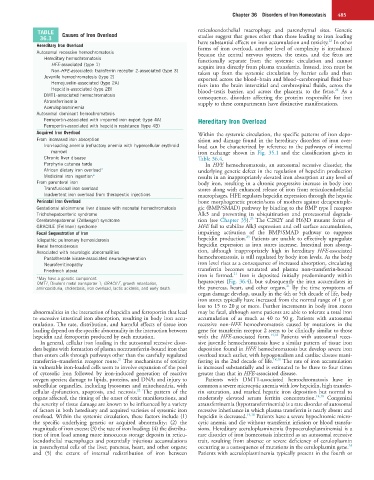
             TABLE   Causes of Iron Overload                      reticuloendothelial  macrophage  and  parenchymal  sites.  Genetic
              36.3                                                studies suggest that genes other than those leading to iron loading
                                                                                                             23
             Hereditary Iron Overload                             have substantial effects on iron accumulation and toxicity.  In other
                                                                  forms  of  iron  overload,  another  level  of  complexity  is  introduced
             Autosomal recessive hemochromatosis                  because  the  central  nervous  system,  the  testes,  and  the  fetus  are
               Hereditary hemochromatosis                         functionally  separate  from  the  systemic  circulation  and  cannot
                  HFE-associated (type 1)                         acquire iron directly from plasma transferrin. Instead, iron must be
                  Non-HFE-associated: transferrin receptor 2-associated (type 3)  taken  up  from  the  systemic  circulation  by  barrier  cells  and  then
               Juvenile hemochromatosis (type 2)                  exported across the blood–brain and blood–cerebrospinal fluid bar-
                  Hemojuvelin-associated (type 2A)                riers  into  the  brain  interstitial  and  cerebrospinal  fluids,  across  the
                  Hepcidin-associated (type 2B)                   blood–testis  barrier,  and  across  the  placenta  to  the  fetus.   As  a
                                                                                                               24
               DMT1-associated hemochromatosis                    consequence,  disorders  affecting  the  proteins  responsible  for  iron
               Atransferrinemia                                   supply to these compartments have distinctive manifestations.
               Aceruloplasminemia
             Autosomal dominant hemochromatosis
               Ferroportin-associated with impaired iron export (type 4A)  Hereditary Iron Overload
               Ferroportin-associated with hepcidin resistance (type 4B)
             Acquired Iron Overload                               Within the systemic circulation, the specific patterns of iron depo-
             From increased iron absorption                       sition and  damage found  in  the hereditary  disorders of iron over-
               Iron-loading anemia (refractory anemia with hypercellular erythroid   load can be characterized by reference to the pathways of internal
                  marrow)                                         iron  exchange  shown  in  Fig.  35.1  and  the  classification  given  in
               Chronic liver disease                              Table 36.4.
               Porphyria cutanea tarda                              In  HFE  hemochromatosis,  an  autosomal  recessive  disorder,  the
               African dietary iron overload*                     underlying genetic defect in the regulation of hepcidin production
               Medicinal iron ingestion*                          results in an inappropriately elevated iron absorption at any level of
             From parenteral iron                                 body iron, resulting in a chronic progressive increase in body iron
               Transfusional iron overload                        stores along with enhanced release of iron from reticuloendothelial
               Inadvertent iron overload from therapeutic injections  macrophages. HFE regulates hepcidin expression through the hepatic
             Perinatal Iron Overload                              bone morphogenetic protein/sons of mothers against decapentaple-
             Gestational alloimmune liver disease with neonatal hemochromatosis  gic (BMP/SMAD) pathway by binding to the BMP type I receptor
             Trichohepatoenteric syndrome                         Alk3  and  preventing  its  ubiquitination  and  proteasomal  degrada-
                                                                                   25
             Cerebrohepatorenal (Zellweger) syndrome              tion  (see  Chapter  35).  The  C282Y  and  H63D  mutant  forms  of
             GRACILE (Fellman) syndrome                           HFE fail to stabilize Alk3 expression and cell surface accumulation,
             Focal Sequestration of Iron                          impairing  activation  of  the  BMP/SMAD  pathway  to  suppress
                                                                                  25
             Idiopathic pulmonary hemosiderosis                   hepcidin production.  Patients are unable to effectively upregulate
             Renal hemosiderosis                                  hepcidin  expression  as  iron  stores  increase.  Intestinal  iron  absorp-
             Associated with neurologic abnormalities             tion,  although  inappropriately  high  in  hereditary  HFE-associated
               Pantothenate kinase-associated neurodegeneration   hemochromatosis, is still regulated by body iron levels. As the body
               Neuroferritinopathy                                iron level rises as a consequence of increased absorption, circulating
               Friedreich ataxia                                  transferrin  becomes  saturated  and  plasma  non-transferrin-bound
                                                                             21
                                                                  iron  is  formed.   Iron  is  deposited  initially  predominantly  within
             *May have a genetic component.                       hepatocytes  (Fig.  36.4),  but  subsequently  the  iron  accumulates  in
             DMT1, Divalent metal transporter 1; GRACILE, growth retardation,                  21
             aminoaciduria, cholestasis, iron overload, lactic acidosis, and early death.  the pancreas,  heart,  and  other  organs.   By the  time  symptoms of
                                                                  organ damage develop, usually in the 4th or 5th decade of life, body
                                                                  iron stores typically have increased from the normal range of 1 g or
                                                                  less to 15 to 20 g or more. Further increments in body iron stores
            abnormalities in the interaction of hepcidin and ferroportin that lead   may be fatal, although some patients are able to tolerate a total iron
            to excessive intestinal iron absorption, resulting in body iron accu-  accumulation  of  as  much  as  40  to  50 g.  Patients  with  autosomal
            mulation. The rate, distribution, and harmful effects of tissue iron   recessive  non-HFE  hemochromatosis  caused  by  mutations  in  the
            loading depend on the specific abnormality in the interaction between   gene for transferrin receptor 2 seem to be clinically similar to those
            hepcidin and ferroportin produced by each mutation.   with  the  HFE-associated  form. 14,18   Patients  with  autosomal  reces-
              In general, cellular iron loading in the autosomal recessive disor-  sive juvenile hemochromatosis have a similar pattern of tissue iron
            ders begins with formation of plasma nontransferrin-bound iron that   deposition found in HFE hemochromatosis but develop severe iron
            then enters cells through pathways other than the carefully regulated   overload much earlier, with hypogonadism and cardiac disease mani-
                                        21
            transferrin–transferrin receptor route.  The mechanisms of toxicity   festing in the 2nd decade of life. 14,18  The rate of iron accumulation
            in vulnerable iron-loaded cells seem to involve expansion of the pool   is increased substantially and is estimated to be three to four times
            of  cytosolic  iron  followed  by  iron-induced  generation  of  reactive   greater than that in HFE-associated disease.
            oxygen species; damage to lipids, proteins, and DNA; and injury to   Patients  with  DMT1-associated  hemochromatosis  have  in
            subcellular organelles, including lysosomes and mitochondria, with   common a severe microcytic anemia with low hepcidin, high transfer-
                                              22
            cellular  dysfunction,  apoptosis,  and  necrosis.  The  pattern  of  the   rin  saturation,  and  marked  hepatic  iron  deposition  but  normal  to
            organs affected, the timing of the onset of toxic manifestations, and   moderately  elevated  serum  ferritin  concentration. 14,18   Congenital
            the severity of tissue damage are known to be influenced by a variety   atransferrinemia (hypotransferrinemia) is a rare disorder of autosomal
            of factors in both hereditary and acquired varieties of systemic iron   recessive inheritance in which plasma transferrin is nearly absent and
            overload. Within the systemic circulation, these factors include (1)   hepcidin is decreased. 14,18  Patients have a severe hypochromic micro-
            the  specific  underlying  genetic  or  acquired  abnormality;  (2)  the   cytic anemia and die without transferrin infusion or blood transfu-
            magnitude of iron excess; (3) the rate of iron loading; (4) the distribu-  sions. Hereditary aceruloplasminemia (hypoceruloplasminemia) is a
            tion of iron load among more innocuous storage deposits in reticu-  rare disorder of iron homeostasis inherited as an autosomal recessive
            loendothelial macrophages and potentially injurious accumulations   trait,  resulting  from  absence  or  severe  deficiency  of  ceruloplasmin
                                                                                                                   24
            in parenchymal cells of the liver, pancreas, heart, and other organs;   occurring as a consequence of mutations in the ceruloplasmin gene.
            and  (5)  the  extent  of  internal  redistribution  of  iron  between   Patients with aceruloplasminemia typically present in the fourth or

