


Page 60 - Hematology_ Basic Principles and Practice ( PDFDrive )
P. 60
32    Part I  Molecular and Cellular Basis of Hematology


        expertise, and instrumentation as well as a large amount of starting   are not suitable for the analysis of large numbers of proteins, because
        material, all of which tended to make systematic proteomic experi-  each protein to be interrogated requires a separate slide. Nevertheless,
        ments  difficult  to  perform  routinely.  However,  newer  instruments   RPPA  remains  a  useful  tool  in  the  armamentarium  of  proteomic
        and  methods  allow  for  the  analysis  of  significantly  more  complex   research  and  may  prove  particularly  useful  for  the  comparison  of
        mixtures, with increased sensitivity and speed. Sequence assignment   proteins  of  interest  across  a  large  panel  of  samples  (e.g.,  across  a
        confidence, especially for modified peptides, has also been markedly   collection of patient samples or cell lines).
        improved owing to the increase in both resolution and mass accuracy.
        For example, in mammalian cells, it is possible to confidently detect
        more than 8000 unique proteins and more than 15,000 phospho-  Bead-Based Profiling
        peptides in a few days using a single instrument. Efforts to perform
        proteome-wide analysis of complex samples such as cells and tissues   Another  proteomic  method  involves  the  multiplexed  analysis  of
        without extensive fractionation represent one end of the spectrum;   protein abundance or phosphorylation. Phosphorylation involves the
        proteomic  analysis  with  single-cell  resolution  represents  the  other   use of microspheres (beads). In this approach, a different protein-
        end. Although these methods (single-cell Western blot analysis and   specific antibody is coupled to beads of distinct color. A mixture of
        flow  cytometry  for  intracellular  proteins)  can  currently  interrogate   antibody-coupled beads is then mixed with protein lysate, and then
        only one or a few analytes at the same time, these methods will evolve   binding events are detected with a labeled secondary antibody (e.g.,
        with ongoing technological progress.                  antiphosphotyrosine antibody). Multiple analytes are thereby simul-
                                                              taneously profiled in a single sample. This approach was successfully
                                                              used  to  profile  the  tyrosine  phosphorylation  status  of  nearly  all
        Reverse Phase Lysates                                 protein tyrosine kinases across a panel of cell lines. The advantage of
                                                              this approach is that multiple proteins (as many as 100 or more) can
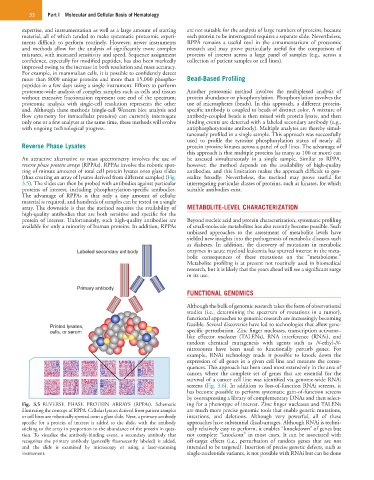
        An  attractive  alternative  to  mass  spectrometry  involves  the  use  of   be  assessed  simultaneously  in  a  single  sample.  Similar  to  RPPA,
        reverse phase protein arrays (RPPAs). RPPAs involve the robotic spot-  however,  the  method  depends  on  the  availability  of  high-quality
        ting of minute amounts of total cell protein lysates onto glass slides   antibodies, and this limitation makes the approach difficult to gen-
        (thus creating an array of lysates derived from different samples) (Fig.   eralize  broadly.  Nevertheless,  the  method  may  prove  useful  for
        3.5). The slides can then be probed with antibodies against particular   interrogating particular classes of proteins, such as kinases, for which
        proteins  of  interest,  including  phosphorylation-specific  antibodies.   suitable antibodies exist.
        The  advantage  of  RPPAs  is  that  only  a  tiny  amount  of  cellular
        material is required, and hundreds of samples can be tested on a single
        array. The downside is that the method requires the availability of   METABOLITE-LEVEL CHARACTERIZATION
        high-quality  antibodies  that  are  both  sensitive  and  specific  for  the
        protein of interest. Unfortunately, such high-quality antibodies are   Beyond nucleic acid and protein characterization, systematic profiling
        available for only a minority of human proteins. In addition, RPPAs   of small-molecule metabolites has also recently become possible. Such
                                                              unbiased  approaches  to  the  assessment  of  metabolite  levels  have
                                                              yielded new insights into the pathogenesis of metabolic diseases such
                                                              as  diabetes.  In  addition,  the  discovery  of  mutations  in  metabolic
                          Labeled secondary antibody          enzymes in acute myeloid leukemia has spurred interest in the meta-
                                                              bolic  consequences  of  these  mutations  on  the  “metabolome.”
                                                              Metabolite profiling is at present not routinely used in biomedical
                                                              research, but it is likely that the years ahead will see a significant surge
                                                              in its use.
                          Primary antibody
                                                              FUNCTIONAL GENOMICS

                                                              Although the bulk of genomic research takes the form of observational
                                                              studies  (i.e.,  determining  the  spectrum  of  mutations  in  a  tumor),
                                                              functional approaches to genomic research are increasingly becoming
                 Printed lysates,                             feasible. Several discoveries have led to technologies that allow gene-
                 cells, or serum                              specific perturbation. Zinc finger nucleases, transcription activator–
                                                              like  effector  nucleases  (TALENs),  RNA  interference  (RNAi),  and
                                                              random  chemical  mutagenesis  with  agents  such  as  N-ethyl-N-
                                                              nitrosourea  have  been  used  to  functionally  perturb  genes.  For
                                                              example,  RNAi  technology  made  it  possible  to  knock  down  the
                                                              expression of all genes in a given cell line and measure the conse-
                                                              quences. This approach has been used most extensively in the area of
                                                              cancer,  where  the  complete  set  of  genes  that  are  essential  for  the
                                                              survival of a cancer cell line was identified via genome-wide RNAi
                                                              screens (Fig. 3.6). In addition to loss-of-function RNAi screens, it
                                                              has become possible to perform systematic gain-of-function screens
                                                              by overexpressing a library of complementary DNAs and then select-
        Fig.  3.5  REVERSE  PHASE  PROTEIN  ARRAYS  (RPPAs).  Schematic   ing for a phenotype of interest. Zinc finger nucleases and TALENs
        illustrating the concept of RPPA. Cellular lysates derived from patient samples   are much more precise genomic tools that enable genetic mutations,
        or cell lines are robotically spotted onto a glass slide. Next, a primary antibody   insertions,  and  deletions.  Although  very  powerful,  all  of  these
        specific  for  a  protein  of  interest  is  added  to  the  slide,  with  the  antibody   approaches have substantial disadvantages. Although RNAi is techni-
        sticking to the array in proportion to the abundance of the protein in ques-  cally relatively easy to perform, it enables “knockdown” of genes but
        tion.  To  visualize  the  antibody-binding  event,  a  secondary  antibody  that   not  complete  “knockout”  in  most  cases.  It  can  be  associated  with
        recognizes  the  primary  antibody  (generally  fluorescently  labeled)  is  added,   off-target  effects  (i.e.,  perturbation  of  random  genes  that  are  not
        and  the  slide  is  examined  by  microscopy  or  using  a  laser-scanning   intended to be targeted). Insertion of precise genetic defects, such as
        instrument.                                           single-nucleotide variants, is not possible with RNAi but can be done

