


Page 57 - Hematology_ Basic Principles and Practice ( PDFDrive )
P. 57
Chapter 3  Genomic Approaches to Hematology  29


                TUMOR


                NORMAL


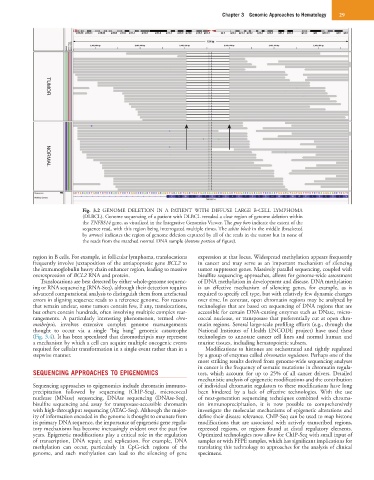
                            Fig.  3.2  GENOME  DELETION  IN  A  PATIENT  WITH  DIFFUSE  LARGE  B-CELL  LYMPHOMA
                            (DLBCL). Genome sequencing of a patient with DLBCL revealed a clear region of genome deletion within
                            the TNFRS14 gene, as visualized in the Integrative Genomics Viewer. The gray bars indicate the extent of the
                            sequence read, with this region being interrogated multiple times. The white block in the middle (bracketed
                            by arrows) indicates the region of genome deletion captured by all of the reads in the tumor but in none of
                            the reads from the matched normal DNA sample (bottom portion of figure).


            region in B cells. For example, in follicular lymphoma, translocations   expression at that locus. Widespread methylation appears frequently
            frequently involve juxtaposition of the antiapoptotic gene BCL2 to   in  cancer  and  may  serve  as  an  important  mechanism  of  silencing
            the immunoglobulin heavy chain enhancer region, leading to massive   tumor suppressor genes. Massively parallel sequencing, coupled with
            overexpression of BCL2 RNA and protein.               bisulfite sequencing approaches, allows for genome-wide assessment
              Translocations are best detected by either whole-genome sequenc-  of DNA methylation in development and disease. DNA methylation
            ing or RNA sequencing (RNA-Seq), although their detection requires   is  an  effective  mechanism  of  silencing  genes,  for  example,  as  is
            advanced computational analysis to distinguish them from artefactual   required to specify cell type, but with relatively few dynamic changes
            errors in aligning sequence reads to a reference genome. For reasons   over time. In contrast, open chromatin regions may be analyzed by
            that remain unclear, some tumors contain few, if any, translocations,   technologies that are based on sequencing of DNA regions that are
            but others contain hundreds, often involving multiple complex rear-  accessible for certain DNA-cutting enzymes such as DNase, micro-
            rangements.  A  particularly  interesting  phenomenon,  termed  chro-  coccal nuclease, or transposase that preferentially cut at open chro-
            mothripsis,  involves  extensive  complex  genome  rearrangements   matin regions. Several large-scale profiling efforts (e.g., through the
            thought  to  occur  via  a  single  “big  bang”  genomic  catastrophe    National  Institutes  of  Health  ENCODE  project)  have  used  these
            (Fig. 3.4). It has been speculated that chromothripsis may represent   technologies  to  annotate  cancer  cell  lines  and  normal  human  and
            a mechanism by which a cell can acquire multiple oncogenic events   murine tissues, including hematopoietic subsets.
            required for cellular transformation in a single event rather than in a   Modifications to histones are orchestrated and tightly regulated
            stepwise manner.                                      by a group of enzymes called chromatin regulators. Perhaps one of the
                                                                  most striking results derived from genome-wide sequencing analyses
                                                                  in cancer is the frequency of somatic mutations in chromatin regula-
            SEQUENCING APPROACHES TO EPIGENOMICS                  tors,  which  account  for  up  to  25%  of  all  cancer  drivers.  Detailed
                                                                  mechanistic analysis of epigenetic modifications and the contribution
            Sequencing approaches to epigenomics include chromatin immuno-  of individual chromatin regulators to these modifications have long
            precipitation  followed  by  sequencing  (ChIP-Seq),  micrococcal   been  hindered  by  a  lack  of  effective  technologies.  With  the  use
            nuclease  (MNase)  sequencing,  DNAse  sequencing  (DNAse-Seq),   of  next-generation  sequencing  techniques  combined  with  chroma-
            bisulfite  sequencing  and  assay  for  transposase-accessible  chromatin   tin  immunoprecipitation,  it  is  now  possible  to  comprehensively
            with high-throughput sequencing (ATAC-Seq). Although the major-  investigate the molecular mechanisms of epigenetic alterations and
            ity of information encoded in the genome is thought to emanate from   define their disease relevance. ChIP-Seq can be used to map histone
            its primary DNA sequence, the importance of epigenetic gene regula-  modifications  that  are  associated  with  actively  transcribed  regions,
            tory mechanisms has become increasingly evident over the past few   repressed  regions,  or  regions  found  at  distal  regulatory  elements.
            years. Epigenetic modifications play a critical role in the regulation   Optimized technologies now allow for ChIP-Seq with small input of
            of  transcription,  DNA  repair,  and  replication.  For  example,  DNA   samples or with FFPE samples, which has significant implications for
            methylation  can  occur,  particularly  in  CpG-rich  regions  of  the   translating this technology to approaches for the analysis of clinical
            genome,  and  such  methylation  can  lead  to  the  silencing  of  gene   specimens.

