


Page 58 - Hematology_ Basic Principles and Practice ( PDFDrive )
P. 58
30    Part I  Molecular and Cellular Basis of Hematology


                 0.1   00221         0.4                               0.1 0.2  0.28     0.4
                                                     1p31.1
          1                                          1p12       1


             2                                                     2

          3                                                     3
                                                     4p15.2
             4                                                     4

          5                                                     5
             6                                                     6
          7                                                     7
             8                                                     8
                                                                                                           8q24.21
          9                                                     9
            10                                                    10
         11                                                    11
            12                                                    12
                                                     12q24.33
         13                                          13q14.2   13
            14                                       14q24.2      14
         15                                                    15
            16                                                    16
         17                                                    17
            18                                                    18
         19                                                    19                                          19p13.2
            20                                       20q11.23     20
         21  22                                                21  22
                        0.25      10 –2  10 –3  10 –4  10 –6                    0.25 10 –1  10 –2  10 –3  10 –4

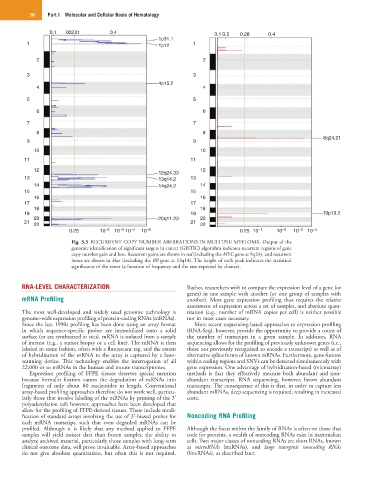
                        Fig. 3.3  RECURRENT COPY NUMBER ABERRATIONS IN MULTIPLE MYELOMA. Output of the
                        genomic identification of significant targets in cancer (GISTIC) algorithm indicates recurrent regions of gene
                        copy number gain and loss. Recurrent gains are shown in red (including the MYC gene at 8q24), and recurrent
                        losses are shown in blue (including the RB gene at 13q14). The height of each peak indicates the statistical
                        significance of the event (a function of frequency and the rate expected by chance).


        RNA-LEVEL CHARACTERIZATION                            Rather, researchers wish to compare the expression level of a gene (or
                                                              genes) in one sample with another (or one group of samples with
        mRNA Profiling                                        another).  Most  gene  expression  profiling  thus  requires  the  relative
                                                              assessment of expression across a set of samples, and absolute quan-
        The  most  well-developed  and  widely  used  genomic  technology  is   titation (e.g., number of mRNA copies per cell) is neither possible
        genome-wide expression profiling of protein-coding RNAs (mRNAs).   nor in most cases necessary.
        Since the late 1990s profiling has been done using an array format   More recent sequencing-based approaches to expression profiling
        in  which  sequence-specific  probes  are  immobilized  onto  a  solid   (RNA-Seq), however, provide the opportunity to provide a count of
        surface (or are synthesized in situ). mRNA is isolated from a sample   the  number  of  transcripts  in  a  given  sample.  In  addition,  RNA
        of interest (e.g., a tumor biopsy or a cell line). The mRNA is then   sequencing allows for the profiling of previously unknown genes (i.e.,
        labeled in some fashion, often with a fluorescent tag, and the extent   those not previously recognized to encode a transcript) as well as of
        of hybridization of the mRNA to the array is captured by a laser-  alternative splice forms of known mRNAs. Furthermore, gene fusions
        scanning  device.  This  technology  enables  the  interrogation  of  all   within coding regions and SNVs can be detected simultaneously with
        22,000 or so mRNAs in the human and mouse transcriptomes.  gene expression. One advantage of hybridization-based (microarray)
           Expression  profiling  of  FFPE  tissues  deserves  special  mention   methods  is  that  they  effectively  measure  both  abundant  and  non-
        because  formalin  fixation  causes  the  degradation  of  mRNAs  into   abundant  transcripts.  RNA  sequencing,  however,  favors  abundant
        fragments  of  only  about  80  nucleotides  in  length.  Conventional   transcripts. The consequence of this is that, in order to capture less
        array-based profiling approaches therefore do not work well, particu-  abundant mRNAs, deep sequencing is required, resulting in increased
        larly those that involve labeling of the mRNAs by priming of the 3′   costs.
        polyadenylation tail; however, approaches have been developed that
        allow for the profiling of FFPE-derived tissues. These include modi-
        fication of standard arrays involving the use of 3′-biased probes for   Noncoding RNA Profiling
        each  mRNA  transcript,  such  that  even  degraded  mRNAs  can  be
        profiled.  Although  it  is  likely  that  any  method  applied  to  FFPE   Although the focus within the family of RNAs is often on those that
        samples  will  yield  noisier  data  than  frozen  samples,  the  ability  to   code for proteins, a wealth of noncoding RNAs exist in mammalian
        analyze archived material, particularly those samples with long-term   cells. Two major classes of noncoding RNAs are short RNAs, known
        clinical outcome data, will prove invaluable. Array-based approaches   as  microRNAs  (miRNAs),  and  large  intergenic  noncoding  RNAs
        do  not  give  absolute  quantitation,  but  often  this  is  not  required.   (lincRNAs), as described later.

