


Page 61 - Hematology_ Basic Principles and Practice ( PDFDrive )
P. 61
Chapter 3  Genomic Approaches to Hematology  33


                                                      Cell lines

                                                                                       Ovarian
                                                                                       Colon
                                                                                       Pancreas
                                                                                       Esophageal
                                                                                       Lung NSCLC
                                                                                       GBM
                                                                                       Lung SCLC
                                                                                       Melanoma
                                                                                       Meningioma
                                                                                       Breast
                                                                                       Gastric
                                                                                       Renal cell carcinoma


                                                                                         Others
                           shRNAs


                                                                                     Normalized
                                                                                     fold enrichment
                                                                                       3


                                                                                       0


                                                                                       –3


                          A
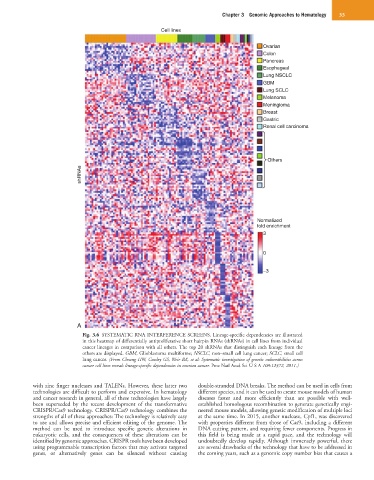
                            Fig. 3.6  SYSTEMATIC RNA INTERFERENCE SCREENS. Lineage-specific dependencies are illustrated
                            in this heatmap of differentially antiproliferative short hairpin RNAs (shRNAs) in cell lines from individual
                            cancer lineages in comparison with all others. The top 20 shRNAs that distinguish each lineage from the
                            others are displayed. GBM, Glioblastoma multiforme; NSCLC, non–small cell lung cancer; SCLC, small cell
                            lung cancer. (From Cheung HW, Cowley GS, Weir BA, et al: Systematic investigation of genetic vulnerabilities across
                            cancer cell lines reveals lineage-specific dependencies in ovarian cancer. Proc Natl Acad Sci U S A 108:12372, 2011.)


            with zinc finger nucleases and TALENs. However, these latter two   double-stranded DNA breaks. The method can be used in cells from
            technologies are difficult to perform and expensive. In hematology   different species, and it can be used to create mouse models of human
            and cancer research in general, all of these technologies have largely   diseases  faster  and  more  efficiently  than  are  possible  with  well-
            been  superseded  by  the  recent  development  of  the  transformative   established homologous recombination to generate genetically engi-
            CRISPR/Cas9 technology. CRISPR/Cas9 technology combines the   neered mouse models, allowing genetic modification of multiple loci
            strengths of all of these approaches: The technology is relatively easy   at the same time. In 2015, another nuclease, Cpf1, was discovered
            to use and allows precise and efficient editing of the genome. The   with properties different from those of Cas9, including a different
            method  can  be  used  to  introduce  specific  genetic  alterations  in   DNA cutting pattern, and requiring fewer components. Progress in
            eukaryotic  cells,  and  the  consequences  of  these  alterations  can  be   this  field  is  being  made  at  a  rapid  pace,  and  the  technology  will
            identified by genomic approaches. CRISPR tools have been developed   undoubtedly develop rapidly. Although immensely powerful, there
            using programmable transcription factors that may activate targeted   are several drawbacks of the technology that have to be addressed in
            genes,  or  alternatively  genes  can  be  silenced  without  causing   the coming years, such as a genomic copy number bias that causes a

