


Page 617 - Hematology_ Basic Principles and Practice ( PDFDrive )
P. 617
526    Part V  Red Blood Cells


        deep tendon reflexes with spasticity or muscle weakness, urinary or   findings  of  combined  immunodeficiency  in  hereditary  folate
        fecal  incontinence,  orthostatic  hypotension,  amaurosis,  dementia,   malabsorption. 112
                                 22
        psychosis, or mood disturbances.  Overall, although the neurologic
        deficits were mild in most cases, the severity was judged related to
        the duration of symptoms before diagnosis; not unexpectedly, those   SPECTRUM OF CLINICAL PRESENTATIONS WITH
        with the shorter duration of symptoms responded most to appropri-  COBALAMIN DEFICIENCY
        ate replacement.
                                                              The age-specific presentations with cobalamin deficiency are discussed
        OTHER EFFECTS OF COBALAMIN AND                        in Nutritional Cobalamin Deficiency. Classic presentations of nutri-
                                                              tional  cobalamin  deficiency  in  developing  countries  are  often
        FOLATE DEFICIENCY                                     accompanied by iron deficiency, and among malnourished popula-
                                                              tions,  many  will  also  have  folate  deficiency.  Among  vegetarians  in
        Cobalamin  deficiency  more  often  than  folate  deficiency  can  also   developing  countries,  cases  with  nutritional  cobalamin  deficiency
        result  in  sterility  from  the  effects  on  the  gonads.  An  unexplained   may present in the second and third decades with pancytopenia, mild
        finding  is  generalized  melanin  pigmentation  that  is  reversible  by   hepatosplenomegaly,  fever,  and  occasionally  thrombocytopenic
                                                                     22
        specific  nutrient  replenishment.  Cobalamin  deficiency  negatively   bleeding.  Alternatively, a neurologic and psychiatric syndrome may
                                          106
        affects  bone  development  and  maintenance,   which  explains  the   develop  with  or  independent  of  anemia.  Because  neuropsychiatric
        reduced  bone  mineral  density  in  those  with  cobalamin  defi-  presentations may dominate the clinical picture and the patient may
        ciency 107,108  including pernicious anemia. 109,110  Folate is also impor-  not have anemia, careful review of the peripheral smear may reveal
                                        111
                                                                        22
        tant for maintenance of regulatory T cells ; this may explain the   macrocytosis.  In over a quarter of patients with cobalamin neuropa-
                                                              thy in the United States, there was no reduction in the hematocrit
                                                              despite  neurologic  disease,  and  only  a  minority  of  patients  had
                                                              combined hematologic and neurologic disease. Indeed, the higher the
                                                              hematocrit,  the  more  severe  the  neurologic  disorder!  Conversely,
                                a                             anemic  patients  may  have  no  neurologic  deficits,  and  the  level  of
                                                              cobalamin may have no correlation with the existence or severity of
                                                              neurologic disease.
                                                              BIOCHEMICAL INDICATORS OF EVOLVING DEFICIENCY
                                                       b
              b
                                                              Early  manifestations  of  negative  cobalamin  balance  are  increased
                                                              serum  methylmalonic  acid  (MMA)  and  total  homocysteine  levels
                                                                        22
                                                              (Table 39.2).  This can occur when the total cobalamin in serum is
                                                              still in the low-normal range. Continued negative cobalamin balance
                                                              leads to an absolute decrease in serum cobalamin level. Normal levels
                                                              of MMA and homocysteine rule out clinically significant cobalamin
                                                              deficiency with virtually 100% certainty. 22
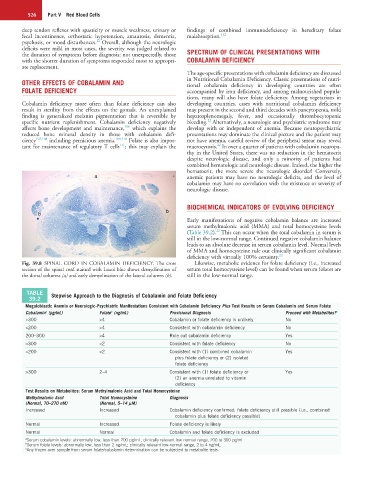
        Fig.  39.8  SPINAL  CORD  IN  COBALAMIN  DEFICIENCY. The  cross   Likewise, metabolic evidence for folate deficiency (i.e., increased
        section of the spinal cord stained with Luxol blue shows demyelination of   serum total homocysteine level) can be found when serum folates are
        the dorsal columns (a) and early demyelination of the lateral columns (b).   still in the low-normal range.

          TABLE   Stepwise Approach to the Diagnosis of Cobalamin and Folate Deficiency
          39.2
         Megaloblastic Anemia or Neurologic-Psychiatric Manifestations Consistent with Cobalamin Deficiency Plus Test Results on Serum Cobalamin and Serum Folate
                                     b
                a
         Cobalamin  (pg/mL)       Folate  (ng/mL)        Provisional Diagnosis                Proceed with Metabolites? c
         >300                     >4                     Cobalamin or folate deficiency is unlikely  No
         <200                     >4                     Consistent with cobalamin deficiency  No
         200–300                  >4                     Rule out cobalamin deficiency        Yes
         >300                     <2                     Consistent with folate deficiency    No
         <200                     <2                     Consistent with (1) combined cobalamin   Yes
                                                          plus folate deficiency or (2) isolated
                                                          folate deficiency
         >300                     2–4                    Consistent with (1) folate deficiency or   Yes
                                                          (2) an anemia unrelated to vitamin
                                                          deficiency
         Test Results on Metabolites: Serum Methylmalonic Acid and Total Homocysteine
         Methylmalonic Acid       Total Homocysteine     Diagnosis
         (Normal, 70–270 nM)      (Normal, 5–14 µM)
         Increased                Increased              Cobalamin deficiency confirmed; folate deficiency still possible (i.e., combined
                                                          cobalamin plus folate deficiency possible)
         Normal                   Increased              Folate deficiency is likely
         Normal                   Normal                 Cobalamin and folate deficiency is excluded
         a Serum cobalamin levels: abnormally low, less than 200 pg/mL; clinically relevant low-normal range, 200 to 300 pg/mL.
         b Serum folate levels: abnormally low, less than 2 ng/mL; clinically relevant low-normal range, 2 to 4 ng/mL.
         c Any frozen-over sample from serum folate/cobalamin determination can be subjected to metabolite tests.

