


Page 620 - Hematology_ Basic Principles and Practice ( PDFDrive )
P. 620
Chapter 39  Megaloblastic Anemias  529


             Summary of the Clinical Usefulness of Tests for Cobalamin and Folate   Serum Folates Are Misleadingly Elevated in
             Deficiencies                                          TABLE   Cobalamin (Vitamin B 12) Deficiency and/or Malaria
                                                                    39.4   Which Are Both Common in Resource-Limited
             Within the clinical context of hematologic or neurologic features that   Settings * (From Antony, 2015 )
                                                                                                   133
                                                                                 a,
             suggest the diagnosis of cobalamin deficiency, if the cobalamin levels
             are  suggestive  but  not  definitive,  then  the  MMA  and  homocysteine        Erythrocyte   Serum
             tests are an excellent gold standard test to confirm a clinical diagnosis.   Serum Folates  Folates  Cobalamin
             Patients with clinical cobalamin deficiency usually have MMA values
             over 1000 nM and homocysteine values over 25 µM. The MMA and   Pure folate   Low  Low          Normal/
             homocysteine  test  results  are  much  more  sensitive  than  cobalamin   deficiency             Low*
             levels and progressively increase much earlier than the drop in cobala-  Pure cobalamin   Normal/High* ,b  Low* ,b  Low
             min levels; one or both metabolites was increased in 99.8% of more   deficiency
             than 400 patients with proven cobalamin deficiency. 22
              Based on the lower costs of serum cobalamin and folate compared   Folate plus   Normal*  Low  Low
             with  serum  MMA  and  homocysteine  levels,  it  is  recommended  (see   cobalamin
             Table 39.2) to first use the cheaper tests that can assist in the diagnosis   deficiency
             of cobalamin and folate deficiency.  Clinicians should also restrict use   Pure malaria  Normal*/High* ,c  High* ,d,e  Normal
                                     22
             of serum MMA and homocysteine to patients with borderline cobalamin
             and folate levels; to patients with existing conditions associated with   Malaria plus   Normal*  Normal*/High*/  Normal
             difficulties  in  the  interpretation  of  test  results;  to  situations  in  which   folate   Low
             cobalamin and folate levels are low, when a high MMA level is useful in   deficiency
             confirming cobalamin deficiency (rather than attributing the condition   Malaria plus   Normal*/High* ,c  Normal*/High* ,e  Low
             to  folate  deficiency  alone);  and  to  patients  with  clearly  low  serum
             levels but for whom there is an alternative explanation for the findings   cobalamin
             that caused an unusual serum cobalamin level to be obtained (e.g.,   deficiency
             a diabetic or alcoholic with peripheral neuropathy, an alcoholic with   Malaria plus   Normal*/High* ,c  Low/Normal* ,e,f  Low
             a  high  MCV  and  a  low  serum  cobalamin  without  anemia).  In  these   folate plus
             cases, serum levels of metabolites can assist in the diagnosis of vitamin   cobalamin
             deficiency.                                             deficiency
              Diagnostic  algorithms  consistently  stress  the  value  of  clinical  data
             to  improve  the  pretest  probability  of  serum  cobalamin  and  serum   *The asterisk indicates misleading values in the clinical settings shown on the
             folate tests.  Without detailed clinical information, the combined test   left. The information presented in this table has been synthesized from several
                     22
             results for serum cobalamin, folate, and metabolite (homocysteine and   sources (see text and references).
                                                                   a
                                                                   Both cobalamin deficiency and clinical malaria and other hemolytic states can
             MMA)  are  not  sufficiently  unambiguous  to  diagnose  and  distinguish   complicate the diagnosis of folate deficiency using tests for serum- or
             cobalamin deficiency from combined cobalamin-plus-folate deficiency.   erythrocyte-folate concentration. 134
             In  combined  cobalamin-plus-folate  deficiency,  both  vitamins  would   b Cobalamin deficiency is accompanied by inability to use folates for one-carbon
             be needed to restore baseline values, particularly of homocysteine. 22  metabolism, so folates leak out of erythroid precursors into serum.
                                                                   c Release of the 30-fold excess folate from infected erythroid precursors,
                                                                   reticulocytes, and mature erythrocytes during hemolysis raises serum folate
                                                                   levels. (An as-yet-unknown quantity of folate is released into serum when
                                                                   folate-rich hepatocytes are destroyed during the exoerythrocytic hepatic phase
            to  baseline. 127–132  Thus  associated  nutritional  cobalamin  deficiency   of malaria.)
            has  the  potential  to  consistently  mask  the  coexistence  of  mild-  to   d Hemolysis induces a compensatory reticulocytosis; these reticulocytes are
                                                                                           82,83,127
            moderate  folate  deficiency  if  the  unwary  clinician  uses  the  serum   richer in folate than mature erythrocytes.
                                                                   e
                                                                   Plasmodium falciparum can also synthesize folates in erythrocyte cultures in
            folate level as a gold standard for diagnosing folate deficiency in this   vitro 135  and raises erythrocyte folates in animal models with high levels of
            clinical  setting.  Second,  such  patients  (with  combined  nutritional   parasitemia. 136
            folate  and  cobalamin  deficiency)  often  reside  in  malarious  regions   f Reticulocytopenia in severe Plasmodium falciparum malaria, caused by either
            where there may be ongoing hemolysis from malaria per se as well   combined cobalamin deficiency plus folate deficiency, which can trigger a
                                                                   reticulocytopenic (megaloblastic) crisis, or cytokine-induced inhibition of
            as intrinsic hemolysis from associated hemoglobinopathies that are   hematopoiesis, will negate an expected rise in erythrocyte folates.
            common in these regions (e.g., thalassemia, sickle cell disease, glucose-  Reused with permission from Antony AC. Megaloblastic anemias. In: Goldman
            6-phosphate  dehydrogenase  deficiency).  In  a  patient  with  malaria   L, Schafer A, eds. Cecil Medicine, 25th Edition. Philadelphia, 2015, Elsevier-
            during hemolysis of Plasmodium falciparum infected erythroid precur-  Saunders: Volume 1, Chapter 164, pp. 1104–1114.
            sors, reticulocytes, and mature erythrocytes, there will be substantial
            release of the 30-fold more folate-rich intraerythrocyte contents into
            serum,  thereby  artificially  raising  the  baseline  serum  folate  level.
            Moreover, red cells normally contain substantial amounts of various   Other Tests
            forms of folate, i.e., 5-methyltetrahydrofolate (monoglutamates) and
                                                      69
            folate-polyglutamates of different glutamate chain lengths ; whereas   The clinical use of low holo-transcobalamin II (holo-TCII) levels, to
            clearance of such released folate monoglutamates would be hindered   provide information on the extent of saturation of serum TCII as an
                                                                                               137
            with  associated  cobalamin  deficiency, 127–132   we  also  know  that  the   early marker of cobalamin homeostasis  or to diagnose cobalamin
            released folate polyglutamates are also inefficiently transported back   deficiency in lieu of serum cobalamin values, is still unclear. This test
                                         34
            into  cells  relative  to  monoglutamates,   thereby  also  resulting  in   has not yet been sufficiently clinically validated 116,138  to define sensi-
            poor clearance. In this clinical context, the current assays for serum   tivity,  specificity,  and  other  clinical  confounders  that  can  alter  the
            folate (which are primarily designed to measure physiologic serum   results.
            5-methyltetrahydrofolate  monoglutamate)  may  not  consistently
            discriminate  among  these  forms  of  folates.  The  net  result  is  that
            a high serum folate could be reported in all such individuals with   PATHOGENESIS OF COBALAMIN DEFICIENCY
            malaria, even when the patient’s tissue folates are significantly depleted.
            This  predictable  masking  of  tissue  folate  depletion  argues  against   Nutritional Cobalamin Deficiency
            the  use  of  serum  tests  for  folate  deficiency  in  this  clinical  setting,
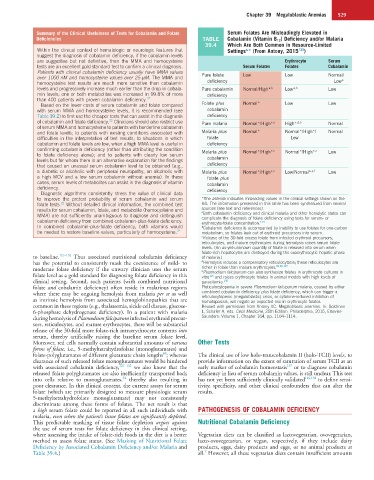
            where assessing the intake of folate-rich foods in the diet is a better   Vegetarian  diets  can  be  classified  as  lactovegetarian,  ovovegetarian,
            method  to  assess  folate  status.  (See  Masking  of  Nutritional  Folate   lacto-ovovegetarian,  or  vegan,  respectively,  if  they  include  dairy
            Deficiency by Associated Cobalamin Deficiency and/or Malaria and    products, eggs, dairy products and eggs, or no animal products at
                                                                    7
            Table 39.4.)                                          all.  However, all these vegetarian diets contain insufficient amounts

