


Page 619 - Hematology_ Basic Principles and Practice ( PDFDrive )
P. 619
528    Part V  Red Blood Cells


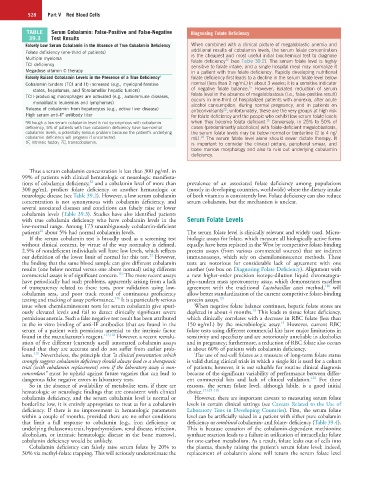
          TABLE   Serum Cobalamin: False-Positive and False-Negative   Diagnosing Folate Deficiency
          39.3    Test Results
         Falsely Low Serum Cobalamin in the Absence of True Cobalamin Deficiency  When combined with a clinical picture of megaloblastic anemia and
         Folate deficiency (one-third of patients)              additional results of cobalamin levels, the serum folate concentration
                                                                is  the  cheapest  and  most  useful  initial  biochemical  test  to  diagnose
         Multiple myeloma                                       folate deficiency  (see Table 39.2). The serum folate level is highly
                                                                           22
         TCI deficiency                                         sensitive to folate intake, and a single hospital meal may normalize it
         Megadose vitamin C therapy                             in a patient with true folate deficiency. Rapidly developing nutritional
         Falsely Raised Cobalamin Levels in the Presence of a True Deficiency a  folate deficiency first leads to a decline in the serum folate level below
         Cobalamin binders (TCI and II) increased (e.g., myeloproliferative   normal (less than 2 ng/mL) in about 3 weeks; it is a sensitive indicator
                                                                                  15
            states, hepatomas, and fibrolamellar hepatic tumors)  of  negative  folate  balance.   However,  isolated  reduction  of  serum
         TCII-producing macrophages are activated (e.g., autoimmune diseases,   folate level in the absence of megaloblastosis (i.e., false-positive result)
                                                                occurs in one-third of hospitalized patients with anorexia, after acute
            monoblastic leukemias and lymphomas)                alcohol  consumption,  during  normal  pregnancy,  and  in  patients  on
         Release of cobalamin from hepatocytes (e.g., active liver disease)  anticonvulsants ; unfortunately, these are the very groups at high risk
                                                                          22
         High serum anti-IF antibody titer                      for folate deficiency and the people who exhibit low serum folate levels
                                                                                        15
         a Although a low serum cobalamin level is not synonymous with cobalamin   when  they  become  folate  deficient.   Conversely,  in  25%  to  50%  of
         deficiency, 5% of patients with true cobalamin deficiency have low-normal   cases (predominantly alcoholics) with folate-deficient megaloblastosis,
         cobalamin levels, a potentially serious problem because the patient’s underlying   the serum folate levels may be below normal or borderline (2 to 4 ng/
         cobalamin deficiency will progress if uncorrected.     mL).   The  serum  folate  level  alone  should  never  dictate  therapy.  It
                                                                   22
         IF, Intrinsic factor; TC, transcobalamin.              is  important  to  consider  the  clinical  picture,  peripheral  smear,  and
                                                                bone marrow morphology and also to rule out underlying cobalamin
                                                                deficiency.
           Thus a serum cobalamin concentration is less than 300 pg/mL in
        99% of patients with clinical hematologic or neurologic manifesta-
                              22
        tions of cobalamin deficiency,  and a cobalamin level of more than   prevalence  of  an  associated  folate  deficiency  among  populations
        300 pg/mL  predicts  folate  deficiency  or  another  hematologic  or   (mostly in developing countries, worldwide) where the dietary intake
        neurologic disease (see Table 39.2). However, a low serum cobalamin   of both vitamins is consistently low. Folate deficiency can also reduce
        concentration  is  not  synonymous  with  cobalamin  deficiency,  and   serum cobalamin, but the mechanism is unclear.
        several associated diseases and conditions can falsely raise or lower
        cobalamin levels (Table 39.3). Studies have also identified patients
        with  true  cobalamin  deficiency  who  have  cobalamin  levels  in  the   Serum Folate Levels
        low-normal range. Among 173 unambiguously cobalamin-deficient
              22
        patients  about 5% had normal cobalamin levels.       The serum folate level is clinically relevant and widely used. Micro-
           If  the  serum  cobalamin  test  is  broadly  used  as  a  screening  test   biologic assays for folate, which measure all biologically active forms
        without clinical context, by virtue of the way normalcy is defined,   equally, have been replaced in the West by competitive folate-binding
        2.5% of nondeficient individuals will have low levels, which reflects   protein  assays  (from  various  commercial  sources)  that  are  indirect
                                                  22
        our definition of the lower limit of normal for this test.  However,   immunoassays,  which  rely  on  chemiluminescence  methods. These
        the finding that the same blood sample can give different cobalamin   tests  are  notorious  for  considerable  lack  of  agreement  with  one
        results (one below normal versus one above normal) using different   another (see box on Diagnosing Folate Deficiency). Alignment with
                                        116
        commercial assays is of significant concern.  The more recent assays   a  new  higher-order  precision  isotope-dilution  liquid  chromatogra-
        have periodically had such problems, apparently arising from a lack   phy–tandem mass spectrometry assay, which demonstrates excellent
                                                                                                           120
        of  transparency  related  to  these  tests,  poor  validation  using  low-  agreement  with  the  traditional  Lactobacillus  casei  method,   will
        cobalamin  sera,  and  poor  track  record  of  continuous  proficiency   allow better standardization of the current competitive folate-binding
                                       116
        testing and tracking of assay performance.  It is a particularly serious   protein assays. 121
        issue when chemiluminescent tests for serum cobalamin give spuri-  When negative folate balance continues, hepatic folate stores are
                                                                                    15
        ously  elevated  levels  and  fail  to  detect  clinically  significant  severe   depleted in about 4 months.  This leads to tissue folate deficiency,
        pernicious anemia. Such a false negative test result has been attributed   which clinically correlates with a decrease in RBC folate (less than
                                                                                             15
        to the in vitro binding of anti-IF antibodies (that are found in the   150 ng/mL)  by  the  microbiologic  assay.   However,  current  RBC
        serum  of  a  patient  with  pernicious  anemia)  to  the  intrinsic  factor   folate tests using different commercial kits have major limitations in
        found in the manufacturer’s reagent. 117,118  However, a recent reevalu-  sensitivity and specificity and are notoriously unreliable in alcoholics
        ation of five different (currently used) automated cobalamin assays   and in pregnancy; furthermore, a reduction of RBC folate also occurs
        found  that  they  are  accurate  and  do  not  suffer  from  earlier  prob-  in about 60% of patients with cobalamin deficiency.
            119
        lems.  Nevertheless, the principle that “a clinical presentation which   The use of red-cell folates as a measure of long-term folate status
        strongly suggests cobalamin deficiency should always lead to a therapeutic   is valid during clinical trials in which a single kit is used for a cohort
        trial (with cobalamin replacement) even if the laboratory assay is non-  of patients; however, it is not valuable for routine clinical diagnosis
        concordant” must be upheld against future vagaries that can lead to   because of the significant variability of performance between differ-
                                                                                                       122
        dangerous false negative errors in laboratory tests.  ent  commercial  kits  and  lack  of  clinical  validation.   For  these
           So in the absence of availability of metabolite tests, if there are   reasons,  the  serum  folate  level,  although  labile,  is  a  good  initial
        hematologic or neurologic findings that are consistent with clinical   choice. 15,123–126
        cobalamin deficiency, and the serum cobalamin level is normal or   However, there are important caveats to measuring serum folate
        borderline low, it is entirely appropriate to treat as for a cobalamin   levels in certain clinical settings (see Caveats Related to the Use of
        deficiency.  If  there  is  no  improvement  in  hematologic  parameters   Laboratory Tests in Developing Countries). First, the serum folate
        within a couple of months, provided there are no other conditions   level can be artificially raised in a patient with either pure cobalamin
        that  limit  a  full  response  to  cobalamin  (e.g.,  iron  deficiency  or   deficiency or combined cobalamin- and folate- deficiency (Table 39.4).
        underlying thalassemia trait, hypothyroidism, renal disease, infection,   This  is  because  cessation  of  the  cobalamin-dependent  methionine
        alcoholism,  or  intrinsic  hematologic  disease  in  the  bone  marrow),   synthase reaction leads to a failure in utilization of intracellular folate
        cobalamin deficiency would be unlikely.               for one-carbon metabolism. As a result, folate leaks out of cells into
           Cobalamin  deficiency  can  falsely  raise  serum  folate  by  20%  to   the plasma, thereby raising the patient’s serum folate level; indeed,
        30% via methyl-folate trapping. This will seriously underestimate the   replacement  of  cobalamin  alone  will  return  the  serum  folate  level

