


Page 687 - Hematology_ Basic Principles and Practice ( PDFDrive )
P. 687
Chapter 41  Pathobiology of Sickle Cell Disease  579


                                                         6
                                                        β glu→val

                      αβ dimer assembly               Hb polymerization                      Hb instability

                                                                                              Hb oxidation
                          % HbS
                                               Sickling
                                                          +       Mechano-
                                                                  sensitivity        Membrane         • O 2 −
                          MCH C                                                     HC, heme, Fe       H 2 O 2
                             S
                                                                                                       • OH
                                                                           LOOH
                                  +
                                 K  & H O                      PS
                                     2
                                   loss                          out
                                               ?   Vesicles
                                                                                  −S−S−     MDA        HC/B3
                        Dehydration                           C5b-9                                   clustering
                                            Fragility
                                                                                                + Ig     + Ig
                       ↓ deformability

                         Trapping           Fragmentation    Osmotic lysis              Erythrophagocytosis
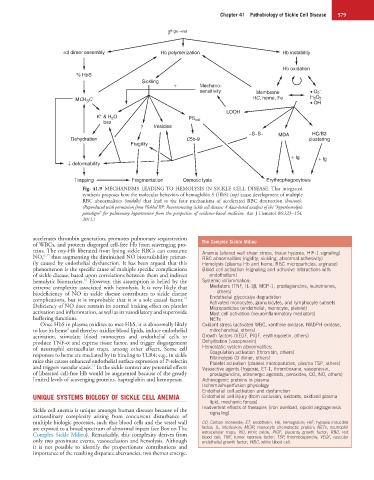
                            Fig.  41.9  MECHANISMS  LEADING TO  HEMOLYSIS  IN  SICKLE  CELL  DISEASE. This  integrated
                            synthesis proposes how the molecular behaviors of hemoglobin S (HbS) (top) cause development of multiple
                            RBC  abnormalities  (middle)  that  lead  to  the  four  mechanisms  of  accelerated  RBC  destruction  (bottom).
                            (Reproduced with permission from Hebbel RP: Reconstructing sickle cell disease: A data-based analysis of the “hyperhemolysis
                            paradigm” for pulmonary hypertension from the perspective of evidence-based medicine. Am J Hematol 86:123−154,
                            2011.)


            accelerates thrombin generation, promotes pulmonary sequestration   The Complex Sickle Milieu
            of WBCs, and protects disgorged cell-free Hb from scavenging pro-
            teins. The oxy-Hb liberated from lysing sickle RBCs can consume   Anemia (altered wall shear stress, tissue hypoxia, HIF-1 signaling)
            NO, 6,15  thus augmenting the diminished NO bioavailability primar-  RBC abnormalities (rigidity, sickling, abnormal adhesivity)
            ily caused by endothelial dysfunction. It has been argued that this   Hemolysis (plasma Hb and heme, RBC microparticles, arginase)
            phenomenon is the specific cause of multiple specific complications   Blood cell activation (signaling and adhesive interactions with
            of sickle disease, based upon correlations between them and indirect   endothelium)
                            16
            hemolytic biomarkers.  However, this assumption is belied by the   Systemic inflammation:
            extreme complexity associated with hemolysis. It is very likely that   Mediators (TNF, IL-1β, MCP-1, prostaglandins, leukotrienes,
            biodeficiency  of  NO  in  sickle  disease  contributes  to  sickle  disease   others)
                                                             12
            complications, but it is improbable that it is a sole causal factor.    Endothelial glycocalyx degradation
                                                                      Activated monocytes, granulocytes, and lymphocyte subsets
            Deficiency of NO does restrain its normal braking effect on platelet   Microparticles (endothelial, monocyte, platelet)
            activation and inflammation, as well as its vasodilatory and superoxide   Mast cell activation (neuroinflammatory mediators)
            buffering functions.                                      NETs
              Once HbS in plasma oxidizes to met-HbS, it is abnormally likely   Oxidant stress (activated WBC, xanthine oxidase, NADPH oxidase,
                       2
            to lose its heme  and thereby: oxidize blood lipids, induce endothelial   mitochondrial, others)
            activation,  stimulate  blood  monocytes  and  endothelial  cells  to   Growth factors (VEGF, PlGF, erythropoietin, others)
            produce TNF-α and express tissue factor, and trigger disgorgement   Dehydration (vasopressin)
            of  neutrophil  extracellular  traps,  among  other  effects.  Some  cell   Hemostatic system abnormalities:
            responses to heme are mediated by its binding to TLR4; e.g., in sickle   Coagulation activation (thrombin, others)
                                                                      Fibrinolysis (D dimer, others)
            mice this causes enhanced endothelial surface expression of P-selectin   Platelet activation (platelet microparticles, plasma TSP, others)
                               17
            and triggers vascular stasis.  In the sickle context any potential effects   Vasoactive agents (hypoxia, ET-1, thromboxane, vasopressin,
            of liberated cell-free Hb would be augmented because of the greatly   prostaglandins, adrenergic agonists, peroxides, CO, NO, others)
            limited levels of scavenging proteins, haptoglobin and hemopexin.  Adhesogenic proteins in plasma
                                                                   Ischemia/reperfusion physiology
                                                                   Endothelial cell activation and dysfunction
            UNIQUE SYSTEMS BIOLOGY OF SICKLE CELL ANEMIA           Endothelial cell injury (from occlusion, oxidants, oxidized plasma
                                                                      lipid, mechanic forces)
                                                                   Inadvertent effects of therapies (iron overload, opioid angiogenesis
            Sickle cell anemia is unique amongst human diseases because of the   signaling)
            extraordinary  complexity  arising  from  concurrent  disturbance  of
            multiple biologic processes, such that blood cells and the vessel wall   CO, Carbon monoxide; ET, endothelin; Hb, hemoglobin; HIF, hypoxia inducible
            are exposed to a broad spectrum of abnormal inputs (see Box on The   factor;  IL,  interleukin;  MCIP,  monocyte  chemotactic  protein;  NETs,  neutrophil
            Complex Sickle Milieu). Remarkably, this complexity derives from   extracellular  traps;  NO,  nitric  oxide;  PlGF,  placenta  growth  factor;  RBC,  red
                                                                   blood  cell;  TNF,  tumor  necrosis  factor;  TSP,  thrombospondin;  VEGF,  vascular
            only two proximate events, vasoocclusion and hemolysis. Although   endothelial growth factor; WBC, white blood cell.
            it  is  not  possible  to  identify  the  proportionate  contributions  and
            importance of the resulting disparate aberrancies, two themes emerge.

