


Page 69 - Hematology_ Basic Principles and Practice ( PDFDrive )
P. 69
Chapter 4  Regulation of Gene Expression, Transcription, Splicing, and RNA Metabolism  41


                        Exon     Intron     Exon                                        mRNA
                                                                                            -AAAAAAAAA
                    5 -                             -3
                                                snRNPs              Nucleus                             Nuclear
                                                                                                       filamentous
                                                                                                        proteins
                         5 -                   -3                           Nuclear
                                                                            basket
                     Spliceosome
                                  DNA
                                  lariat
                                                                        Nuclear         Central
                                                                       envelope       core channel


                           5 -           -3
                             Mature mRNA
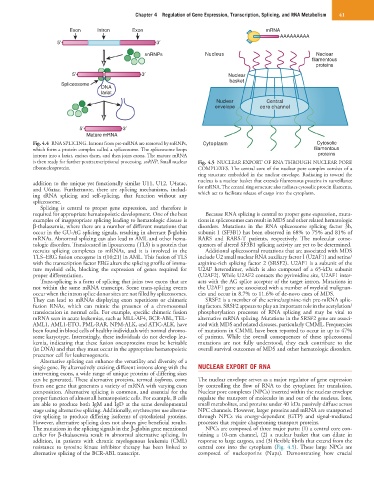
            Fig. 4.4  RNA SPLICING. Introns from pre-mRNA are removed by snRNPs,   Cytoplasm             Cytosolic
            which form a protein complex called a spliceosome. The spliceosome loops                    filamentous
            introns into a lariat, excises them, and then joins exons. The mature mRNA                   proteins
            is then ready for further posttranscriptional processing. snRNP, Small nuclear   Fig. 4.5  NUCLEAR EXPORT OF RNA THROUGH NUCLEAR PORE
            ribonucleoprotein.                                    COMPLEXES. The central core of the nuclear pore complex consists of a
                                                                  ring structure embedded in the nuclear envelope. Radiating in toward the
                                                                  nucleus is a nuclear basket that extends filamentous proteins in surveillance
            addition to the unique yet functionally similar U11, U12, U4atac,
            and  U6atac.  Furthermore,  there  are  splicing  mechanisms,  includ-  for mRNA. The central ring structure also radiates cytosolic protein filaments,
            ing  tRNA  splicing  and  self-splicing,  that  function  without  any   which act to facilitate release of cargo into the cytoplasm.
            spliceosome.
              Splicing  is  central  to  proper  gene  expression,  and  therefore  is
            required for appropriate hematopoietic development. One of the best   Because RNA splicing is central to proper gene expression, muta-
            examples of inappropriate splicing leading to hematologic disease is   tions in spliceosomes can result in MDS and other related hematologic
            β-thalassemia, where there are a number of different mutations that   disorders.  Mutations  in  the  RNA  spliceosome  splicing  factor  3b,
            occur in the GU-AG splicing signals, resulting in aberrant β-globin   subunit 1 (SF3B1) has been observed in 68% to 75% and 81% of
            mRNAs. Abnormal splicing can also lead to AML and other hema-  RARS  and  RARS-T  patients,  respectively.  The  molecular  conse-
            tologic disorders. Translocated in liposarcoma (TLS) is a protein that   quences of altered SF3B1 splicing activity are yet to be determined.
            recruits  splicing  complexes  to  mRNAs,  and  it  is  involved  in  the   Additional spliceosomal mutations that are associated with MDS
            TLS–ERG fusion oncogene in t(16;21) in AML. This fusion of TLS   include U2 small nuclear RNA auxiliary factor I (U2AF1) and serine/
            with the transcription factor ERG alters the splicing profile of imma-  arginine-rich splicing factor 2 (SRSF2). U2AF1 is a subunit of the
            ture  myeloid  cells,  blocking  the  expression  of  genes  required  for   U2AF  heterodimer,  which  is  also  composed  of  a  65-kDa  subunit
            proper differentiation.                               (U2AF2). While U2AF2 contacts the pyrimidine site, U2AF1 inter-
              Trans-splicing is a form of splicing that joins two exons that are   acts with the AG splice acceptor of the target intron. Mutations in
            not within the same mRNA transcript. Some trans-splicing events   the U2AF1 gene are associated with a number of myeloid malignan-
            occur when the intron splice donor sites are not filled by spliceosomes.   cies and occur in 8.7% to 11.6% of de-novo cases of MDS.
            They  can  lead  to  mRNAs  displaying  exon  repetitions  or  chimeric   SRSF2 is a member of the serine/arginine-rich pre-mRNA splic-
            fusion  RNAs,  which  can  mimic  the  presence  of  a  chromosomal   ing factors. SRSF2 appears to play an important role in the acetylation/
            translocation in normal cells. For example, specific chimeric fusion   phosphorylation  processes  of  RNA  splicing  and  may  be  vital  to
            mRNA seen in acute leukemias, such as MLL-AF4, BCR-ABL, TEL-  alternative mRNA splicing. Mutations in the SRSF2 gene are associ-
            AML1, AML1-ETO, PML-RAR, NPM-ALK, and ATIC-ALK, have   ated with MDS and related diseases, particularly CMML. Frequencies
            been found in blood cells of healthy individuals with normal chromo-  of mutations in CMML have been reported to occur in up to 47%
            some karyotype. Interestingly, these individuals do not develop leu-  of  patients.  While  the  overall  consequences  of  these  spliceosomal
            kemia, indicating that these fusion oncoproteins must be heritable   mutations  are  not  fully  understood,  they  each  contribute  to  the
            (in DNA) and that they must occur in the appropriate hematopoietic   overall survival outcomes of MDS and other hematologic disorders.
            precursor cell for leukemogenesis.
              Alternative splicing can enhance the versatility and diversity of a
            single gene. By alternatively excising different introns along with the   NUCLEAR EXPORT OF RNA
            intervening exons, a wide range of unique proteins of differing sizes
            can be generated. These alternative proteins, termed isoforms, come   The nuclear envelope serves as a major regulator of gene expression
            from one gene that generates a variety of mRNA with varying exon   by  controlling  the  flow  of  RNA  to  the  cytoplasm  for  translation.
            composition. Alternative splicing is common, and essential for the   Nuclear pore complexes (NPCs) inserted within the nuclear envelope
            proper function of almost all hematopoietic cells. For example, B cells   regulate the transport of molecules in and out of the nucleus. Ions,
            are able to produce both IgM and IgD at the same developmental   small metabolites, and proteins under 40 kDa passively diffuse across
            stage using alternative splicing. Additionally, erythrocytes use alterna-  NPC channels. However, larger proteins and mRNA are transported
            tive splicing to produce differing isoforms of cytoskeletal proteins.   through  NPCs  via  energy-dependent  (GTP)  and  signal-mediated
            However, alternative splicing does not always give beneficial results.   processes that require chaperoning transport proteins.
            The mutations in the splicing signals in the β-globin gene mentioned   NPCs are composed of three major parts: (1) a central core con-
            earlier for β-thalassemia result in abnormal alternative splicing. In   taining  a  10-nm  channel,  (2)  a  nuclear  basket  that  can  dilate  in
            addition,  in  patients  with  chronic  myelogenous  leukemia  (CML)   response to large cargoes, and (3) flexible fibrils that extend from the
            resistance  to  tyrosine  kinase  inhibitor  therapy  has  been  linked  to   central  core  into  the  cytoplasm  (Fig.  4.5).  These  large  NPCs  are
            alternative splicing of the BCR-ABL transcript.       composed  of  nucleoporins  (Nups).  Demonstrating  how  crucial

