


Page 71 - Hematology_ Basic Principles and Practice ( PDFDrive )
P. 71
Chapter 4  Regulation of Gene Expression, Transcription, Splicing, and RNA Metabolism  43
                                                       Transferrin receptor mRNA

                                                                 Five IREs in 3  UTR


                                 5             Protein coding                        AAAAAAAAA   3


                                                       − Fe

                                         IRP                              + Fe

                                                                                       Endonuclease
                             Protein coding               AAAAAAAAA   3

                                               Translation
                                                        5      Protein coding               AAAAAAAAA   3

                                                                                  RNA degradation


                                    Transferrin receptor protein

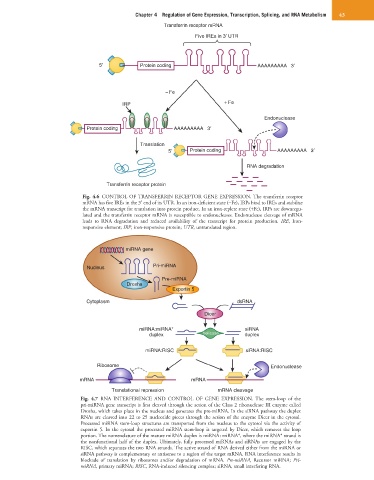
                            Fig. 4.6  CONTROL OF TRANSFERRIN RECEPTOR GENE EXPRESSION. The transferrin receptor
                            mRNA has five IREs in the 3′ end of its UTR. In an iron-deficient state (−Fe), IRPs bind to IREs and stabilize
                            the mRNA transcript for translation into protein product. In an iron-replete state (+Fe), IRPs are downregu-
                            lated and the transferrin receptor mRNA is susceptible to endonucleases. Endonuclease cleavage of mRNA
                            leads  to  RNA  degradation  and  reduced  availability  of  the  transcript  for  protein  production.  IRE,  Iron-
                            responsive element; IRP, iron-responsive protein; UTR, untranslated region.


                                          miRNA gene


                             Nucleus               Pri-miRNA
                                                      Pre-miRNA
                                          Drosha
                                                         Exportin 5

                             Cytoplasm                                         dsRNA
                                                                    Dicer

                                               miRNA:miRNA*                      siRNA
                                                  duplex           helicase      duplex

                                                 miRNA:RISC                      siRNA:RISC

                                 Ribosome                                                 Endonuclease

                           mRNA                                 mRNA
                                      Translational repression          mRNA cleavage
                           Fig.  4.7  RNA  INTERFERENCE  AND  CONTROL  OF  GENE  EXPRESSION. The  stem-loop  of  the
                           pri-miRNA gene transcript is first cleaved through the action of the Class 2 ribonuclease III enzyme called
                           Drosha, which takes place in the nucleus and generates the pre-miRNA. In the siRNA pathway the duplex
                           RNAs are cleaved into 22 to 25 nucleotide pieces through the action of the enzyme Dicer in the cytosol.
                           Processed miRNA stem-loop structures are transported from the nucleus to the cytosol via the activity of
                           exportin  5.  In  the cytosol  the  processed  miRNA  stem-loop  is targeted by Dicer,  which removes  the loop
                           portion. The nomenclature of the mature miRNA duplex is miRNA : miRNA*, where the miRNA* strand is
                           the nonfunctional half of the duplex. Ultimately, fully processed miRNAs and siRNAs are engaged by the
                           RISC, which separates the two RNA strands. The active strand of RNA derived either from the miRNA or
                           siRNA pathway is complementary or antisense to a region of the target mRNA. RNA interference results in
                           blockade  of  translation  by  ribosomes  and/or  degradation  of  mRNA.  Pre-miRNA,  Recursor  miRNA;  Pri-
                           miRNA, primary miRNA; RISC, RNA-induced silencing complex; siRNA, small interfering RNA.

