


Page 74 - Hematology_ Basic Principles and Practice ( PDFDrive )
P. 74
46    Part I  Molecular and Cellular Basis of Hematology


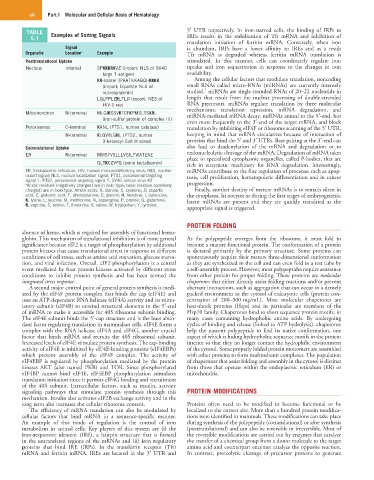
          TABLE   Examples of Sorting Signals                 5′  UTR  respectively.  In  iron-starved  cells,  the  binding  of  IRPs  to
           5.1                                                IREs  results  in  the  stabilization  of  Tfr  mRNA  and  inhibition  of
                                                              translation  initiation  of  ferritin  mRNA.  Conversely,  when  iron
                      Signal                                  is  abundant,  IRPs  have  a  lower  affinity  to  IREs  and  as  a  result
         Organelle    Location a  Example                     Tfr  mRNA  is  degraded  whereas  ferritin  mRNA  translation  is
         Posttranslational Uptake                             stimulated.  In  this  manner,  cells  can  coordinately  regulate  iron
         Nucleus      Internal   SPKKKRKVE (import; NLS of SV40   uptake  and  iron  sequestration  in  response  to  the  changes  in  iron
                                   large T antigen)           availability.
                                 KR-spacer (PAATKKAGQ)-KKKK      Among the cellular factors that modulate translation, noncoding
                                   (import; bipartite NLS of   small  RNAs  called  micro-RNAs  (miRNAs)  are  currently  intensely
                                                                    1
                                   nucleoplasmin)             studied.  miRNAs are single stranded RNAs of 20–22 nucleotide in
                                 LQLPPLERLTLD (export; NES of   length  that  result  from  the  nuclear  processing  of  double-stranded
                                   HIV-1 rev)                 RNA  precursors.  miRNAs  regulate  translation  by  three  molecular
                                                              mechanisms:  translation  repression,  mRNA  degradation,  and
         Mitochondrion  N-terminal  MLGIRSSVKTCFKPMSLTSKRL    miRNA-mediated mRNA decay. miRNAs anneal to the 5′-end, but
                                   (iron-sulfur protein of complex III)
                                                              even more frequently to the 3′-end of the target mRNA, and block
         Peroxisomes  C-terminal  KANL (PTS1, human catalase)  translation by inhibiting eIF4F or ribosome scanning of the 5′ UTR,
                      N-terminal  RLQVVLGHL (PTS2, human      keeping in mind that mRNA circularizes because of interaction of
                                   3-ketoacyl-CoA thiolase)   proteins that bind the 5′ and 3′ UTRs. Base pairing at the 3′-end can
         Cotranslational Uptake                               also  lead  to  deadenylation  of  the  mRNA  and  degradation  or  to
         ER           N-terminal  MMSFVSLLLVGILFWATEAE        endonucleolytic cleavage of the mRNA. Degradation of mRNA takes
                                                              place in specialized cytoplasmic organelles, called P-bodies, that are
                                 QLTKCEVFQ (ovine lactalbumin)  rich  in  enzymatic  machinery  for  RNA  degradation.  Interestingly,
         ER, Endoplasmic reticulum; HIV, human immunodeficiency virus; NES, nuclear   miRNAs contribute to the fine regulation of processes such as apop-
         export signal; NLS, nuclear localization signal; PTS1, peroxisomal targeting   tosis, cell proliferation, hematopoietic differentiation and in cancer
         signal-1; PTS2, peroxisomal targeting signal-2; SV40, simian virus 40.
         a Acidic residues (negatively charged) are in italic type; basic residues (positively   progression.
         charged) are in bold type. Amino acids: A, alanine; C, cysteine; D, aspartic   Finally, another destiny of mature mRNAs is to remain silent in
         acid; E, glutamic acid; F, phenylalanine; G, glycine; H, histidine; I, isoleucine;   the cytoplasm. In oocytes or during the first stages of embryogenesis,
         K, lysine; L, leucine; M, methionine; N, asparagine; P, proline; Q, glutamine;   latent  mRNAs  are  present  and  they  are  quickly  translated  as  the
         R, arginine; S, serine; T, threonine; V, valine; W, tryptophan; Y, tyrosine.
                                                              appropriate signal is triggered.

                                                              PROTEIN FOLDING
        absence of heme, which is required for assembly of functional hemo-
        globin. This mechanism of translational inhibition is of more general   As  the  polypeptide  emerges  from  the  ribosome,  it  must  fold  to
        significance because eIF2 is a target of phosphorylation by additional   become a mature functional protein. The conformation of a protein
        protein kinases that cause translational arrest in response to different   is  dictated  primarily  by  the  primary  structure.  Some  proteins  can
        conditions of cell stress, such as amino acid starvation, glucose starva-  spontaneously acquire their mature three-dimensional conformation
        tion, and viral infection. Overall, eIF2 phosphorylation is a central   as they are synthesized in the cell and can even fold in a test tube by
        event mediated by four protein kinases activated by different stress   a self-assembly process. However, most polypeptides require assistance
        conditions  to  inhibit  protein  synthesis  and  has  been  termed  the   from other protein for proper folding. These proteins are molecular
        integrated stress response.                           chaperones that either directly assist folding reactions and/or prevent
           A second major control point of general protein synthesis is medi-  aberrant interactions, such as aggregation that can occur in a densely
        ated by the eIF4F protein complex that binds the cap (eIF4E) and   packed environment as the cytosol of eukaryotic cells (protein con-
        uses an ATP-dependent RNA helicase (eIF4A) activity and its stimu-  centration  of  200–300 mg/mL).  Most  molecular  chaperones  are
        latory subunit (eIF4B) to unwind structural elements in the 5′-end   heat-shock  proteins  (Hsps)  and  in  particular  are  members  of  the
        of mRNA to make it accessible for 40S ribosome subunit binding.   Hsp70 family. Chaperones bind to short sequence protein motifs, in
        The eIF4E subunit binds the 5′-cap structure and is the least abun-  many  cases  containing  hydrophobic  amino  acids.  By  undergoing
        dant factor regulating translation in mammalian cells. eIF4E forms a   cycles of binding and release (linked to ATP hydrolysis), chaperones
        complex with the RNA helicase eIF4A and eIF4G, another crucial   help  the  nascent  polypeptide  to  find  its  native  conformation,  one
        factor  that  binds  mRNA  and  recruits  the  40S  ribosomal  subunit.   aspect of which is hiding hydrophobic sequence motifs in the protein
        Increased levels of eIF4E stimulate protein synthesis. The cap-binding   interior so that they no longer contact the hydrophilic environment
        activity of eIF4E is inhibited by eIF4E-binding proteins (eIF4EBPs)   of the cytosol. Some properly folded protein monomers are assembled
        which  prevent  assembly  of  the  eIF4F  complex.  The  activity  of   with other proteins to form multisubunit complexes. The population
        eIF4EBP is regulated by phosphorylation mediated by the protein   of chaperones that assist folding and assembly in the cytosol is distinct
        kinases  AKT  (also  named  PKB)  and TOR.  Since  phosphorylated   from those that operate within the endoplasmic reticulum (ER) or
        eIF4BP  cannot  bind  eIF4E,  eIF4EBP  phosphorylation  stimulates   mitochondria.
        translation initiation since it permits eIF4G binding and recruitment
        of  the  40S  subunit.  Extracellular  factors,  such  as  insulin,  activate
        signaling  pathways  that  stimulate  protein  synthesis  through  this   PROTEIN MODIFICATIONS
        mechanism. Insulin also activates eIF2B exchange activity and in the
        long term also increases the cellular ribosome content.  Proteins  often  need  to  be  modified  to  become  functional  or  be
           The efficiency of mRNA translation can also be modulated by   localized to the correct site. More than a hundred protein modifica-
        cellular  factors  that  bind  mRNA  in  a  sequence-specific  manner.   tions were identified in mammals. These modifications can take place
        An  example  of  this  mode  of  regulation  is  the  control  of  iron   during synthesis of the polypeptide (cotranslational) or after synthesis
        metabolism  in  animal  cells.  Key  players  of  this  system  are  (i)  the   (posttranslational) and can also be reversible or irreversible. Most of
        iron-responsive  element  (IRE),  a  hairpin  structure  that  is  formed   the reversible modifications are carried out by enzymes that catalyze
        in the untranslated regions of the mRNAs and (ii) iron regulatory   the transfer of a chemical group from a donor molecule to the target
        proteins  that  bind  IRE  (IRPs).  In  the  transferrin  receptor  (Tfr)   amino acid and counterpart enzymes catalyze the opposite reaction.
        mRNA  and  ferritin  mRNA,  IREs  are  located  in  the  3′  UTR  and   In  contrast,  proteolytic  cleavage  of  precursor  proteins  to  generate

