


Page 730 - Hematology_ Basic Principles and Practice ( PDFDrive )
P. 730
Chapter 44  Red Blood Cell Enzymopathies  617


                                                              Glutathione production
                                                                  GSH   GSSG
                                            Glucose
                                         ATD    Hexokinase     NADP       NADPH
                                                               NADP
                                                                          NADPH
                                         ADP
                                                                                6PG
                                           Glucose 6-P                          6PG
                                                Glucose       Glucose and phosphate dehydrogenase
                                                              Glucose and phosphate dehydrogenase
                                    Glycolysis  phosphoisomerase
                                                                   Pentose shunt
                                           Fructose 6-P            Pentose shunt
                                         ATD
                                                Phosphofructokinase
                                         ADP
                                        Fructose 1, 6-biP
                                                   Aldolase
                                       Glyceraldehyde 3-P         DHAP
                                                        Triosephosphate
                                       NAD
                                                        isomerase
                                      NADH
                                                 Glyceraldehyde phosphate
                                                 dehydrogenase
                                            1, 3-BPG                 Rapoport-
                                                                     Rapoport-
                                                                           Synthase
                                                                           Synthase
                                                                BPG
                                        ATD     Phosphoglycerate  BPG   Luebering  2.3-BPG
                                                                        Luebering
                                                                                   2.3-BPG
                                                                mutase
                                                                     Phosphatase
                                        ADP     kinase          mutase Phosphatase
                                                                        Shunt
                                          3-P-Glycerate                 Shunt
                                                Phosphoglyceromutase
                                          2-P-Glycerate
                                                Enolase
                                       Phosphoenolpyruvate
                                        ADH     Pyruvate
                                        ATD     Kinase
                                      NADH      Lactate
                                                dehydrogenase
                                      NAD
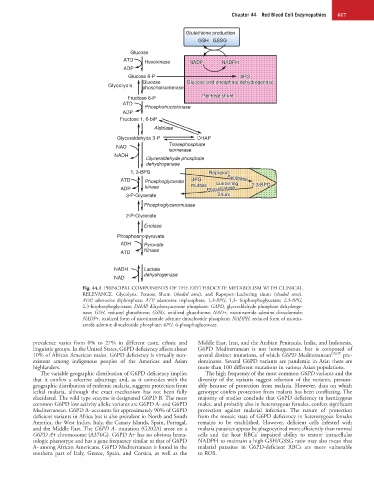
                            Fig. 44.1  PRINCIPAL COMPONENTS OF THE ERYTHROCYTE METABOLISM WITH CLINICAL
                            RELEVANCE.  Glycolysis,  Pentose  Shunt  (shaded  area),  and  Rapoport-Luebering  shunt  (shaded  area).
                            ADP,  adenosine  diphosphate;  ATP,  adenosine  triphosphate;  1,3-BPG,  1,3-  bisphosphoglycerate;  2,3-BPG,
                            2,3-bisphosphoglycerate; DHAP, dihydroxyacetone phosphate; GAPD, glyceraldehyde phosphate dehydroge-
                            nase;  GSH,  reduced  glutathione;  GSSG,  oxidized  glutathione;  NAD+,  nicotinamide  adenine  dinucleotide;
                            NADP+, oxidized form of nicotinamide adenine dinucleotide phosphate; NADPH, reduced form of nicotin-
                            amide adenine dinucleotide phosphate; 6PG, 6-phosphogluconate.

            prevalence  varies  from  0%  to  27%  in  different  caste,  ethnic  and   Middle East, Iran, and the Arabian Peninsula, India, and Indonesia.
            linguistic groups. In the United States, G6PD deficiency affects about   G6PD  Mediterranean  is  not  homogeneous,  but  is  composed  of
            10% of African American males. G6PD deficiency is virtually non-  several distinct mutations, of which G6PD Mediterranean C563T  pre-
            existent  among  indigenous  peoples  of  the  Americas  and  Asian   dominates. Several G6PD variants are pandemic in Asia; there are
            highlanders.                                          more than 100 different mutations in various Asian populations.
              The variable geographic distribution of G6PD deficiency implies   The high frequency of the most common G6PD variants and the
            that  it  confers  a  selective  advantage  and,  as  it  coincides  with  the   diversity  of  the  variants  suggest  selection  of  the  variants,  presum-
            geographic distribution of endemic malaria, suggests protection from   ably  because  of  protection  from  malaria.  However,  data  on  which
            lethal  malaria,  although  the  exact  mechanism  has  not  been  fully   genotype confers protection from malaria has been conflicting. The
            elucidated. The wild type enzyme is designated G6PD B. The most   majority of studies conclude that G6PD deficiency in hemizygous
            common G6PD low activity allelic variants are G6PD A- and G6PD   males, and probably also in heterozygous females, confers significant
            Mediterranean. G6PD A- accounts for approximately 90% of G6PD   protection  against  malarial  infection.  The  nature  of  protection
            deficient variants in Africa but is also prevalent in North and South   from the mosaic state of G6PD deficiency in heterozygous females
            America, the West Indies, Italy, the Canary Islands, Spain, Portugal,   remains  to  be  established.  However,  deficient  cells  infested  with
            and the Middle East. The G6PD A- mutation (G202A) arose on a   malaria parasites appear be phagocytized more efficiently than normal
            G6PD A+ chromosome (A376G). G6PD A+ has no obvious hema-  cells  and  the  host  RBCs’  impaired  ability  to  restore  intracellular
            tologic phenotype and has a gene frequency similar to that of G6PD   NADPH to maintain a high GSH/GSSG ratio may also mean that
            A- among African Americans. G6PD Mediterranean is found in the   malarial  parasites  in  G6PD-deficient  RBCs  are  more  vulnerable
            southern  part  of  Italy,  Greece,  Spain,  and  Corsica,  as  well  as  the   to ROS.

