


Page 727 - Hematology_ Basic Principles and Practice ( PDFDrive )
P. 727
614    Part V  Red Blood Cells


                      A                                          C

                                         G helix                                G helix


                                                                                           67 val
                                           87 his
                      E helix                                                92 his
                                         Fe
                                                                                   Fe
                                                                                              E helix
                                58 his              F helix           F helix


                      B                                         D
                                         G helix                                G helix


                                           87 his                                      67 glu
                      E helix                                                92 his
                                       Fe
                                                                                  Fe
                                                                                      G helix
                                58 tyr                                                        E helix
                                                    F helix          F helix

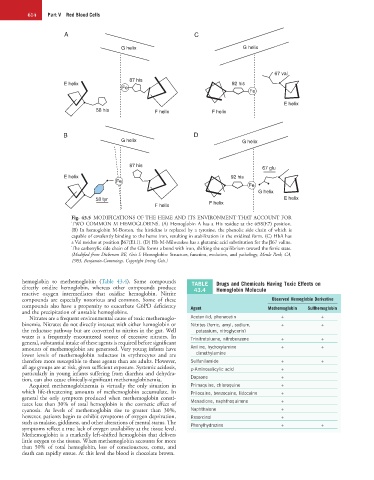
                        Fig. 43.5  MODIFICATIONS OF THE HEME AND ITS ENVIRONMENT THAT ACCOUNT FOR
                        TWO COMMON M HEMOGLOBINS. (A) Hemoglobin A has a His residue at the α58(E7) position.
                        (B) In hemoglobin M-Boston, the histidine is replaced by a tyrosine, the phenolic side chain of which is
                        capable of covalently binding to the heme iron, resulting in stabilization in the oxidized form. (C) HbA has
                        a Val residue at position β67(E11). (D) Hb M-Milwaukee has a glutamic acid substitution for the β67 valine.
                        The carboxylic side chain of the Glu forms a bond with iron, shifting the equilibrium toward the ferric state.
                        (Modified from Dickerson RE, Geis I: Hemoglobin: Structure, function, evolution, and pathology, Menlo Park, CA,
                        1983, Benjamin-Cummings. Copyright Irving Geis.)


        hemoglobin  to  methemoglobin  (Table  43.4).  Some  compounds   TABLE   Drugs and Chemicals Having Toxic Effects on
        directly  oxidize  hemoglobin,  whereas  other  compounds  produce   43.4  Hemoglobin Molecule
        reactive  oxygen  intermediates  that  oxidize  hemoglobin.  Nitrite
        compounds  are  especially  notorious  and  common.  Some  of  these              Observed Hemoglobin Derivative
        compounds also have a propensity to exacerbate G6PD deficiency   Agent           Methemoglobin  Sulfhemoglobin
        and the precipitation of unstable hemoglobins.
           Nitrates are a frequent environmental cause of toxic methemoglo-  Acetanilid, phenacetin  +    +
        binemia. Nitrates do not directly interact with either hemoglobin or   Nitrites (ferric, amyl, sodium,   +  +
        the reductase pathway but are converted to nitrites in the gut. Well   potassium, nitroglycerin)
        water  is  a  frequently  encountered  source  of  excessive  nitrates.  In   Trinitrotoluene, nitrobenzene  +  +
        general, substantial intake of these agents is required before significant
        amounts of methemoglobin are generated. Very young infants have   Aniline, hydroxylamine   +      +
        lower  levels  of  methemoglobin  reductase  in  erythrocytes  and  are   dimethylamine
        therefore more susceptible to these agents than are adults. However,   Sulfanilamide  +           +
        all age groups are at risk, given sufficient exposure. Systemic acidosis,   p-Aminosalicylic acid  +
        particularly in young infants suffering from diarrhea and dehydra-
        tion, can also cause clinically-significant methemoglobinemia.  Dapsone              +
           Acquired  methemoglobinemia  is  virtually  the  only  situation  in   Primaquine, chloroquine  +
        which  life-threatening  amounts  of  methemoglobin  accumulate.  In   Prilocaine, benzocaine, lidocaine  +
        general the only symptom produced when methemoglobin consti-                         +
        tutes  less  than  30%  of  total  hemoglobin  is  the  cosmetic  effect  of   Menadione, naphthoquinone
        cyanosis.  As  levels  of  methemoglobin  rise  to  greater  than  30%,   Naphthalene  +
        however, patients begin to exhibit symptoms of oxygen deprivation,   Resorcinol      +
        such as malaise, giddiness, and other alterations of mental status. The   Phenylhydrazine  +      +
        symptoms reflect a true lack of oxygen availability at the tissue level.
        Methemoglobin is a markedly left-shifted hemoglobin that delivers
        little oxygen to the tissues. When methemoglobin accounts for more
        than  50%  of  total  hemoglobin,  loss  of  consciousness,  coma,  and
        death can rapidly ensue. At this level the blood is chocolate brown.

