


Page 725 - Hematology_ Basic Principles and Practice ( PDFDrive )
P. 725
612    Part V  Red Blood Cells


        Some  patients  require  transfusions  during  bouts  of  severe  acute        High-affinity Hb
        hemolytic anemia. Patients who have significant morbidity because   100                             20
        of chronic anemia or repeated episodes of severe hemolysis should be   2.5
        considered  candidates  for  splenectomy,  especially  if  hypersplenism
        has developed. Children with severe hemolysis may require transfu-  5.3
        sion support until they are old enough (at least 3 or 4 years of age)   80                          16
        to  undergo  splenectomy  without  unacceptable  immunologic  com-             HbA
        promise. Splenectomy is usually effective for abolition or reduction   9.5
        of anemia. However, splenectomy should be used only as a last resort               Low-affinity Hb
        because of the long-term risks of overwhelming sepsis and thrombo-  60                              12
        sis.  Infection  often  exacerbates  hemolysis.  Fever  should  therefore
        prompt  close  monitoring  of  patients  for  evidence  of  hemolysis  or   O 2  saturation (%)  50     O 2  content (vol %)
        infection.  Postsplenectomy  patients  with  a  hemolytic  diathesis  are
        also afflicted by a hypercoagulable state, probably due to the deranged   40                        8
        membrane architecture resulting from oxidative damage. They thus
        require monitoring for thrombotic events and may need intermittent
        or long-term anticoagulant therapy.
                                                                20                                          4
        HEMOGLOBINS WITH INCREASED OXYGEN AFFINITY

        Efficient oxygen delivery by hemoglobin depends on the sigmoid shape   0                            0
        of the hemoglobin-oxygen affinity curve. During the transition from   0  20  40   60      80      100
        the fully deoxygenated to the fully oxygenated state, the initial oxygen-  O  pressure (mm Hg)
                                                                                 2
        ation steps occur with difficulty. In fact, the act of binding the first
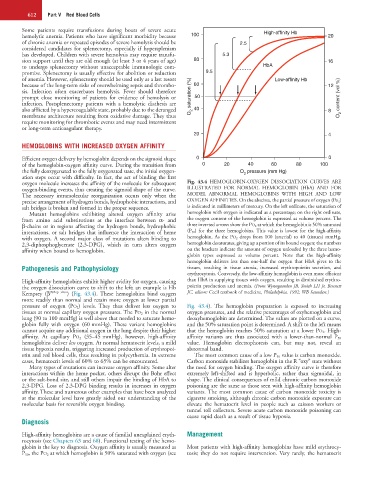
        oxygen molecule increases the affinity of the molecule for subsequent   Fig.  43.4  HEMOGLOBIN-OXYGEN  DISSOCIATION  CURVES  ARE
        oxygen-binding events, thus creating the sigmoid shape of the curve.   ILLUSTRATED  FOR  NORMAL  HEMOGLOBIN  (HbA)  AND  FOR
        The  necessary  intramolecular  reorganization  occurs  only  when  the   MODEL  ABNORMAL  HEMOGLOBINS  WITH  HIGH  AND  LOW
        precise arrangement of hydrogen bonds, hydrophobic interactions, and   OXYGEN AFFINITIES. On the abscissa, the partial pressure of oxygen (Po 2 )
        salt bridges is broken and formed in the proper sequence.  is indicated in millimeters of mercury. On the left ordinate, the saturation of
           Mutant  hemoglobins  exhibiting  altered  oxygen  affinity  arise   hemoglobin with oxygen is indicated as a percentage; on the right ordinate,
        from  amino  acid  substitutions  at  the  interface  between  α-  and   the oxygen content of the hemoglobin is expressed as volume percent. The
        β-chains or in regions affecting the hydrogen bonds, hydrophobic   three inverted arrows show the PO 2  at which the hemoglobin is 50% saturated
        interactions, or salt bridges that influence the interaction of heme   (P 50 )  for  the  three  hemoglobins. This  value  is  lowest  for  the  high-affinity
        with  oxygen.  A  second  major  class  of  mutations  alters  binding  to   hemoglobin. As the PO 2  drops from 100 (arterial) to 40 (tissues) mmHg,
        2,3-diphosphoglycerate  (2,3-DPG),  which  in  turn  alters  oxygen   hemoglobin desaturates, giving up a portion of its bound oxygen; the numbers
        affinity when bound to hemoglobin.                    on the brackets indicate the amount of oxygen unloaded by the three hemo-
                                                              globin  types  expressed  as  volume  percent.  Note  that  the  high-affinity
                                                              hemoglobin  delivers  less  than  one-half  the  oxygen  that  HbA  gives  to  the
        Pathogenesis and Pathophysiology                      tissues,  resulting  in  tissue  anoxia,  increased  erythropoietin  secretion,  and
                                                              erythrocytosis. Conversely, the low-affinity hemoglobin is even more efficient
        High-affinity hemoglobins exhibit higher avidity for oxygen, causing   than HbA in supplying tissues with oxygen, resulting in diminished erythro-
        the oxygen dissociation curve to shift to the left; an example is Hb   poietin production and anemia. (From Wynngaarden JB, Smith LH Jr, Bennett
        Kempsey  (β 99Asp→Asn )  (Fig.  43.4). These  hemoglobins  bind  oxygen   JC, editors: Cecil textbook of medicine, Philadelphia, 1992, WB Saunders.)
        more readily than normal and retain more oxygen at lower partial
        pressure  of  oxygen  (PO 2 )  levels.  They  thus  deliver  less  oxygen  to   Fig.  43.4).  The  hemoglobin  preparation  is  exposed  to  increasing
        tissues at normal capillary oxygen pressures. The PO 2  in the normal   oxygen pressures, and the relative percentages of oxyhemoglobin and
        lung (90 to 100 mmHg) is well above that needed to saturate hemo-  deoxyhemoglobin are determined. The values are plotted on a curve,
        globin  fully  with  oxygen  (60 mmHg). These  variant  hemoglobins   and the 50% saturation point is determined. A shift to the left means
        cannot acquire any additional oxygen in the lung despite their higher   that the hemoglobin reaches 50% saturation at a lower PO 2 . High-
        affinity.  At  capillary  PO 2   (35–45 mmHg),  however,  high-affinity   affinity  variants  are  thus  associated  with  a  lower-than-normal  P 50
        hemoglobins deliver less oxygen. At normal hematocrit levels, a mild   value.  Hemoglobin  electrophoresis  can,  but  may  not,  reveal  an
        tissue hypoxia results, triggering increased production of erythropoi-  abnormal band.
        etin and red blood cells, thus resulting in polycythemia. In extreme   The most common cause of a low P 50  value is carbon monoxide.
        cases, hematocrit levels of 60% to 65% can be encountered.  Carbon monoxide stabilizes hemoglobin in the R “oxy” state without
           Many types of mutations can increase oxygen affinity. Some alter   the need for oxygen binding. The oxygen affinity curve is therefore
        interactions within the heme pocket, others disrupt the Bohr effect   extremely  left-shifted  and  is  hyperbolic,  rather  than  sigmoidal,  in
        or the salt-bond site, and still others impair the binding of HbA to   shape. The clinical consequences of mild chronic carbon monoxide
        2,3-DPG. Loss of 2,3-DPG binding results in increases in oxygen   poisoning are the same as those seen with high-affinity hemoglobin
        affinity. These and numerous other examples that have been analyzed   variants. The  most  common  cause  of  carbon  monoxide  toxicity  is
        at the molecular level have greatly aided our understanding of the   cigarette smoking, although chronic carbon monoxide exposure can
        molecular basis for reversible oxygen binding.        elevate  the  hematocrit  level  in  people  such  as  caisson  workers  or
                                                              tunnel toll collectors. Severe acute carbon monoxide poisoning can
                                                              cause rapid death as a result of tissue hypoxia.
        Diagnosis

        High-affinity hemoglobins are a cause of familial unexplained eryth-  Management
        rocytosis (see Chapters 63 and 68). Functional testing of the hemo-
        globin is the key to diagnosis. Oxygen affinity is usually measured as   Most patients with high-affinity hemoglobins have mild erythrocy-
        P 50, the PO 2 at which hemoglobin is 50% saturated with oxygen (see   tosis; they do not require intervention. Very rarely, the hematocrit

