


Page 726 - Hematology_ Basic Principles and Practice ( PDFDrive )
P. 726
Chapter 43  Hemoglobin Variants Associated With Hemolytic Anemia, Altered Oxygen Affinity, and Methemoglobinemias  613


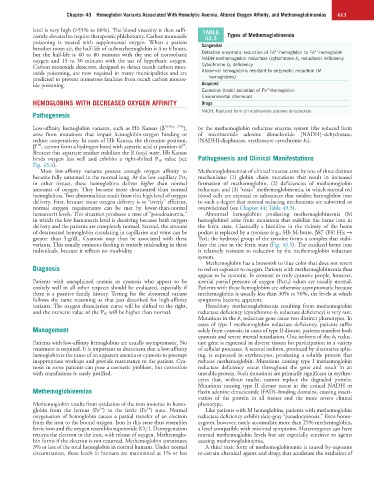
            level is very high (>55% to 60%). The blood viscosity is then suffi-  TABLE
            ciently elevated to require therapeutic phlebotomy. Carbon monoxide   43.3  Types of Methemoglobinemia
            poisoning  is  treated  with  supplemental  oxygen.  When  a  patient
            breathes room air, the half-life of carboxyhemoglobin is 4 to 6 hours,   Congenital  3+     2+
            but  the  half-life  is  40  to  80  minutes  with  the  use  of  normobaric   Defective enzymatic reduction of Fe -hemoglobin to Fe -hemoglobin
            oxygen  and  15  to  30  minutes  with  the  use  of  hyperbaric  oxygen.   NADH-methemoglobin reductase (cytochrome-b 5  reductase) deficiency
            Carbon monoxide detectors, designed to detect occult carbon mon-  Cytochrome b 3  deficiency
            oxide poisoning, are now required in many municipalities and are   Abnormal hemoglobins resistant to enzymatic reduction (M
            predicted to prevent numerous fatalities from occult carbon monox-  hemoglobins)
            ide poisoning.                                         Acquired
                                                                                        2+
                                                                   Excessive (toxic) oxidation of Fe -hemoglobin
                                                                   Environmental chemicals
            HEMOGLOBINS WITH DECREASED OXYGEN AFFINITY             Drugs
                                                                   NADH, Reduced form of nicotinamide adenine dinucleotide.
            Pathogenesis
            Low-affinity hemoglobin variants, such as Hb Kansas (β 102Asn→Thr ),   by the methemoglobin reductase enzyme system (the reduced form
            arise  from  mutations  that  impair  hemoglobin-oxygen  binding  or   of  nicotinamide  adenine  dinucleotide  [NADH]–dehydratase,
            reduce cooperativity. In cases of Hb Kansas, the threonine position,   [NADH]-diaphorase, erythrocyte cytochrome b 5 ).
             102
                                                             94
            β , cannot form a hydrogen bond with aspartic acid at position α .
            Because this aspartate residue stabilizes the R (oxy) state, Hb Kansas
            binds  oxygen  less  well  and  exhibits  a  right-shifted  P 50  value  (see   Pathogenesis and Clinical Manifestations
            Fig. 43.4).
              Most  low-affinity  variants  possess  enough  oxygen  affinity  to   Methemoglobinemias of clinical interest arise by one of three distinct
            become fully saturated in the normal lung. At the low capillary PO 2    mechanisms:  (1)  globin  chain  mutations  that  result  in  increased
            in  other  tissues,  these  hemoglobins  deliver  higher  than  normal   formation  of  methemoglobin,  (2)  deficiencies  of  methemoglobin
            amounts  of  oxygen.  They  become  more  desaturated  than  normal   reductase, and (3) “toxic” methemoglobinemia, in which normal red
            hemoglobins. Two abnormalities result from this high level of oxygen   blood cells are exposed to substances that oxidize hemoglobin iron
            delivery. First, because tissue oxygen delivery is so “overly” efficient,   to such a degree that normal reducing mechanisms are subverted or
            normal  oxygen  requirements  can  be  met  by  lower-than-normal   overwhelmed (see Chapter 44; Table 43.3).
            hematocrit levels. This situation produces a state of “pseudoanemia,”   Abnormal  hemoglobins  producing  methemoglobinemia  (M
            in which the low hematocrit level is deceiving because both oxygen   hemoglobins) arise from mutations that stabilize the heme iron in
            delivery and the patients are completely normal. Second, the amount   the  ferric  state.  Classically  a  histidine  in  the  vicinity  of  the  heme
            of desaturated hemoglobin circulating in capillaries and veins can be   pocket is replaced by a tyrosine (e.g., Hb M-Iwate, β87 (F8) His →
            greater  than  5 g/dL.  Cyanosis  may  thus  be  associated  with  these   Tyr); the hydroxyl group of the tyrosine forms a complex that stabi-
            variants. This usually ominous finding is entirely misleading in these   lizes the iron in the ferric state (Fig. 43.5). The oxidized heme iron
            individuals, because it reflects no morbidity.        is relatively resistant to reduction by the methemoglobin reductase
                                                                  system.
                                                                    Methemoglobin has a brownish to blue color that does not revert
            Diagnosis                                             to red on exposure to oxygen. Patients with methemoglobinemia thus
                                                                  appear to be cyanotic. In contrast to truly cyanotic people, however,
            Patients  with  unexplained  anemia  or  cyanosis  who  appear  to  be   arterial partial pressure of oxygen (PaO 2 ) values are usually normal.
            entirely well in all other respects should be evaluated, especially if   Patients with these hemoglobins are otherwise asymptomatic because
            there is a positive family history. Testing for the abnormal variant   methemoglobin is usually less than 30% to 50%, the levels at which
            follows  the  same  reasoning  as  that  just  described  for  high-affinity   symptoms become apparent.
            variants. The oxygen dissociation curve will be shifted to the right,   Hereditary  methemoglobinemia  resulting  from  methemoglobin
            and the numeric value of the P 50  will be higher than normal.  reductase deficiency (cytochrome-b 5  reductase deficiency) is very rare.
                                                                  Mutations in the b 5  reductase gene cause two distinct phenotypes. In
                                                                  cases of type I methemoglobin reductase deficiency, patients suffer
            Management                                            solely from cyanosis; in cases of type II disease, patients manifest both
                                                                  cyanosis and severe mental retardation. One isoform of the b 5  reduc-
            Patients with low-affinity hemoglobins are usually asymptomatic. No   tase gene is expressed in diverse tissues for participation in a variety
            treatment is required. It is important to document that a low-affinity   of cellular processes. A second isoform, produced by alternative splic-
            hemoglobin is the cause of an apparent anemia or cyanosis to preempt   ing,  is  expressed  in  erythrocytes,  producing  a  soluble  protein  that
            inappropriate workups and provide reassurance to the patient. Cya-  reduces methemoglobin. Mutations causing type I methemoglobin
            nosis in some patients can pose a cosmetic problem, but correction   reductase  deficiency  occur  throughout  the  gene  and  result  in  an
            with transfusions is rarely justified.                unstable protein. Such mutations are primarily significant in erythro-
                                                                  cytes  that,  without  nuclei,  cannot  replace  the  degraded  protein.
                                                                  Mutations  causing  type  II  disease  occur  in  the  critical  NADH  or
            Methemoglobinemias                                    flavin adenine dinucleotide (FAD)–binding domains, causing inacti-
                                                                  vation  of  the  protein  in  all  tissues  and  the  more  severe  clinical
            Methemoglobin results from oxidation of the iron moieties in hemo-  phenotype.
                                                 3+
                                  2+
            globin  from  the  ferrous  (Fe )  to  the  ferric  (Fe )  state.  Normal   Like patients with M hemoglobins, patients with methemoglobin
            oxygenation of hemoglobin causes a partial transfer of an electron   reductase deficiency exhibit slate-gray “pseudocyanosis.” Even homo-
            from the iron to the bound oxygen. Iron in this state thus resembles   zygotes, however, rarely accumulate more than 25% methemoglobin,
                                                 −
            ferric iron and the oxygen resembles superoxide (O 2 ). Deoxygenation   a level compatible with minimal symptoms. Heterozygotes can have
            returns the electron to the iron, with release of oxygen. Methemoglo-  normal methemoglobin levels but are especially sensitive to agents
            bin forms if the electron is not returned. Methemoglobin constitutes   causing methemoglobinemia.
            3% or less of the total hemoglobin in normal humans. Under normal   A third toxic form of methemoglobinemia is caused by exposure
            circumstances, these levels in humans are maintained at 1% or less   to certain chemical agents and drugs that accelerate the oxidation of

