


Page 742 - Hematology_ Basic Principles and Practice ( PDFDrive )
P. 742
Chapter 45  Red Blood Cell Membrane Disorders  629


                        Spectrin/ankyrin                                                         Hemolysis
                          deficiency                                                ↓ pH
                                                                                 ↑ Macrophage
                                                                                   contact
                                         Release of microvesicles


                                                                        Splenic     Splenic     Further loss
                                                                        trapping,  conditioning  of membrane
                                                                      erythrostasis
                      Band 3/protein 4.2
                         deficiency
                                                    Spherocytes

                                          Release of microvesicles


                                                                                 Microspherocytes
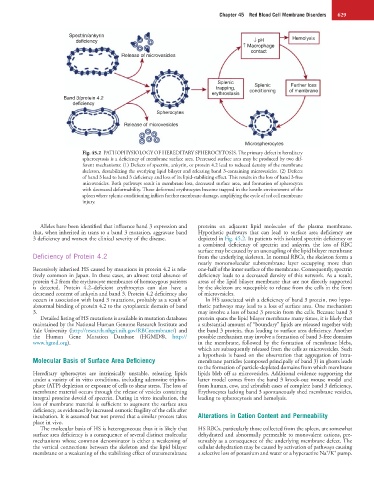
                            Fig. 45.2  PATHOPHYSIOLOGY OF HEREDITARY SPHEROCYTOSIS. The primary defect in hereditary
                            spherocytosis is a deficiency of membrane surface area. Decreased surface area may be produced by two dif-
                            ferent mechanisms: (1) Defects of spectrin, ankyrin, or protein 4.2 lead to reduced density of the membrane
                            skeleton, destabilizing the overlying lipid bilayer and releasing band 3-containing microvesicles. (2) Defects
                            of band 3 lead to band 3 deficiency and loss of its lipid-stabilizing effect. This results in the loss of band 3-free
                            microvesicles. Both pathways result in membrane loss, decreased surface area, and formation of spherocytes
                            with decreased deformability. These deformed erythrocytes become trapped in the hostile environment of the
                            spleen where splenic conditioning inflicts further membrane damage, amplifying the cycle of red cell membrane
                            injury.


              Alleles have been identified that influence band 3 expression and   proteins  on  adjacent  lipid  molecules  of  the  plasma  membrane.
            that, when inherited in trans to a band 3 mutation, aggravate band   Hypothetic  pathways  that  can  lead  to  surface  area  deficiency  are
            3 deficiency and worsen the clinical severity of the disease.  depicted in Fig. 45.2. In patients with isolated spectrin deficiency or
                                                                  a  combined  deficiency  of  spectrin  and  ankyrin,  the  loss  of  RBC
                                                                  surface may be caused by an uncoupling of the lipid bilayer membrane
            Deficiency of Protein 4.2                             from the underlying skeleton. In normal RBCs, the skeleton forms a
                                                                  nearly  monomolecular  submembrane  layer  occupying  more  than
            Recessively inherited HS caused by mutations in protein 4.2 is rela-  one-half of the inner surface of the membrane. Consequently, spectrin
            tively common in Japan. In these cases, an almost total absence of   deficiency leads to a decreased density of this network. As a result,
            protein 4.2 from the erythrocyte membranes of homozygous patients   areas of the lipid bilayer membrane that are not directly supported
            is  detected.  Protein  4.2–deficient  erythrocytes  can  also  have  a   by the skeleton are susceptible to release from the cells in the form
            decreased content of ankyrin and band 3. Protein 4.2 deficiency also   of microvesicles.
            occurs in association with band 3 mutations, probably as a result of   In HS associated with a deficiency of band 3 protein, two hypo-
            abnormal binding of protein 4.2 to the cytoplasmic domain of band   thetic pathways may lead to a loss of surface area. One mechanism
            3.                                                    may involve a loss of band 3 protein from the cells. Because band 3
              Detailed listing of HS mutations is available in mutation databases   protein spans the lipid bilayer membrane many times, it is likely that
            maintained by the National Human Genome Research Institute and   a substantial amount of “boundary” lipids are released together with
            Yale University (http://research.nhgri.nih.gov/RBCmembrane/) and   the band 3 protein, thus leading to surface area deficiency. Another
            the  Human  Gene  Mutation  Database  (HGMD®,  http://  possible mechanism may involve a formation of band 3-free domains
            www.hgmd.org).                                        in  the  membrane,  followed  by  the  formation  of  membrane  blebs,
                                                                  which are subsequently released from the cells as microvesicles. Such
                                                                  a hypothesis is based on the observation that aggregation of intra-
            Molecular Basis of Surface Area Deficiency            membrane particles (composed principally of band 3) in ghosts leads
                                                                  to the formation of particle-depleted domains from which membrane
            Hereditary  spherocytes  are  intrinsically  unstable,  releasing  lipids   lipids bleb off as microvesicles. Additional evidence supporting the
            under a variety of in vitro conditions, including adenosine triphos-  latter model comes from the band 3 knock-out mouse model and
            phate (ATP) depletion or exposure of cells to shear stress. The loss of   from human, cow, and zebrafish cases of complete band 3 deficiency.
            membrane material occurs through the release of vesicles containing   Erythrocytes lacking band 3 spontaneously shed membrane vesicles,
            integral proteins devoid of spectrin. During in vitro incubation, the   leading to spherocytosis and hemolysis.
            loss of membrane material is sufficient to augment the surface area
            deficiency, as evidenced by increased osmotic fragility of the cells after
            incubation. It is assumed but not proved that a similar process takes   Alterations in Cation Content and Permeability
            place in vivo.
              The molecular basis of HS is heterogeneous; thus it is likely that   HS RBCs, particularly those collected from the spleen, are somewhat
            surface area deficiency is a consequence of several distinct molecular   dehydrated and abnormally permeable to monovalent cations, pre-
            mechanisms whose common denominator is either a weakening of   sumably as a consequence of the underlying membrane defect. The
            the vertical connections between the skeleton and the lipid bilayer   cellular dehydration may be caused by activation of pathways causing
                                                                                                            +
                                                                                                              +
            membrane or a weakening of the stabilizing effect of transmembrane   a selective loss of potassium and water or a hyperactive Na /K  pump.

