


Page 745 - Hematology_ Basic Principles and Practice ( PDFDrive )
P. 745
632    Part V  Red Blood Cells


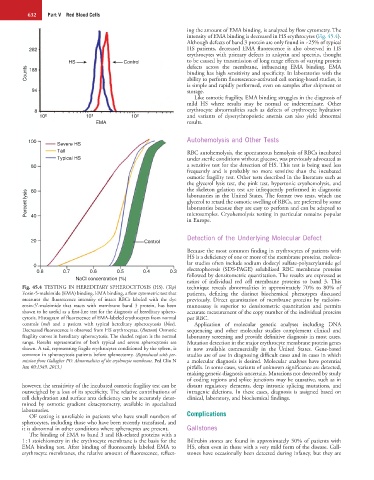
                                                              ing the amount of EMA binding, is analyzed by flow cytometry. The
                                                              intensity of EMA binding is decreased in HS erythrocytes (Fig. 45.4).
                                                              Although defects of band 3 protein are only found in ~25% of typical
           282                                                HS  patients,  decreased  EMA  fluorescence  is  also  observed  in  HS
                                                              erythrocytes with primary defects in ankyrin and spectrin, thought
                       HS                Control              to be caused by transmission of long range effects of varying protein
                                                              defects  across  the  membrane,  influencing  EMA  binding.  EMA
          Counts  188                                         binding has high sensitivity and specificity. In laboratories with the
                                                              ability to perform fluorescence-activated cell sorting-based studies, it
                                                              is simple and rapidly performed, even on samples after shipment or
           94                                                 storage.
                                                                 Like osmotic fragility, EMA binding struggles in the diagnosis of
                                                              mild  HS  where  results  may  be  normal  or  indeterminate.  Other
            8                                                 erythrocyte  abnormalities  such  as  defects  of  erythrocyte  hydration
              10 0           10 1           10 2              and  variants  of  dyserythropoietic  anemia  can  also  yield  abnormal
                                EMA                           results.


          100                                                 Autohemolysis and Other Tests
                    Severe HS
                    Tail                                      RBC autohemolysis, the spontaneous hemolysis of RBCs incubated
                    Typical HS                                under sterile conditions without glucose, was previously advocated as
           80                                                 a sensitive test for the detection of HS. This test is being used less
                                                              frequently  and  is  probably  no  more  sensitive  than  the  incubated
                                                              osmotic fragility test. Other tests described in the literature such as
                                                              the glycerol lysis test, the pink test, hypertonic cryohemolysis, and
                                                              the skeleton gelation test are infrequently performed in diagnostic
           60
          Percent lysis                                       laboratories in the United States. The former two tests, which use
                                                              glycerol to retard the osmotic swelling of RBCs, are preferred by some
                                                              laboratories because they are easy to perform and can be adapted to
                                                              microsamples. Cryohemolysis testing in particular remains popular
           40
                                                              in Europe.

                                                              Detection of the Underlying Molecular Defect
           20                                   Control
                                                              Because the most common finding in erythrocytes of patients with
                                                              HS is a deficiency of one or more of the membrane proteins, molecu-
            0                                                 lar studies often include sodium dodecyl sulfate-polyacrylamide gel
             0.8      0.7     0.6      0.5      0.4      0.3  electrophoresis  (SDS-PAGE)  solubilized  RBC  membrane  proteins
                                                              followed by densitometric quantitation. The results are expressed as
                          NaCl concentration (%)
                                                              ratios  of  individual  red  cell  membrane  proteins  to  band  3.  This
        Fig. 45.4  TESTING IN HEREDITARY SPHEROCYTOSIS (HS). (Top)   technique  reveals  abnormalities  in  approximately  70%  to  80%  of
        Eosin-5-maleimide (EMA) binding. EMA binding, a flow cytometric test that   patients,  defining  the  distinct  biochemical  phenotypes  discussed
        measures  the  fluorescence  intensity  of  intact  RBCs  labeled  with  the  dye   previously.  Direct  quantitation  of  membrane  proteins  by  radioim-
        eosin-5′-maleimide  that  reacts  with  membrane  band  3  protein,  has  been   munoassay  is  superior  to  densitometric  quantitation  and  permits
        shown to be useful as a first-line test for the diagnosis of hereditary sphero-  accurate measurement of the copy number of the individual proteins
        cytosis. Histogram of fluorescence of EMA-labeled erythrocytes from normal   per RBC.
        controls  (red)  and  a  patient  with  typical  hereditary  spherocytosis  (blue).   Application  of  molecular  genetic  analyses  including  DNA
        Decreased fluorescence is observed from HS erythrocytes. (Bottom) Osmotic   sequencing  and  other  molecular  studies  complement  clinical  and
        fragility curves in hereditary spherocytosis. The shaded region is the normal   laboratory screening and provide definitive diagnosis in most cases.
        range.  Results  representative  of  both  typical  and  severe  spherocytosis  are   Mutation detection in the major erythrocyte membrane protein genes
        shown. A tail, representing fragile erythrocytes conditioned by the spleen, is   is  now  available  commercially  in  the  United  States.  Gene-based
        common in spherocytosis patients before splenectomy. (Reproduced with per-  studies are of use in diagnosing difficult cases and in cases in which
        mission from Gallagher PG: Abnormalities of the erythrocyte membrane. Ped Clin N   a molecular diagnosis is desired. Molecular analyses have potential
        Am 60:1349, 2013.)                                    pitfalls. In some cases, variants of unknown significance are detected,
                                                              making genetic diagnosis uncertain. Mutations not detected by study
                                                              of coding regions and splice junctions may be causative, such as in
        however, the sensitivity of the incubated osmotic fragility test can be   distant  regulatory  elements,  deep  intronic  splicing  mutations,  and
        outweighed by a loss of its specificity. The relative contributions of   intragenic  deletions.  In  these  cases,  diagnosis  is  assigned  based  on
        cell dehydration and surface area deficiency can be accurately deter-  clinical, laboratory, and biochemical findings.
        mined  by  osmotic  gradient  ektacytometry,  available  in  specialized
        laboratories.
           OF testing is unreliable in patients who have small numbers of   Complications
        spherocytes, including those who have been recently transfused, and
        it is abnormal in other conditions where spherocytes are present.  Gallstones
           The binding of EMA to band 3 and Rh-related proteins with a
        1 : 1 stoichiometry in the erythrocyte membrane is the basis for the   Bilirubin stones are found in approximately 50% of patients with
        EMA binding test. After binding of fluorescently labeled EMA to   HS, often even in those with a very mild form of the disease. Gall-
        erythrocyte membranes, the relative amount of fluorescence, reflect-  stones have occasionally been detected during infancy, but they are

