


Page 744 - Hematology_ Basic Principles and Practice ( PDFDrive )
P. 744
Chapter 45  Red Blood Cell Membrane Disorders  631

            Laboratory Manifestations                             smear evaluation; the cells appear as “fat” disks rather than as true
                                                                  spherocytes.
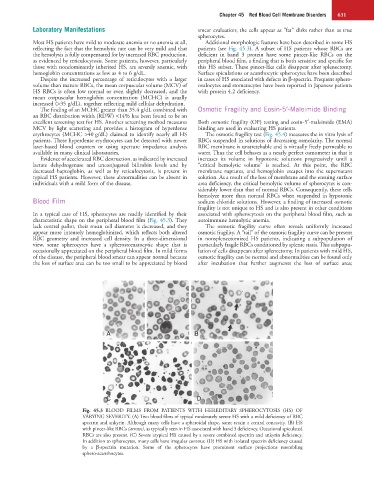
            Most HS patients have mild to moderate anemia or no anemia at all,   Additional morphologic features have been described in some HS
            reflecting the fact that the hemolytic rate can be very mild and that   patients  (see  Fig.  45.3).  A  subset  of  HS  patients  whose  RBCs  are
            the hemolysis is fully compensated for by increased RBC production,   deficient  in  band  3  protein  have  some  pincer-like  RBCs  on  the
            as evidenced by reticulocytosis. Some patients, however, particularly   peripheral blood film, a finding that is both sensitive and specific for
            those with nondominantly inherited HS, are severely anemic, with   this HS subset. These pincer-like cells disappear after splenectomy.
            hemoglobin concentrations as low as 4 to 6 g/dL.      Surface spiculations or acanthocytic spherocytes have been described
              Despite  the  increased  percentage  of  reticulocytes  with  a  larger   in cases of HS associated with defects in β-spectrin. Frequent sphero-
            volume than mature RBCs, the mean corpuscular volume (MCV) of   ovalocytes and stomatocytes have been reported in Japanese patients
            HS RBCs is often low normal or even slightly decreased, and the   with protein 4.2 deficiency.
            mean  corpuscular  hemoglobin  concentration  (MCHC)  is  usually
            increased (>35 g/dL), together reflecting mild cellular dehydration.
              The finding of an MCHC greater than 35.4 g/dL combined with   Osmotic Fragility and Eosin-5′-Maleimide Binding
            an RBC distribution width (RDW) <14% has been found to be an
            excellent screening test for HS. Another screening method measures   Both osmotic fragility (OF) testing and eosin-5′-maleimide (EMA)
            MCV  by  light  scattering  and  provides  a  histogram  of  hyperdense   binding are used in evaluating HS patients.
            erythrocytes (MCHC >40 g/dL) claimed to identify nearly all HS   The osmotic fragility test (Fig. 45.4) measures the in vitro lysis of
            patients. These hyperdense erythrocytes can be detected with newer   RBCs suspended in solutions of decreasing osmolarity. The normal
            laser-based  blood  counters  or  using  aperture  impedance  analysis   RBC membrane is unstretchable and is virtually freely permeable to
            available in many clinical laboratories.              water. Thus the cell behaves as a nearly perfect osmometer in that it
              Evidence of accelerated RBC destruction, as indicated by increased   increases  its  volume  in  hypotonic  solutions  progressively  until  a
            lactate  dehydrogenase  and  unconjugated  bilirubin  levels  and  by   “critical  hemolytic  volume”  is  reached.  At  this  point,  the  RBC
            decreased  haptoglobin,  as  well  as  by  reticulocytosis,  is  present  in   membrane ruptures, and hemoglobin escapes into the supernatant
            typical HS patients. However, these abnormalities can be absent in   solution. As a result of the loss of membrane and the ensuing surface
            individuals with a mild form of the disease.          area deficiency, the critical hemolytic volume of spherocytes is con-
                                                                  siderably lower than that of normal RBCs. Consequently, these cells
                                                                  hemolyze  more  than  normal  RBCs  when  suspended  in  hypotonic
            Blood Film                                            sodium chloride solutions. However, a finding of increased osmotic
                                                                  fragility is not unique to HS and is also present in other conditions
            In a typical case of HS, spherocytes are readily identified by their   associated with spherocytosis on the peripheral blood film, such as
            characteristic shape on the peripheral blood film (Fig. 45.3). They   autoimmune hemolytic anemia.
            lack central pallor, their mean cell diameter is decreased, and they   The  osmotic  fragility  curve  often  reveals  uniformly  increased
            appear more intensely hemoglobinized, which reflects both altered   osmotic fragility. A “tail” of the osmotic fragility curve can be present
            RBC  geometry  and  increased  cell  density.  In  a  three-dimensional   in  nonsplenectomized  HS  patients,  indicating  a  subpopulation  of
            view,  some  spherocytes  have  a  spherostomatocytic  shape  that  is   particularly fragile RBCs conditioned by splenic stasis. This subpopu-
            occasionally appreciated on the peripheral blood film. In mild forms   lation of cells disappears after splenectomy. In patients with mild HS,
            of the disease, the peripheral blood smear can appear normal because   osmotic fragility can be normal and abnormalities can be found only
            the loss of surface area can be too small to be appreciated by blood   after  incubation  that  further  augments  the  loss  of  surface  area;


                                    A                            B


                                    C                            D

                            Fig.  45.3  BLOOD  FILMS  FROM  PATIENTS  WITH  HEREDITARY  SPHEROCYTOSIS  (HS)  OF
                            VARYING SEVERITY. (A) Two blood films of typical moderately severe HS with a mild deficiency of RBC
                            spectrin and ankyrin. Although many cells have a spheroidal shape, some retain a central concavity. (B) HS
                            with pincer-like RBCs (arrows), as typically seen in HS associated with band 3 deficiency. Occasional spiculated
                            RBCs are also present. (C) Severe atypical HS caused by a severe combined spectrin and ankyrin deficiency.
                            In addition to spherocytes, many cells have irregular contour. (D) HS with isolated spectrin deficiency caused
                            by  a  β-spectrin  mutation.  Some  of  the  spherocytes  have  prominent  surface  projections  resembling
                            sphero-acanthocytes.

