


Page 75 - Hematology_ Basic Principles and Practice ( PDFDrive )
P. 75
Chapter 5  Protein Synthesis, Processing, and Trafficking  47


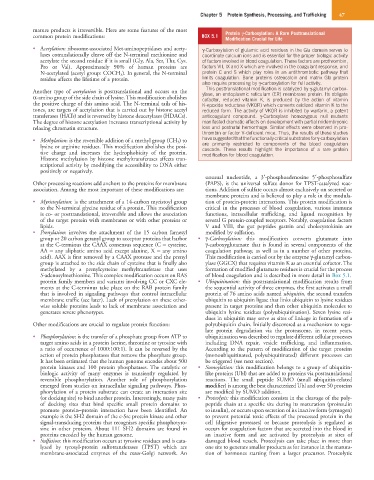
            mature products is irreversible. Here are some features of the most   Protein γ-Carboxylation: A Rare Posttranslational
            common protein modifications:                          BOX 5.1  Modification Crucial for Life
            •  Acetylation: ribosome-associated Met-aminopeptidases and acety-  γ-Carboxylation of glutamic acid residues in the Gla domain serves to
              lases cotranslationally cleave off the N-terminal methionine and   coordinate calcium ions and is essential for the proper biologic activity
              acetylate the second residue if it is small (Gly, Ala, Ser, Thr, Cys.   of factors involved in blood coagulation. These factors are prothrombin,
              Pro  or  Val).  Approximately  90%  of  human  proteins  are   factors VII, IX and X which are involved in the coagulant response, and
              N-acetylated (acetyl group: COCH 3). In general, the N-terminal   protein  C  and  S  which  play  roles  in  an  antithrombotic  pathway  that
              residue affects the lifetime of a protein.           limits  coagulation.  Bone  proteins  osteocalcin  and  matrix  Gla  protein
                                                                   also require processing by γ-carboxylation for full activity.
                                                                    This posttranslational modification is catalyzed by γ-glutamyl carbox-
            Another  type  of  acetylation  is  posttranslational  and  occurs  on  the   ylase, an endoplasmic reticulum (ER) membrane protein. Its obligate
            α-amino group of the side chain of lysine. This modification abolishes   cofactor,  reduced  vitamin  K,  is  produced  by  the  action  of  vitamin
            the positive charge of this amino acid. The N-terminal tails of his-  K-epoxide reductase (VKOR) which converts oxidized vitamin K to the
            tones, are targets of acetylation that is carried out by histone acetyl   reduced form. The activity of VKOR is inhibited by warfarin, a potent
            transferases (HATs) and is reversed by histone deacetylases (HDACs).   anticoagulant  compound.  γ-Carboxylase  homozygous  null  mutants
            The degree of histone acetylation increases transcriptional activity by   manifested dramatic effects on development with partial midembryonic
            relaxing chromatin structure.                          loss and postnatal hemorrhage. Similar effects were observed in pro-
                                                                   thrombin or factor V-deficient mice. Thus, the results of these studies
            •  Methylation: is the reversible addition of a methyl group (CH 3) to   have suggested that the functionally critical substrates for γ-carboxylation
              lysine or arginine residues. This modification abolishes the posi-  are  primarily  restricted  to  components  of  the  blood  coagulation
                                                                   cascade.  These  results  highlight  the  importance  of  a  rare  protein
              tive  charge  and  increases  the  hydrophobicity  of  the  protein.   modification for blood coagulation.
              Histone  methylation  by  histone  methyltransferases  affects  tran-
              scriptional activity by modifying the accessibility to DNA either
              positively or negatively.
                                                                    unusual  nucleotide,  a  3′-phosphoadenosine  5′-phosphosulfate
            Other processing reactions add anchors to the proteins for membrane   (PAPS),  is  the  universal  sulfate  donor  for TPST-catalyzed  reac-
            association. Among the most important of these modifications are:  tions. Addition of sulfate occurs almost exclusively on secreted or
                                                                    membrane proteins and is believed to play a role in the modula-
            •  Myristoylation: is the attachment of a 14-carbon myristoyl group   tion of protein-protein interactions. This protein modification is
              to the N-terminal glycine residue of a protein. This modification   critical  in  the  processes  of  blood  coagulation,  various  immune
              is co- or posttranslational, irreversible and allows the association   functions,  intracellular  trafficking,  and  ligand  recognition  by
              of the target protein with membranes or with other proteins or   several G protein-coupled receptors. Notably, coagulation factors
              lipids.                                               V  and  VIII,  the  gut  peptides  gastrin  and  cholecystokinin  are
            •  Prenylation:  involves  the  attachment  of  the  15  carbon  farnesyl   modified by sulfation.
              group or 20 carbon geranyl group to acceptor proteins that harbor   •  γ-Carboxylation:  this  modification  converts  glutamate  into
              at the C-terminus the CAAX consensus sequence (C = cysteine,   γ-carboxyglutamate  that  is  found  in  several  components  of  the
              AA = any aliphatic amino acid except alanine, X = any amino   coagulation pathway, as well as in a number of other proteins.
              acid). AAX is first removed by a CAAX protease and the prenyl   This modification is carried out by the enzyme γ-glutamyl carbox-
              group is attached to the side chain of cysteine that is finally also   ylase (GGCX) that requires vitamin K as an essential cofactor. The
              methylated  by  a  prenylcysteine  methyltransferase  that  uses   formation of modified glutamate residues is crucial for the process
              S-adenosylmethionine. This complex modification occurs on RAS   of blood coagulation and is described in more detail in Box 5.1.
              protein family members and variants involving CC or CXC ele-  •  Ubiquitination:  this  posttranslational  modification  results  from
              ments at the C-terminus take place on the RAB protein family   the sequential activity of three enzymes, the first activates a small
              that is involved in signaling pathways that control intracellular   protein of 76 amino acids named ubiquitin, the second transfers
              membrane traffic (see later). Lack of prenylation on these other-  ubiquitin to ubiquitin ligase that links ubiquitin to lysine residues
              wise soluble proteins leads to lack of membrane association and   present in target proteins and then other ubiquitin molecules to
              generates severe phenotypes.                          ubiquitin lysine residues (polyubiquitination). Seven lysine resi-
                                                                    dues in ubiquitin may serve as sites of linkage in formation of a
            Other modifications are crucial to regulate protein function:  polyubiquitin chain. Initially discovered as a mechanism to regu-
                                                                    late  protein  degradation  via  the  proteasome,  in  recent  years,
            •  Phosphorylation: is the transfer of a phosphate group from ATP to   ubiquitination was described to regulate different cellular processes
              target amino acids in a protein (serine, threonine or tyrosine with   including  DNA  repair,  vesicle  trafficking,  and  inflammation.
              a ratio of occurrence of 1000:100:1). It can be reversed by the   According to the pattern of modification of the target proteins
              action of protein phosphatases that remove the phosphate group.   (monoubiquitinated,  polyubiquitinated)  different  processes  can
              It has been estimated that the human genome encodes about 500   be triggered (see next section).
              protein  kinases  and  100  protein  phosphatases. The  catalytic  or   •  Sumoylation: this modification belongs to a group of ubiquitin-
              biologic  activity  of  many  enzymes  is  transiently  regulated  by   like proteins (Ubl) that are added to proteins via posttranslational
              reversible  phosphorylation.  Another  role  of  phosphorylation   reactions.  The  small  peptide  SUMO  (small  ubiquitin-related
              emerged from studies on intracellular signaling pathways. Phos-  modifier) is among the best characterized Ubl and over 50 proteins
              phorylation of a protein substrate can create an interaction site   are modified by SUMO addition.
              (or docking site) to bind another protein. Interestingly, many pairs   •  Proteolysis: this modification consists in the cleavage of the poly-
              of  docking  sites  that  bind  specific  small  protein  domains  to   peptide chain at a specific site during its maturation (proinsulin
              promote  protein–protein  interaction  have  been  identified.  An   to insulin), or occurs upon secretion of its inactive form (zymogen)
              example is the SH2 domain of the c-Src protein kinase and other   to prevent potential toxic effects of the processed protein in the
              signal-transducing proteins that recognizes specific phosphotyro-  cell  (digestive  proteases)  or  because  proteolysis  is  regulated  as
              sine  in  other  proteins.  About  111  SH2  domains  are  found  in   occurs for coagulation factors that are secreted into the blood in
              proteins encoded by the human genome.                 an  inactive  form  and  are  activated  by  proteolysis  at  sites  of
            •  Sulfation: this modification occurs at tyrosine residues and is cata-  damaged blood vessels. Proteolysis can take place in more than
              lyzed  by  tyrosyl-protein  sulfotransferases  (TPST)  which  are   one site to generate smaller products as for instance in the matura-
              membrane-associated  enzymes  of  the  trans-Golgi  network.  An   tion  of  hormones  starting  from  a  larger  precursor.  Proteolytic

